

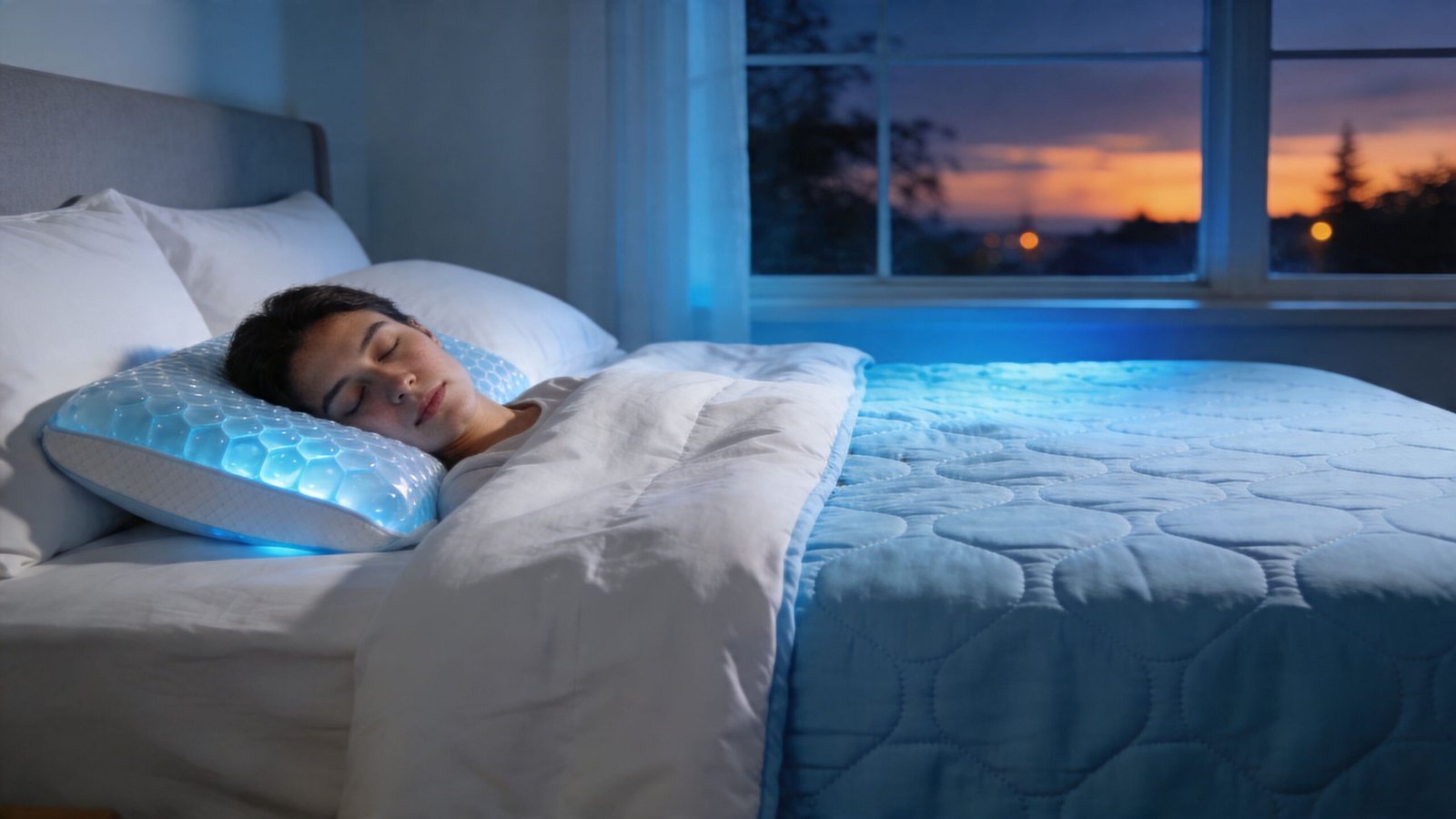
If you're waking up at 2:47 a.m. with damp sheets, a sticky back, and one leg kicked out of the bed trying to find relief, your problem often isn't just the room temperature. It's the microclimate in your bed.
I test sleep products in Florida, where even a well-air-conditioned bedroom can feel swampy once your body heat, sweat, mattress foam, and dense sheets all start working against you. That's why “cooling” bedding gets so much attention. Some of it helps. A lot of it is branding.
The useful way to think about cooling bedding for hot sleepers is simple. Don’t start with product hype. Start with physics. Some sleepers need more airflow. Some need better moisture handling. Some need that immediate cool-to-the-touch sensation because they run hot the moment they lie down. If you know which problem you have, buying gets much easier.
Waking Up Hot? Why Your Bedding Is the First Place to Look
The most common pattern I see is someone blaming the thermostat first, then the mattress, then their own body. Meanwhile they’re sleeping under heat-trapping sheets that hold moisture close to the skin.

In real bedrooms, heat buildup starts at the fabric level. Your body gives off warmth all night. If your sheets don’t let that heat escape, or if they absorb sweat and stay damp, you end up sleeping in a warm, humid pocket. Lowering the AC can help, but it often doesn’t fix what’s happening right against your skin.
That’s why bedding is usually the first place I tell hot sleepers to look. It’s the part of the sleep setup with the most direct contact, and it can either vent heat or trap it.
Cooling bedding is not just a trend
There’s solid evidence that cooling sheets can improve sleep for people who overheat at night. A 2024 pilot study found that after switching to cooling sheets, participants’ complaints of trouble sleeping due to heat dropped by 52%, and average sleep duration increased by 26 minutes (PMC study on cooling sheets and sleep).
That result matches what I see in product testing. Not every “cooling” product works, but the right bedding can make a noticeable difference fast, especially for:
- People in humid climates who still feel clammy even with AC on
- Menopausal sleepers dealing with sudden heat spikes and sweat
- Athletes who go to bed overheated after training
- Couples where one person runs hot and turns the whole bed warm
Practical rule: If you wake up sweaty from the chest, neck, back, or behind the knees, start with sheets and pillowcases before you replace your whole mattress.
The first mistake most hot sleepers make
They buy based on labels like “cooling,” “luxury,” or “high thread count.”
Those labels don’t tell you whether a fabric breathes, wicks, or feels cool against the skin. In testing, I’ve found expensive sheets that sleep warm and simpler percale sets that outperform them in a Florida bedroom.
The right question isn’t “What’s the fanciest cooling set?” It’s “What kind of heat problem am I trying to solve?”
That’s where the physics matters.
How Cooling Bedding Actually Works
“Cooling” gets used as if it means one thing. It doesn’t. In bedding, it usually comes from three different mechanisms. If you mix them up, you’ll buy the wrong product.
Breathability lets heat escape
Breathability is airflow. It's akin to opening a window in a stuffy room. A breathable fabric gives body heat somewhere to go.
This is why weave matters so much. A percale weave uses a one-over-one-under structure that creates tiny air pockets, improving airflow and pulling moisture from the skin 2-3 times faster than a denser sateen weave, which helps reduce the “heat blanket effect” for hot sleepers (ettitude on cooling sheet weave and breathability).
That single point explains a lot of real-world confusion. People compare two cotton sheet sets and assume cotton is cotton. It isn’t. A crisp percale can sleep much cooler than a smoother sateen because the structure is more open.
Moisture-wicking keeps sweat from sitting on you
This is the second part of cooling, and for many people in humid climates, it’s the bigger one.
A sheet can be breathable and still feel lousy if it holds sweat against your skin. Moisture-wicking fabrics move sweat away from the body so it can evaporate instead of turning the bed clammy. That’s why some sheets feel dry and light overnight while others feel sticky by early morning.
If you’ve ever slept in athletic gear that dries fast, you already know the principle. Good moisture management doesn’t make your body stop sweating. It stops that sweat from becoming a wet layer that ruins sleep.
Thermal conductivity gives the cool touch effect
This is the sensation people notice first when they slide into bed and say, “These feel cold.”
That immediate cool feel comes from how fast a fabric pulls heat away on contact. In bedding, brands often talk about this with terms like Qmax, which is a measure of the cool-to-the-touch sensation. A high-Qmax fabric can feel cooler at first touch even if it doesn’t necessarily stay cooler all night unless the rest of the system also breathes and handles moisture well.
Some high-tech fabrics earn their keep. Others only win the first five minutes.
Cool-to-touch is real. It just isn’t the same thing as all-night temperature control.
Why some cooling bedding disappoints
Most bad cooling products fail because they only do one job.
A fabric may feel chilled at first but stop helping once it warms with body heat. Another may wick decently but feel slick, heavy, or humid in a damp room. Some dense “luxury” sheets feel soft in the hand and sleep hot in practice.
Here’s the simplest way to diagnose what you need:
| Problem you notice at night | What usually helps most |
|---|---|
| You feel trapped under the sheet | Breathability |
| You wake up damp or clammy | Moisture-wicking |
| You feel hot the moment you get in bed | Cool-to-touch conductivity |
| Your bed feels fine at first, then overheats later | Better airflow across the whole sleep system |
What to prioritize first
If you live somewhere dry, the cool-touch feel can matter more.
If you live somewhere humid, or you deal with night sweats, prioritize airflow and moisture movement first. A fabric that feels crisp, light, and dry usually beats one that feels icy for ten minutes and then turns muggy.
That’s the lens I use when testing cooling bedding for hot sleepers. Start with what the fabric does. Ignore most marketing adjectives.
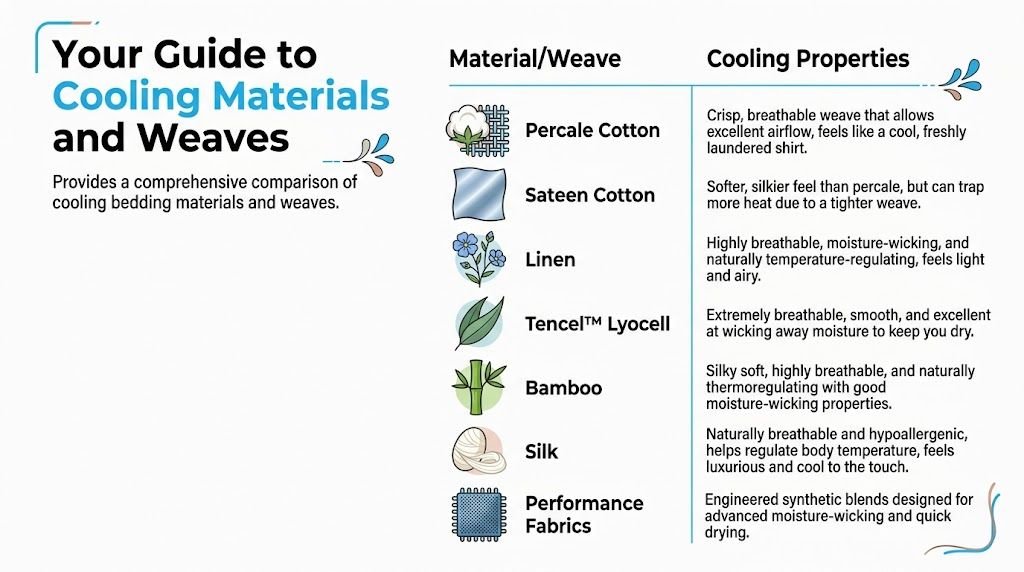
Your Guide to Cooling Materials and Weaves
Materials matter. So does weave. And the feel you like isn’t always the feel that sleeps coolest.
I’ve tested enough bedding to know that many hot sleepers buy the wrong fabric for a simple reason. They shop by softness in the package instead of performance in bed. The sheet that feels the smoothest on day one is often not the one that handles heat best at 3 a.m.
What usually works best
For most hot sleepers, I keep coming back to a short list:
- Percale cotton when you want crisp airflow and easy care
- Linen when you want maximum airiness and don’t mind texture
- Tencel or lyocell when you want smooth fabric with strong moisture handling
- Bamboo-based fabrics when you want softness plus cooling performance
- Performance fabrics when contact cooling and fast drying matter most
The first big myth to drop is thread count worship. Many shoppers still think higher numbers mean better sheets. For hot sleepers, that often backfires. Thread counts over 400 can trap heat, and tests cited by Doze Bedding found that bamboo viscose sheets can keep skin temperature 2-3 degrees cooler than 400-thread-count cotton sheets because they breathe and wick better (Doze Bedding guide to cooling sheets for hot sleepers).
Material-by-material trade-offs
Percale cotton
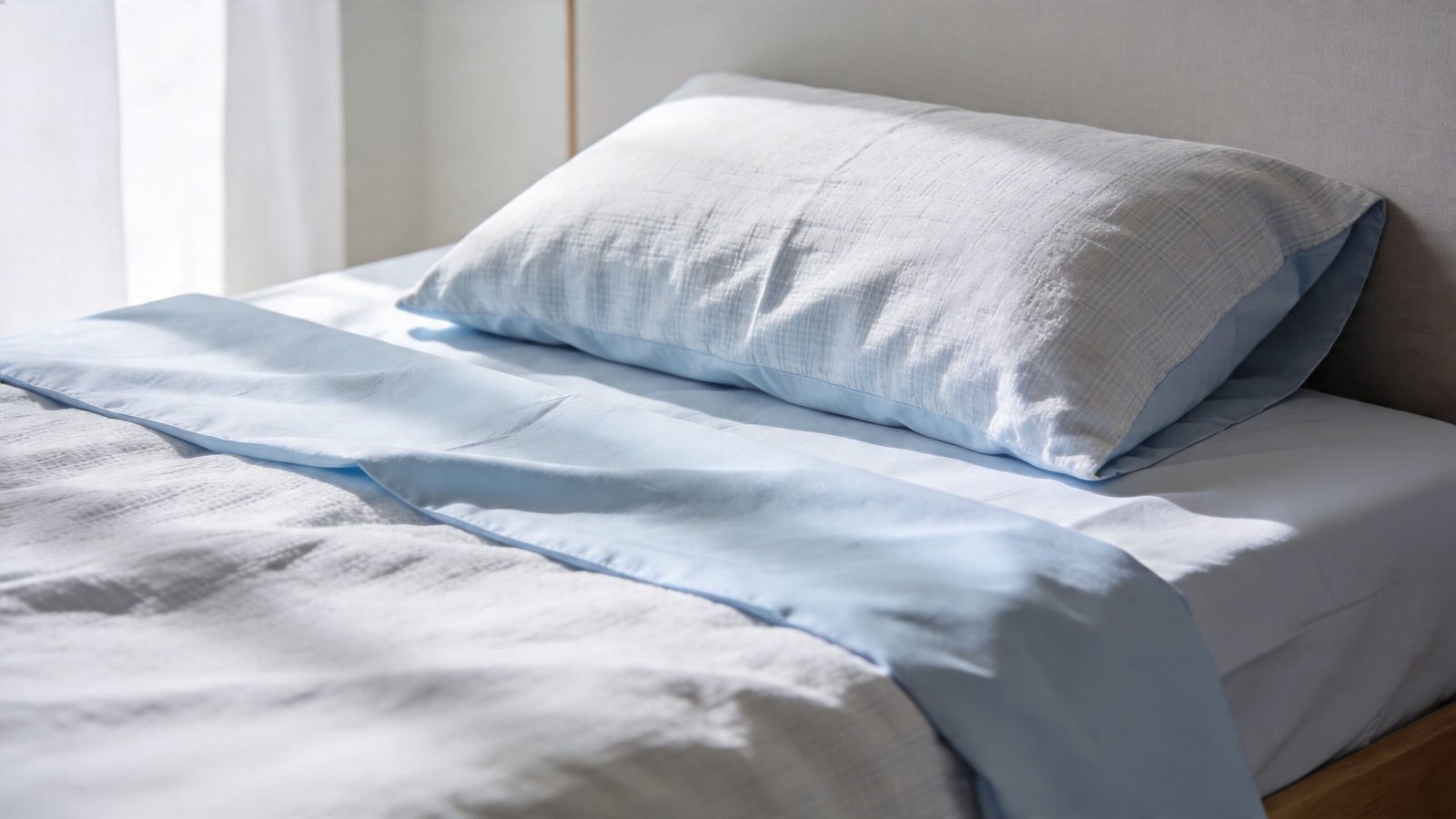
This is the safest recommendation for people who want cooling without fuss. Good percale feels crisp, not slippery. It tends to vent heat well and gets along with most sleepers.
The downside is feel. If you want buttery, drapey, silky sheets, percale may seem plain at first. But for a sweaty sleeper in a humid room, plain can be a feature.
Sateen cotton
Sateen feels smoother and more polished. Many people love it in the store.
I’m more cautious with it for hot sleepers. It usually has a tighter weave, so it can hold warmth more easily. If someone sleeps mildly warm and values softness first, sateen can still work. If they wake up sweating, it’s rarely my first pick.
Linen
Linen is airy, textured, and excellent at not feeling suffocating. In Florida, it often performs well because it doesn’t cling and tends to stay comfortable in damp conditions.
The trade-off is obvious. Linen wrinkles, has a more casual look, and not everyone likes the texture. Some people end up loving that broken-in feel. Others never do.
Tencel and lyocell
These fabrics usually strike a nice balance between smoothness and moisture management. They feel more refined than percale and less rough than linen.
For sleepers who hate crisp cotton but still need real cooling, this category is often the sweet spot.
Bamboo-based fabrics
Bamboo sheets vary a lot by construction and quality. Good ones can feel soft, breathable, and very comfortable for night sweats. Bad ones can feel overly slick or less durable than expected.
If you love a softer hand feel but still sleep hot, bamboo is worth considering. Just don’t assume every bamboo sheet is a cooling winner by default.
Performance fabrics
This category includes engineered fabrics meant to wick fast, dry fast, and sometimes feel cool on contact. They can work very well for some sleepers, especially those who sweat heavily or need a stronger cool-touch effect.
They also come with trade-offs. Some have a more synthetic hand feel. Some are excellent pillowcase materials but less appealing if you want classic sheet comfort.
Cooling Bedding Material Comparison
| Material | Breathability (1-5) | Moisture-Wicking (1-5) | Cool-to-Touch Feel (1-5) | Best For |
|---|---|---|---|---|
| Percale Cotton | 5 | 3 | 2 | Hot sleepers who want crisp airflow and a familiar cotton feel |
| Sateen Cotton | 2 | 2 | 2 | Sleepers who prioritize softness over maximum cooling |
| Linen | 5 | 4 | 2 | Humid climates and sleepers who hate feeling smothered |
| Tencel Lyocell | 4 | 5 | 3 | Night sweats and sleepers who want smooth fabric without heaviness |
| Bamboo | 4 | 4 | 3 | People who want soft, drapey sheets with good heat control |
| Silk | 3 | 2 | 4 | Sleepers who want a cool hand feel and a luxe texture |
| Performance Fabrics | 3 | 5 | 5 | Athletes, heavy sweaters, and people who want technical cooling |
What I’d skip if you sleep very hot
A few things consistently underperform in real bedrooms:
- Very high thread count cotton because it often sleeps dense
- Heavy sateen sets if your issue is trapped heat
- Cheap “cooling” polyester blends that feel slick but don’t vent well
- Gel marketing with no breathable construction because surface coolness fades fast
The best cooling bedding for hot sleepers usually feels lighter, crisper, or drier. If it feels heavy in your hands, it often sleeps heavy too.
If you want a broader look at strong sheet options, this roundup of best sheets for hot sleepers is a good companion to the material-first approach here.
Building Your Complete Cooling Sleep System
Even great sheets can lose the fight if the layers under them hold heat.
That’s why I rarely look at cooling bedding for hot sleepers as a single-product problem. Bed temperature is a stack. Sheets matter, but so do the pillow, protector, topper, and the mattress surface below everything else.
Start from the mattress upward
If your mattress traps heat, your sheets are doing cleanup work all night.
Memory foam is the biggest troublemaker here. It can contour beautifully and still sleep warm. If replacing the mattress isn’t on the table, a breathable topper or pad is often the most effective upgrade after sheets. I usually steer hot sleepers toward options that focus on airflow, not just a cold-feeling cover. If you’re comparing styles, this guide to cooling mattress pads is a useful next step.
A good cooling setup usually looks like this:
- Base layer with airflow, not a sealed heat trap
- Protector or pad that doesn’t choke ventilation
- Sheets matched to your heat pattern
- Pillowcase and pillow that don’t hold facial heat
- Blanket or comforter light enough for your climate
The sheet can’t fix a bad protector
This gets missed constantly.
A waterproof protector with a plasticky feel can block airflow and add warmth. You can put great percale or Tencel sheets on top and still wake up hot because the layer underneath is the underlying problem. If you need spill protection or allergy control, look for one that stays breathable and doesn’t feel laminated.
Where advanced cooling fabrics fit
Some engineered fabrics do offer more than marketing. Evercool® is one example people ask about because it leans into measurable cool-touch performance. According to the product details, Evercool® uses IONIC+™ silver and a high Qmax value to create a quantifiable cool-to-the-touch sensation, while also helping dissipate heat and reduce microclimate humidity around the body (Evercool sheet set details).
That kind of fabric can make sense if your biggest complaint is getting hot fast on contact, or if you hate that warm, stale feeling that builds near the skin. It’s less useful if the rest of the bed is a furnace.
A cooling sheet on top of a heat-trapping mattress is like opening a window in a room with the heater still blasting.
Don’t neglect the pillow zone
A lot of perceived “whole body overheating” starts at the head and neck. If your pillow runs warm, your body often feels like the whole bed is hot.
That’s why system thinking works better than one-off purchases. When I test setups that feel noticeably better, they usually share the same pattern:
| Layer | What helps | What hurts |
|---|---|---|
| Pillow | Breathable fill, ventilated design, cool-touch cover | Dense foam with a heat-sealing cover |
| Protector or pad | Thin, breathable construction | Waterproof membrane that sleeps plasticky |
| Sheets | Open weave, moisture movement | Dense weave, heavy drape |
| Top layer | Lightweight blanket or breathable comforter | Thick comforter used year-round |
Here’s a quick visual walkthrough of how bedding layers affect sleep temperature in practice.
The best setups are balanced, not extreme
You don’t need every layer to be “cooling branded.”
You need the full stack to stop trapping heat. Sometimes the winning setup is simple: breathable sheets, a non-suffocating protector, a cooler pillow, and a lighter blanket. That works better than throwing money at the flashiest cooling sheet set and ignoring the rest.
The Best Cooling Bedding for Your Sleeper Profile
The right setup depends on why you’re overheating. A person in coastal Florida doesn’t need the exact same bedding strategy as a marathon runner or someone dealing with hormonal night sweats.
The humid-climate sleeper
This is the classic Southeast problem. The room may be cool enough on paper, but the bed feels damp and stale overnight.
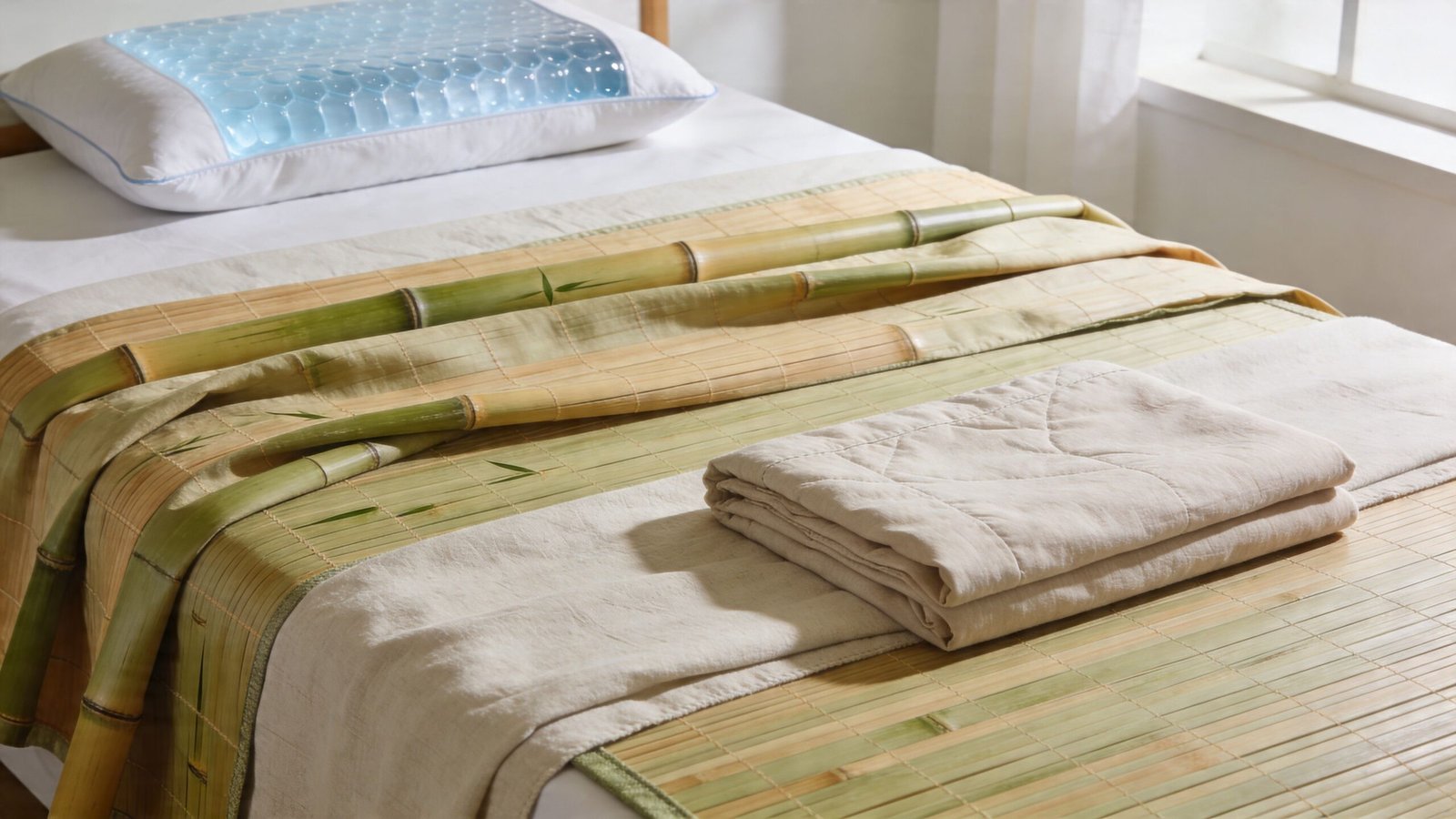
For this sleeper, moisture handling beats surface chill. I’d prioritize percale cotton, linen, Tencel, or a strong bamboo sheet that doesn’t feel overly dense. Add a breathable protector and keep the top layer light.
What usually fails here is anything that feels slick, coated, or thick. In humid conditions, those materials can feel swampy fast.
Best fit:
- Sheets with high airflow
- Pillowcase that doesn’t trap facial sweat
- Light blanket instead of a heavy comforter unless the room is cold enough to justify it
The menopause or hormonal night sweat sleeper
This sleeper often has sudden heat surges instead of steady warmth. They may feel fine at bedtime and then wake up flushed and damp.
For that pattern, I look for fabrics that recover well after a sweat episode. Smooth moisture-wicking materials often work better than dense cotton because they don’t stay wet as long against the skin. A cool-touch pillowcase can also help because the head and neck area tends to feel especially uncomfortable during a hot flash.
The biggest mistake here is over-insulating out of habit. A bed can look light and still trap too much heat if the protector, topper, and comforter all run warm.
The athlete who sleeps hot
Athletes are a different category because overheating can interfere with recovery, not just comfort. Sleep Foundation notes that hot sleepers experience 25% slower recovery, and that sleeping hot can impair recovery by hindering growth hormone release. It also points to moisture-wicking bedding above 200g/m²/day and 37.5® technology that reduces skin temperature as relevant for recovery-focused sleep (Sleep Foundation on cooling sheets for hot sleepers).
That profile needs bedding that can handle heavier sweat output without turning clammy. I’d lean toward technical moisture-wicking fabrics, performance pillowcases, and a breathable mattress pad over anything chosen mainly for softness.
Best fit:
- Fast-drying sheets over plush ones
- Cooler pillow setup because post-workout body heat lingers around the head and neck
- Low-bulk bedding that won’t trap residual heat after evening training
If head heat is part of the problem, a dedicated cooling pillow is often one of the most noticeable upgrades.
Athletes usually don’t need prettier bedding. They need bedding that can keep up with sweat.
The couple with opposite temperature needs
This is the hardest setup to get right because one person is trying to dump heat while the other wants coziness.
The best compromise is usually a breathable shared base with customizable top layers. In practice, that means neutral sheets that don’t overheat the hot sleeper, then separate blankets or a split approach to comfort on top. Trying to solve this with one thick comforter for both people usually goes badly.
What I’ve seen work well:
- Percale, Tencel, or balanced bamboo sheets for the whole bed
- Separate throws or blankets
- A cooler pillow for the hot sleeper, standard pillow for the cold sleeper
- Less insulation under the hot sleeper’s side if the bed allows it
The sleeper who wants the cheapest effective fix
If budget is tight, don’t try to buy a full “cooling collection” all at once.
Upgrade the layer that touches the body most and traps the most heat. In many cases that means replacing warm sheets first. If your pillow gets hot, fix the pillow next. A lighter blanket can come after that.
That order usually gets better real-world results than buying one flashy premium item and leaving the rest of the hot setup intact.
Putting It All Together Testing, Care, and Smart Buying
A cooling product isn’t useful if it only feels good in the package. The goal is to figure out whether it will still help after laundry day, in your room, with your mattress, and with your body heat.
How to test bedding before you commit
When I evaluate cooling bedding for hot sleepers, I don’t rely on hand-feel alone. A smooth fabric can still sleep warm.
Use a practical checklist:
- Hold it to light and look for openness in the weave. More visible spacing often means better airflow.
- Rub it between your fingers and notice whether it feels crisp, airy, slick, or dense. Dense usually means warmer.
- Lie on it long enough to see what happens after the initial cool feel fades. Contact chill is not the whole story.
- Check how it handles moisture after a warm night. If it feels damp for too long, it’s not doing enough.
- Notice drape and weight because heavy drape can feel luxurious while trapping body heat.
If a fabric wins in the showroom but loses after one humid night, the showroom test didn’t matter.
Care mistakes that ruin cooling performance
A lot of bedding sleeps hotter over time because people wash it in ways that coat or stress the fibers.
The most common mistake is using products that leave residue behind. Fabric softeners can reduce the airy, dry feel that makes cooling sheets appealing in the first place. Heavy detergent use can do the same.
A safer approach:
- Use mild detergent so fibers stay cleaner and less coated
- Skip fabric softener when cooling performance matters
- Dry with moderate heat or according to the fabric’s care instructions
- Rotate sets so one set isn’t taking all the wear
- Wash pillowcases often because facial oils and sweat can change the feel faster than you think
Natural fabrics and technical fabrics each have their own care quirks, but the principle stays the same. Cleaner fibers usually breathe better.
Where to spend and where to save
Not every sleeper needs premium cooling technology.
Spend more when:
- You have intense night sweats
- You live in a humid climate and standard sheets keep failing
- You overheat from the head and neck up
- You want a specific feel plus cooling, not just basic relief
Save money when:
- Your main issue is one heat-trapping layer you can replace cheaply
- You’re paying extra only for branding or luxury finish
- The fabric feels heavy and the cooling claim seems vague
My bias is simple. Buy for the problem, not for the label. A well-chosen mid-range percale or bamboo set can outperform a more expensive “cooling” sheet that relies on branding and not much else.
A smart buying sequence
If you’re overwhelmed, follow this order:
- Fix the hottest contact layer first, usually sheets or pillowcase.
- Check the protector or pad, because it may be blocking airflow.
- Adjust the top layer, especially if you use one comforter year-round.
- Upgrade the pillow, if head heat keeps waking you up.
- Only then consider specialty cooling tech, if the basics still aren’t enough.
That sequence keeps you from overspending and usually gets faster relief.
FAQs About Cooling Bedding for Hot Sleepers
Do cooling sheets actually stay cool all night
Some do better than others, but most don’t stay cold in the literal sense. The best ones either keep air moving, move sweat away, or avoid trapping heat as the night goes on. That’s more useful than a quick icy feel that disappears.
What’s the best weave for a hot sleeper
Percale is often the safer bet because it’s airy and less likely to feel heat-trapping. Sateen can still work for some sleepers, but it’s usually not my first pick when someone says they wake up sweaty.
What if my partner sleeps cold
Use a breathable base layer for the whole bed and customize warmth above it. Separate blankets solve more couple sleep fights than any “compromise” comforter I’ve tested.
What’s the most budget-friendly cooling upgrade
Start with sheets if yours are dense or high-thread-count. If your head gets hot first, start with the pillowcase or pillow instead. Those changes usually matter more than decorative bedding swaps.
How can I tell if a cooling claim is mostly marketing
Be skeptical if the product description focuses on vague terms like “luxury cooling” without explaining whether the fabric is breathable, moisture-wicking, or cool-to-touch. Good products usually tell you how they work, not just that they’re “advanced.”
Are bamboo, Tencel, and linen all good for hot sleepers
They can be. The better choice depends on what you dislike most. Bamboo and Tencel often appeal to people who want smoother fabric. Linen is better for sleepers who want maximum airiness and don’t care about a crisp or textured feel.
If you’re tired of waking up sweaty and want honest advice instead of recycled product hype, visit CoolRestGuide. It’s built for hot sleepers who need cooling sheets, pillows, mattress pads, and bedding that work in real bedrooms, especially in warm and humid climates.
