

You wake up at 2:13 a.m., flip the pillow, find the cool side for maybe a minute, then feel that familiar swampy heat building under your neck again. The AC is running. The sheets seemed breathable when you bought them. But your head still feels like it's parked over a heating vent, and by morning the pillow is damp, flat, and somehow hotter than the room.
That cycle is why so many people start searching for pillows cooling instead of just “a better pillow.” They don’t need fluff. They need a pillow that can handle real body heat, sweat, and humidity night after night, especially in places like Florida where the air itself feels wet.
I’ve tested enough cooling bedding in humid conditions to know the biggest mistake shoppers make. They buy for the first five minutes, not for month six. A lot of pillows feel cool when you first lie down. Far fewer still feel breathable after weeks of sweat, compressed foam, and a pillowcase that chokes the cooling fabric.
Your Guide to Finally Sleeping Cool

The market for cooling pillows keeps growing because the problem is real. The cooling pillow market was valued at $1.84 billion in 2024 and is projected to reach $2.91 billion by 2032, with many products priced two to three times higher than conventional pillows because of advanced materials and construction, according to cooling pillow market analysis. More options sounds good, but it also means more marketing language designed to hide weak long-term performance.
That’s the part shoppers need to understand. A “cooling” label doesn’t tell you whether the pillow uses a brief cold-touch surface, a material that moves heat away, or a design that stays breathable in humid air. Those are not the same thing.
What matters most in real bedrooms
Most bad pillow purchases happen for one of four reasons:
- Initial chill gets mistaken for all-night cooling: A surface can feel cold at first and still trap heat later.
- Support gets ignored: If the pillow sleeps cooler but shoves your neck out of alignment, you’ll still toss around.
- Humidity gets overlooked: A pillow that works in a dry room may struggle badly in sticky air.
- Durability never gets tested: Many reviews stop before compression, clumping, and heat retention show up.
Bottom line: Buy for sustained airflow and heat management, not just the cold touch in the first minute.
The useful way to shop is simple. First, understand how a pillow cools. Then match the technology to your sleep style, sweating pattern, and climate. After that, test it like a skeptic before the return window closes.
That approach saves money, frustration, and a lot of miserable nights.
How Cooling Pillows Actually Work
Your pillow isn’t just supporting your head. It’s creating a microclimate around your face, scalp, neck, and shoulders. When that small pocket traps body heat and moisture, your skin gets warmer, sweat lingers longer, and sleep gets lighter.
The best pillows cooling designs attack that problem in three different ways. Some pull heat away fast. Some let air move through the pillow so heat can escape. Some absorb heat for a period of time before releasing it later.
Conduction pulls heat away
Think of conduction like stepping onto a cool tile floor. The tile feels cool because it draws heat out of your skin. Some pillow surfaces do the same thing when your head first hits them.
Gel layers, mineral-infused covers, and some performance fabrics create that cold-touch feel. This can help people who fall asleep hot, but conduction by itself has limits. Once the surface warms up, the effect can fade if the pillow doesn’t also move air well.
Convection lets heat leave
Convection is the airflow piece. If a pillow has an open structure, cutouts, perforations, shredded fill, or a breathable cover, warm air can escape and cooler room air can circulate back in.
That’s why some pillows that don’t feel icy at first still sleep cooler through the night. They aren’t trying to shock your skin with cold. They’re trying to stop heat from pooling in the first place.
If you struggle with your head getting damp or your neck sweating into the pillow, convection matters more than flashy cold-touch marketing. This is also why room conditions matter. Body temperature during sleep affects how much work your pillow has to do.
Phase-change materials absorb heat spikes
Phase-change materials, often called PCM, work differently. They absorb heat as they change state at skin-contact temperatures, which helps buffer those early heat surges when you first settle in.
That makes PCM useful for people who feel a sudden wave of warmth in the first part of the night. It doesn’t replace airflow. It buys time and smooths out temperature swings.
A good cooling pillow doesn’t need to feel freezing. It needs to stop your head and neck from entering that overheated, damp cycle that wakes you up.
What works overnight and what fades fast
Here’s the practical split I use when testing:
| Cooling style | What it feels like | Main strength | Common weakness |
|---|---|---|---|
| Cold-touch surface | Cool immediately | Fast relief at bedtime | Can warm up quickly |
| Airflow-first design | Less dramatic at first | Better sustained comfort | May not feel “cold” enough to some shoppers |
| PCM-based cover | Adaptive, smoother temp control | Helps manage heat spikes | Still depends on the rest of the pillow design |
If you only remember one thing, remember this: instant cool and sustained cool are different jobs. The best pillows cooling products usually combine more than one approach.
A Deep Dive into Cooling Materials and Technologies
Most cooling pillow marketing just renames familiar materials. Strip away the branding and you’ll usually find a short list of technologies doing the actual work. Once you know what each one does well, the buying process gets much easier.
Gel-infused foam and gel pads
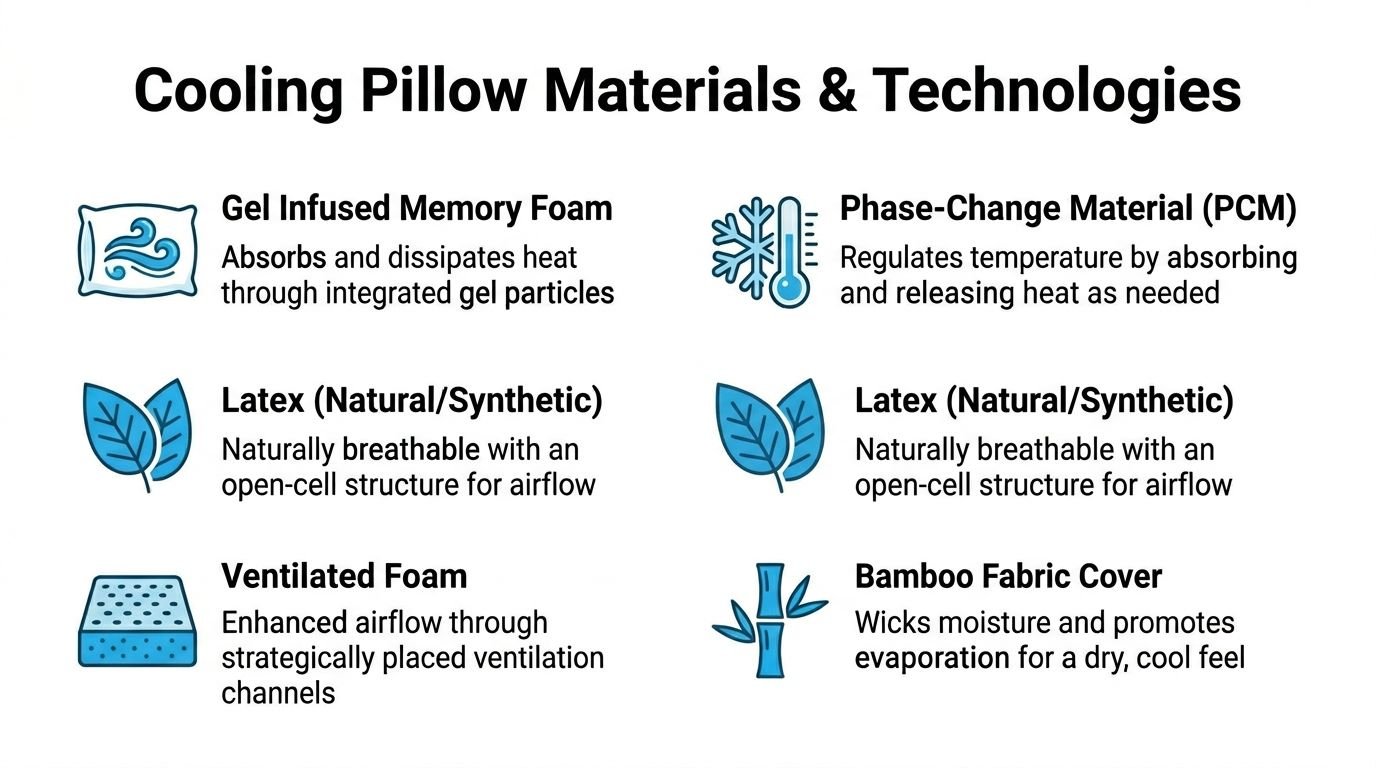
Gel-infused memory foam is everywhere because it’s easy to market. It usually gives you a cooler first contact than plain foam, and it can help disperse heat better than traditional memory foam.
But there’s a catch. Foam still hugs the head, and that contouring can reduce airflow. In humid bedrooms, I often find gel foam works best for people who want pressure relief first and cooling second, not for the most aggressive hot sleepers.
Gel grids and gel pads usually do better with structure. Because they hold shape more firmly, they can leave a little more breathing room around the head and neck. The trade-off is feel. Some people love the support. Others think it feels too firm or too “engineered.”
Phase-change covers and advanced fabrics
GlacioTex uses a phase-change material polymer coating that can reduce pillow surface temperature by up to 4°C, and those microcapsules can absorb enough heat to manage roughly 15 to 20 minutes of peak body heat before that heat builds up, according to Helix GlacioTex product details. That kind of cover is useful because it tackles the hottest part of the sleep-onset period instead of just feeling chilly for a few seconds.
For humid climates, PCM covers have a real advantage. They’re trying to regulate the temperature swing at the surface rather than relying only on trapped gel inside foam.
Another cover technology worth understanding is FRíO rapid chill cooling fibers. Purecare says these fibers tunnel heat away from the body 5 times faster than traditional polyester fibers in its Cooling SoftCell Chill Pillow, which is why fiber choice matters as much as core choice in some designs. The cover can decide whether moisture evaporates or stays parked against your skin.
If your sheets and pillowcase run hot, even a strong cooling pillow will underperform. Pairing it with sheets for hot sleepers matters more than is commonly assumed.
Practical rule: If the cooling story only talks about the foam and says nothing useful about the cover, I lower my expectations.
Latex, ventilated foam, and shredded fills
Natural latex doesn’t usually feel icy on contact. That’s not its strength. Its strength is consistent breathability and faster rebound. It doesn’t let your head sink in as much as many memory foams, so more air can circulate around you.
Ventilated foams use channels, holes, or cutouts to improve airflow. This is one of the smarter design moves because it attacks the actual problem of trapped heat. A breathable foam with real ventilation often outperforms a denser “cooling” foam that has gel mixed in.
Shredded fills are another strong option for hot sleepers. Shredded latex, shredded foam, and performance fibers leave more internal air pockets than a single solid slab. That usually means better breathability and easier loft adjustment. The downside is consistency. Some shredded pillows feel great after fluffing and less great after a few nights if the fill shifts too much.
Cooling Pillow Material Comparison
| Material | Cooling Mechanism | Pros | Cons | Best For |
|---|---|---|---|---|
| Gel-infused memory foam | Pulls and disperses heat through gel in foam | Good pressure relief, familiar feel, cool first touch | Can still trap heat, often less breathable over time | Back and side sleepers who like contouring |
| Gel grid or gel pad | Conductive cool surface with more structure | Better shape retention, less sink | Can feel firm or unusual | Hot sleepers who hate deep foam hug |
| PCM cover | Absorbs heat at skin-contact temperatures | Better temperature regulation, strong for early night heat surges | Depends on core support and airflow underneath | Night sweaters and humidity-prone sleepers |
| Natural latex | Open, buoyant structure improves airflow | Durable feel, breathable, responsive support | Less dramatic cool-touch sensation | Extreme hot sleepers and combo sleepers |
| Ventilated foam | Air channels let heat escape | Better sustained cooling than dense foam | Cooling depends on actual perforation design | Sleepers who want foam support without as much heat buildup |
| Shredded fill | Air pockets improve circulation | Adjustable loft, breathable, customizable | Fill can shift, quality varies a lot | People who want to tune support and airflow |
| Performance cooling fibers | Conductive and moisture-wicking cover fabric | Better surface comfort, helps humidity management | Won’t fix a bad core | Sleepers who get damp around the head and neck |
What I trust most in high humidity
For Florida-style humidity, I trust pillow designs in this order:
- Breathable structure first
- Adaptive cover second
- Cold-touch gimmick third
That means latex, ventilated cores, shredded constructions, and PCM covers usually earn more of my attention than dense gel foam alone. A pillow has to keep working after the room, your skin, and your pillowcase all get slightly damp. That’s the true test.
Is a Cooling Pillow Right for You
Some people buy a cooling pillow because they’re curious. Others buy one because they’re exhausted and running out of patience. The second group usually gets better results, because they know what problem they’re trying to solve.
Hot sleepers and night sweats
If you wake with a hot scalp, damp neck, or that gross feeling that the pillow has absorbed your whole body temperature, a cooling pillow can help. The best evidence here isn’t just comfort language. In a clinical study tracking more than 1,100 nights of sleep, participants using a cooling pillow saw a 9% increase in REM sleep minutes and reported major reductions in intense night sweats, according to the Journal of Sleep abstract.
That matters because the right pillow isn’t only about feeling cooler. It can reduce interruptions that keep breaking your sleep apart.
If night sweating is your main issue, don’t treat the pillow as a standalone fix. There are usually other layers involved, including room conditions, sheets, sleepwear, and underlying triggers. If that’s your situation, ways to stop night sweats can help you sort out the bigger picture.
Menopause and hormone-driven overheating
This is one of the clearest use cases. Menopause-related heat can come in waves, and the head and neck are often where you feel trapped first. A pillow with moisture-wicking fabric and stable airflow tends to be more helpful than one that only offers a cold touch at bedtime.
The practical goal isn’t to make the bed cold. It’s to reduce the chance that one heat spike turns into a full wake-up.
When hormonal heat is the trigger, steady temperature control usually beats dramatic “ice-cold” marketing.
Athletes and post-workout sleepers
Athletes often miss this category because they think of cooling products as comfort products. They’re recovery products too. If you train in evening heat, your body may still be carrying extra warmth when you get into bed. In that case, a pillow that releases heat and manages moisture can make falling asleep easier and can reduce that restless head-turning that comes from sleeping too warm.
Couples with opposite temperature needs
This is one of the smartest reasons to start with a cooling pillow instead of changing the whole mattress. If one person overheats and the other runs cold, the pillow can isolate cooling right where it’s needed.
That’s often easier than turning the entire bed into a fridge. It also creates less conflict. The hot sleeper gets targeted relief. The cold sleeper doesn’t have to surrender every blanket in the house.
Become a Pillow Tester Your DIY Guide
Many individuals judge a pillow too early. They lie down, feel a cool cover, and decide it works. That tells you almost nothing about what happens after body heat, sweat, compression, and a pillowcase all start interacting.

A smarter approach is to test the pillow in stages during the return window. You’re not trying to prove the marketing right. You’re trying to catch weak points before you’re stuck with them.
Start with three quick checks
The hand-press test
Press your palm firmly into the pillow for a short stretch, then lift it. Dense materials that hold your heat too long often reveal themselves here. If the spot stays noticeably warm and stuffy, that’s a warning sign.
The edge-breathability check
Hold the pillow against your face without lying down and breathe near the surface. You’re checking whether the cover and fill feel airy or sealed off. It’s not a laboratory method. It’s a fast way to detect whether the pillow wants to trap humidity.
The moisture-wicking check
Put a very small amount of water on the outer fabric, not enough to soak the pillow. Watch whether the moisture spreads and begins to dissipate or whether it sits heavily on top. Better covers tend to move moisture outward instead of letting it linger against the skin.
Watch for durability clues early
Long-term fade is where many cooling pillows lose the plot. A key issue is that gel infusions can migrate and foams can compress, reducing breathability by 30% to 50% within a year, while natural latex tends to offer more consistent long-term breathability, as noted in Sleep Foundation’s cooling pillow guide.
You won’t know the full one-year story in a trial period, but you can spot early warning signs:
- Fast body impression: If the center starts looking sunken quickly, airflow may get worse later.
- Sticky warm-up: If the pillow feels good for a short time and then turns muggy, the cooling layer may be shallow or weak.
- Clumping or uneven fill: Shredded designs should stay adjustable, not bunch into hot lumps.
- Flattened edges and weak rebound: That usually means support and ventilation are both heading the wrong way.
Buy with your future self in mind. In humid conditions, a pillow that merely survives the first week hasn’t passed the test.
Use your bedding like a stress test
Now add the pillowcase you’ll use. This step matters because a bad pillowcase can mute the benefit of a good pillow. Heavy, slick, non-breathable cases often trap heat right at the surface.
Here’s a helpful walkthrough before you test your own setup:
Keep a simple sleep log
Don’t overcomplicate it. Track a few observations for several nights:
- How hot the pillow feels at bedtime
- Whether you wake with a damp neck or hairline
- How often you flip the pillow
- Whether the loft changes by morning
- Whether the cover still feels breathable after several nights
Patterns show up quickly when you write them down. A pillow that seems fine in one sleepy moment often looks a lot less impressive across a week of notes.
Smarter Shopping and Long-Term Care
A cooling pillow can be expensive, so the goal isn’t just to buy the coolest one. The goal is to buy the right one, keep it working, and avoid turning a premium pillow into a warm sponge with bad care habits.
Shop with a filter, not with hope
Before buying, match the pillow to the way you sleep.
- Side sleepers: Usually do best with enough loft to fill the shoulder gap without burying the face in dense foam.
- Back sleepers: Usually need moderate loft and stable support under the neck.
- Stomach sleepers: Usually need a lower profile and softer compression so the neck doesn’t crank backward.
Then match your heat profile to the material. If you just run a little warm, a decent cooling cover over supportive foam may be enough. If you wake sweaty in humid air, go after breathable structure first, not just a cool-touch fabric.
What couples should do instead of fighting the thermostat
This question gets surprisingly little useful advice. For mixed-temperature couples, stacking a cooling pillow with cooling sheets can reduce system heat by 15% to 25%, but it can also over-cool the partner who already runs cold, according to Mattress Clarity’s discussion of cooling pillow combinations. A better compromise is often a dual-sided pillow or an adaptive phase-change cover used only on the hot sleeper’s side.
That targeted approach works because it solves the right problem. You don’t always need to cool the entire bed. You need to cool the person who’s overheating without dragging the other person into it.
Care habits that preserve cooling
Most cooling failures aren’t dramatic. They develop through oils, sweat, compressed fill, and blocked airflow.
Use these habits to slow that down:
- Choose a breathable pillowcase: If the pillow has a premium cooling cover, don’t smother it with a thick, heat-trapping case.
- Wash removable covers on schedule: Skin oils and sweat can blunt moisture-wicking performance over time.
- Air out the core regularly: Let the pillow breathe outside the bed setup now and then, especially in humid months.
- Don’t fold or crush structured foams: Repeated compression can reduce the airflow those designs depend on.
- Spot clean carefully: Over-wetting the core can hurt performance and take forever to dry in muggy climates.
Fix common cooling complaints
| Problem | Likely cause | What to try |
|---|---|---|
| Feels cool for a few minutes, then hot | Surface cooling only, weak airflow underneath | Switch to a more breathable core or use a lighter pillowcase |
| Neck area feels damp by morning | Poor moisture management | Use a more breathable case and a wicking cover material |
| Pillow feels flatter and warmer over time | Compression reducing airflow | Reassess support, fluff shredded fills, replace failing foam |
| Partner is too cold | Cooling setup affects both sleepers | Use targeted pillow cooling instead of whole-bed cooling |
Most “cooling pillow failures” are really system failures. The pillow, pillowcase, sheets, room humidity, and your sleep position all interact.
Don’t ignore the trial and warranty
This part is boring until you need it. A premium cooling pillow should give you enough time to judge not just comfort, but heat retention after repeated nights. If the product promises advanced materials but doesn’t back them with a sensible trial or warranty, I treat that as a caution sign.
A pillow that costs more should earn that price over time, not only in the first weekend.
Cooling Pillow Recommendations for Every Sleeper
The best pillow type depends less on the logo and more on your heat pattern, support needs, and tolerance for maintenance. Here’s where I’d point different sleepers after years of seeing what holds up and what disappoints.
For the extreme hot sleeper in humid climates
Go with a ventilated latex pillow or a pillow with a strong PCM cover over a breathable core. Latex usually wins on sustained airflow, while PCM helps smooth out those early-night heat spikes.
This type is my first pick for people in Florida, Texas, and other humid places where “cool to the touch” isn’t enough. You need something that won’t collapse into a warm, damp pocket under your head.
For side sleepers who still need support
Look for a high-loft breathable pillow with either ventilated foam, shredded latex, or a well-executed cooling cover. Side sleepers can’t just chase airflow and forget alignment. If your shoulder gap isn’t filled correctly, you’ll toss around and generate more heat from movement alone.
A firmer structured pillow often works better here than a very soft gel pillow that lets your head sink too deep.
For back sleepers who run warm but hate a firm feel
A medium-loft ventilated memory foam pillow with a performance cooling cover is usually the sweet spot. You still get contouring and pressure relief, but the ventilation and cover do enough heat management to prevent the usual foam furnace effect.
Many mainstream cooling pillows can work well, provided the core isn’t overly dense.
For menopause-related night sweats
Choose a breathable shredded fill or PCM-based pillow with strong moisture management. The reason is simple. Night sweats aren’t only a heat issue. They’re a moisture issue too.
You want a pillow that can recover quickly after a hot episode instead of holding that damp warmth against your skin. In practice, this usually means avoiding the densest all-foam options unless the cover and internal airflow are unusually strong.
For athletes and active sleepers
A supportive foam or latex pillow with a technical cooling cover makes sense here. Athletes often need both neck stability and heat release, especially after evening training or outdoor workouts.
I’d lean toward a model that feels steady and resilient rather than plush and sinky. Recovery sleep is easier when your head stays supported and your pillow doesn’t feel waterlogged with heat.
For the budget-conscious buyer
A well-made gel-infused pillow with a breathable cover can still be worth buying if your overheating is moderate. The trick is keeping expectations realistic. Budget cooling pillows often provide better first-contact coolness than all-night regulation.
If your room is mildly warm, this can be enough. If your room is humid and you sweat heavily, spending a bit more on breathability is usually the better long-term move.
For couples with different temperature preferences
Look for dual-sided pillows, adjustable shredded-fill pillows, or targeted cooling only on the hot sleeper’s side. This setup avoids turning bedtime into a negotiation over blankets, fan angles, and thermostat settings.
For mixed couples, the smartest choice is usually the most flexible one. Customizable loft and one-sided cooling are often more useful than maximum cooling everywhere.
The short version
If you want the cleanest buying framework, use this:
- Need maximum sustained cooling: Ventilated latex or breathable PCM design
- Need contouring plus some cooling: Ventilated memory foam with a strong cover
- Need adjustable comfort: Shredded latex or shredded foam
- Need lower upfront cost: Gel-infused pillow with a breathable case
- Need a couple-friendly compromise: Dual-sided or adjustable design
The biggest lesson is simple. Don’t buy the pillow that feels most dramatic in the showroom or on night one. Buy the one that still feels breathable after sweat, compression, humidity, and real use. That’s the difference between a product that helps and one that becomes closet clutter.
If you’re tired of wasting money on “cooling” bedding that stops working once high heat and humidity show up, CoolRestGuide is built for you. It focuses on honest, no-BS help for hot sleepers who need practical answers on pillows, sheets, toppers, and other cooling sleep gear that holds up in everyday use.
