

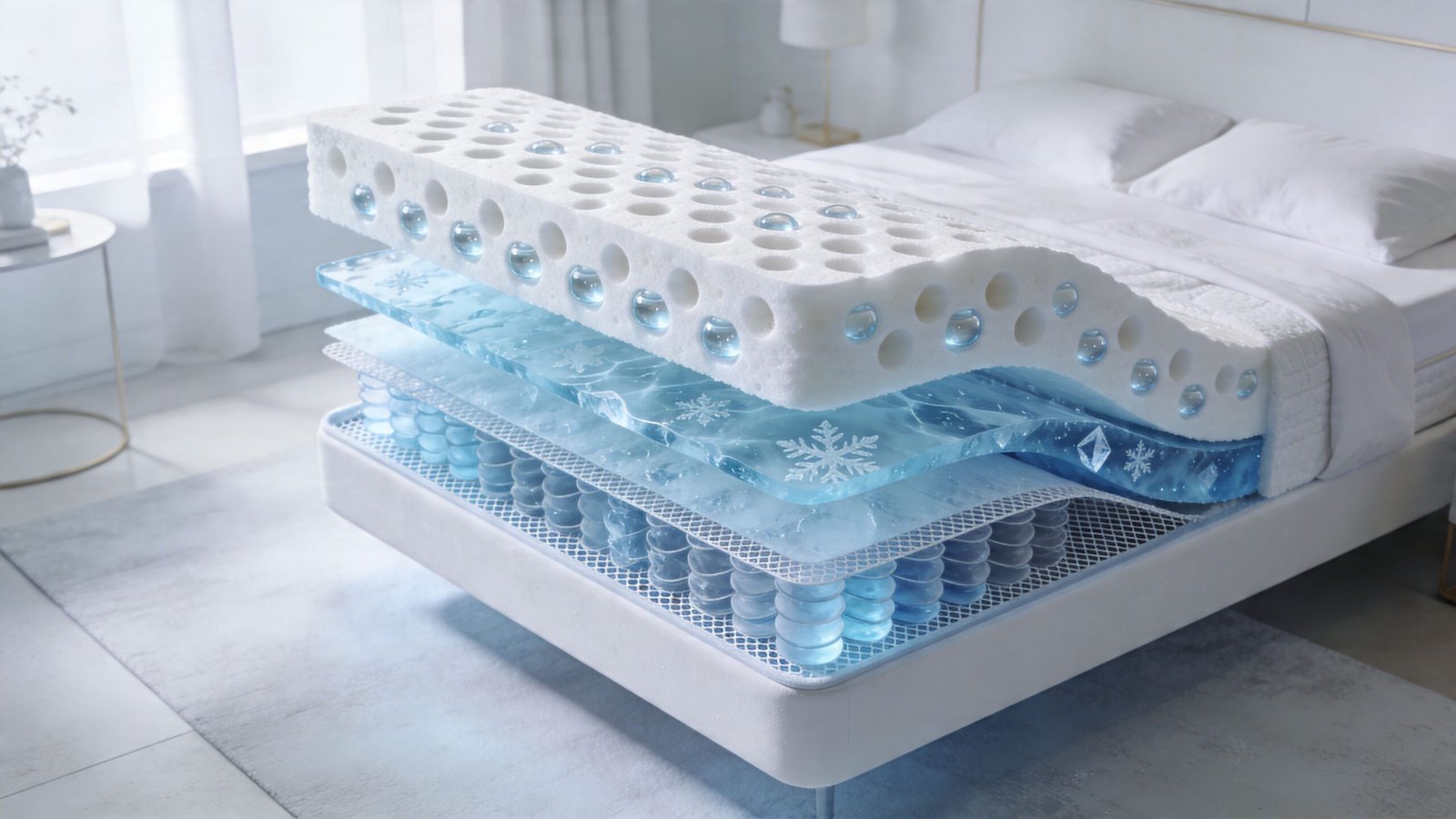
You’re probably reading this after another bad night. The AC was on, the sheets were supposed to be “cooling,” and you still woke up damp, kicked one leg out from under the blanket, flipped the pillow twice, then spent the next hour trying to fall back asleep.
That problem gets worse in places like Florida, where the air already feels heavy before you even lie down. A mattress that seems fine in a quick showroom test can turn into a heat trap once your body settles in and the humidity has nowhere to go. I’ve slept on enough beds in that kind of climate to say this plainly: most “cooling” claims are weak, and some are just code for a cover that feels cool for ten minutes.
The best mattresses for cooling don’t just feel chilly at first touch. They keep moving heat away from your body, keep air circulating under pressure, and avoid that swampy, stuck-in-foam feeling that makes hot nights miserable.
Why 'Sleeping Hot' Is More Than Just a Minor Annoyance
A bad cooling setup usually shows up at 3 a.m., not at bedtime.
You fall asleep fine, then wake up damp through the chest or behind the knees. One partner is kicking the blanket off while the other is pulling it back on. The room temperature may be reasonable, but the sleep surface feels wet, warm, and stagnant. In humid climates, that pattern often points to trapped heat and trapped moisture in the mattress, not just a warm bedroom.

After testing mattresses in Florida weather, I’ve found that “sleeping hot” is rarely just about body temperature. It’s usually a mix of heat retention, poor airflow under heavier parts of the body, and humidity that has nowhere to go once you sink into the top layers. If you’re trying to pinpoint the cause, this guide on why you get so hot when you sleep covers the common triggers.
Humidity changes the equation. In drier climates, a mattress that runs a little warm can still be tolerable. In sticky air, the same bed can feel swampy after an hour because sweat does not evaporate well, and dense foams keep that moisture close to the skin.
The consequences of a hot bed
The main problem is broken sleep. You wake up to cool off, then wake up again because you got too cool after throwing the covers off. By morning, you may have logged enough hours in bed and still feel wrung out.
That matters even more for people who already have a narrow comfort window. Night sweats, menopause, heavier body weight, post-workout heat, and certain medications can all make a borderline-warm mattress feel much worse. Couples run into an extra problem that mattress brands often gloss over. One person may need airflow and a flatter sleep surface, while the other needs deeper pressure relief and sleeps closer to neutral.
That’s why I judge cooling beds by overnight stability, not the first cool touch of the cover.
A mattress does not need to feel cold. It needs to stay dry enough, breathable enough, and neutral enough that your body can settle in and stay asleep.
Our 2026 Top-Rated Cooling Mattresses at a Glance
If you want the short list first, these are the models I’d pay attention to before anything else. Each one solves a slightly different version of the overheating problem.
| Top Cooling Mattresses of 2026 | Type | Key Cooling Feature | Best For | Price Range |
|---|---|---|---|---|
| WinkBed | Hybrid | Breathable Tencel cover and zoned pocketed coils | Most hot sleepers who want balanced support | Premium |
| Saatva Classic Luxury Firm | Innerspring-hybrid style coil mattress | Coil-on-coil airflow and Euro-top comfort | Sleepers who want a cooler, more traditional feel | Premium |
| Nectar Premier Hybrid | Hybrid | Cooling-focused hybrid build with strong temperature regulation | Couples and hot sleepers who want more pressure relief | Mid to premium |
| Purple RestorePlus Hybrid | Hybrid | Gel-Flex Grid for immediate heat dissipation | People who hate the stuck-in-foam feel | Premium |
| Helix Midnight Luxe | Hybrid | Breathable cover options and strong overnight heat pull-away | Side sleepers and those who want a plusher hybrid | Premium |
A quick pattern jumps out from that table. The strongest performers are mostly hybrids or coil-based designs, not dense all-foam beds. That doesn’t mean every hybrid sleeps cool, because plenty still bury too much foam on top. It does mean the best mattresses for cooling usually combine breathable top materials with a support core that lets heat escape instead of trapping it beneath you.
How to read these picks
Don’t shop this category by one feature alone. A “cooling cover” matters less if the layers underneath store heat. Gel foam can help, but it won’t rescue a mattress that hugs too much and kills airflow. Coils, latex, and grid-style surfaces tend to do more of the heavy lifting than flashy brand names for proprietary yarns.
A few examples:
- WinkBed stands out if you want a safe all-around choice with airflow and support.
- Saatva Classic Luxury Firm makes sense if you sleep hot and also dislike the slow, dense feel of memory foam.
- Nectar Premier Hybrid is worth a look if you want more contour without going fully heat-trapping.
- Purple RestorePlus Hybrid is the most distinctive feel of the bunch, and some sleepers love it for that floating, ventilated surface.
- Helix Midnight Luxe works well for side sleepers who still need legitimate cooling, not just softness.
The best pick isn’t the coldest-feeling bed in a showroom. It’s the one that still feels neutral at 3 a.m.
That’s where noticeable differences become clear, especially in a humid bedroom.
What separates the winners
The top models here have different feels, but they all avoid one common failure point. They don’t let your body sink so much that heat gets pinned around your core. That matters more than marketing language ever will.
How Cooling Mattress Technology Actually Works
Two people can sleep on the same bed in a humid Florida bedroom and have opposite complaints. One wakes up sweaty at 2 a.m. The other is fine until the room cools off before dawn. That mismatch is why “cooling” needs a more precise definition than a cold-feeling cover in a showroom.
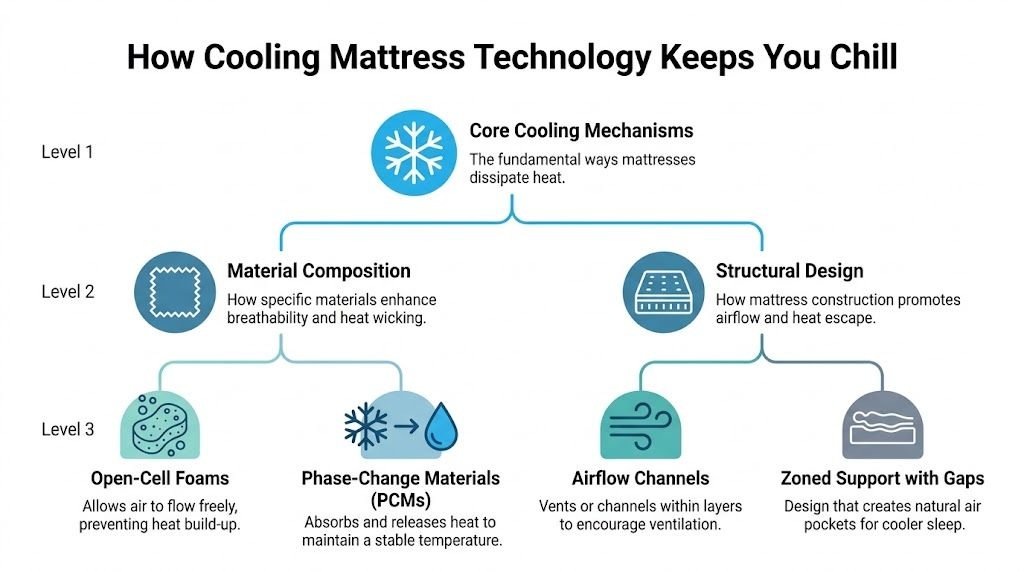
A mattress manages heat in a few different ways. Some materials pull heat away on contact. Some slow down temperature swings at the surface. Others leave enough open space inside the bed for heat and moisture to escape instead of collecting under your torso. Brands often bundle all three under one label, but they do different jobs.
If you want a broader look at the hardware behind cooler sleep, this guide to sleep technology for hot sleepers is worth a read.
Surface cooling versus overnight cooling
Start with the distinction that matters most in real use.
Surface coolness is the first-touch sensation from the cover. It can feel great for a few minutes. It also disappears fast if the layers below hold heat and humidity.
Overnight cooling is the mattress’s ability to stay temperature-neutral after hours of pressure and body heat. That comes from the full build, not just the fabric on top.
Three mechanisms show up again and again:
- Conductive cooling pulls heat away from the body into another material.
- Thermal buffering slows the rate at which the sleep surface warms up.
- Convective cooling gives warm air a path out of the bed and allows new air to move in.
The best performers usually combine at least two of those. In humid climates, airflow matters more because moisture in the air makes it harder for sweat to evaporate.
Which cooling features matter most
In practice, some cooling features carry more weight than others.
The most useful systems tend to be phase change materials near the surface, open structures such as grids or coils that keep air moving, and comfort layers that do not let you sink too far. By contrast, thin cool-touch covers and token gel infusions often create a brief cool hand-feel without changing what happens at 3 a.m.
That order matches what I notice during long tests in a humid room. Beds with good airflow and stable surface temperature stay more neutral through the night. Beds that rely on a flashy cover usually start strong and fade.
Phase change materials
Phase change material, usually shortened to PCM, is one of the few cooling features with a clear, sensible job. As explained by the Sleep Foundation’s guide to phase change material, PCM absorbs and releases heat as temperatures shift, which helps flatten out those sudden warm-ups on the sleep surface.
That does not make the mattress cold. It makes the surface less jumpy.
That distinction matters for couples, especially when one person runs hot and the other does not want a bed that feels chilly all night. PCM can help the hotter sleeper avoid sharp heat buildup without forcing the whole mattress into a cold-feeling profile.
Gel and heat-dissipating grids
Gel foam is inconsistent. Some versions spread a little warmth near the surface. Some do very little after the first hour.
Grid designs are different because they change the structure of the bed, not just the formula of the foam. Purple’s GelFlex Grid, for example, leaves open channels for air movement and resists the dense, wrapped-up feel that makes many foam beds sleep warmer. That does not mean everyone will like the sensation. Some sleepers love the buoyant, floating feel. Others never adjust to it.
The cooling advantage is real, but it comes with a comfort trade-off.
A quick visual helps if you want to see the concepts in motion.
Why coils still matter more than most cover fabrics
If I had to choose between better airflow through the core or a better cool-touch cover, I’d choose airflow every time.
Pocketed coils create open space inside the mattress. That space gives trapped heat somewhere to go once your body has been in one position for a while. Aerated latex helps for the same reason. Both materials keep the bed from turning into a dense heat pocket under the hips and ribcage.
Practical rule: If the comfort layers are thick, dense, and slow to rebound, the mattress will usually sleep warmer than the product page suggests.
Foam is not the enemy here. Excess sink is. A well-built cooling hybrid can use foam comfortably as long as the upper layers stay breathable and the support system underneath keeps air moving.
What tends to disappoint
A few features miss their promise more often than they deliver.
- Cool-touch covers by themselves feel good at first contact, then fade once body heat builds.
- Dense memory foam with small gel additions may sleep a bit less warm than old memory foam, but it can still trap heat in humid rooms.
- Extra-plush pillow tops often reduce airflow because they let the body settle too far into the mattress.
This is also where couples need to be careful. A plush bed that feels cozy to the cooler sleeper can create a warm pocket under the hotter sleeper’s shoulders and hips. Split firmness options, zoned support, and faster-response comfort layers usually solve that problem better than chasing the coldest cover.
Comparing Mattress Types for Hot and Humid Nights
At 2 a.m. in a humid Florida bedroom, the wrong mattress does not just feel warm. It feels damp, heavy, and stale under the parts of your body pressing deepest into the bed. That is why mattress type matters more in humid climates than it does in dry ones.
The useful question is not “which category sleeps coolest?” It is which construction keeps airflow, handles moisture, and avoids heat buildup after a few hours under real body weight. Couples need to be even more careful. One partner can be comfortable while the other is stuck in a warmer pocket, especially on softer foam-heavy beds.
Hybrid mattresses
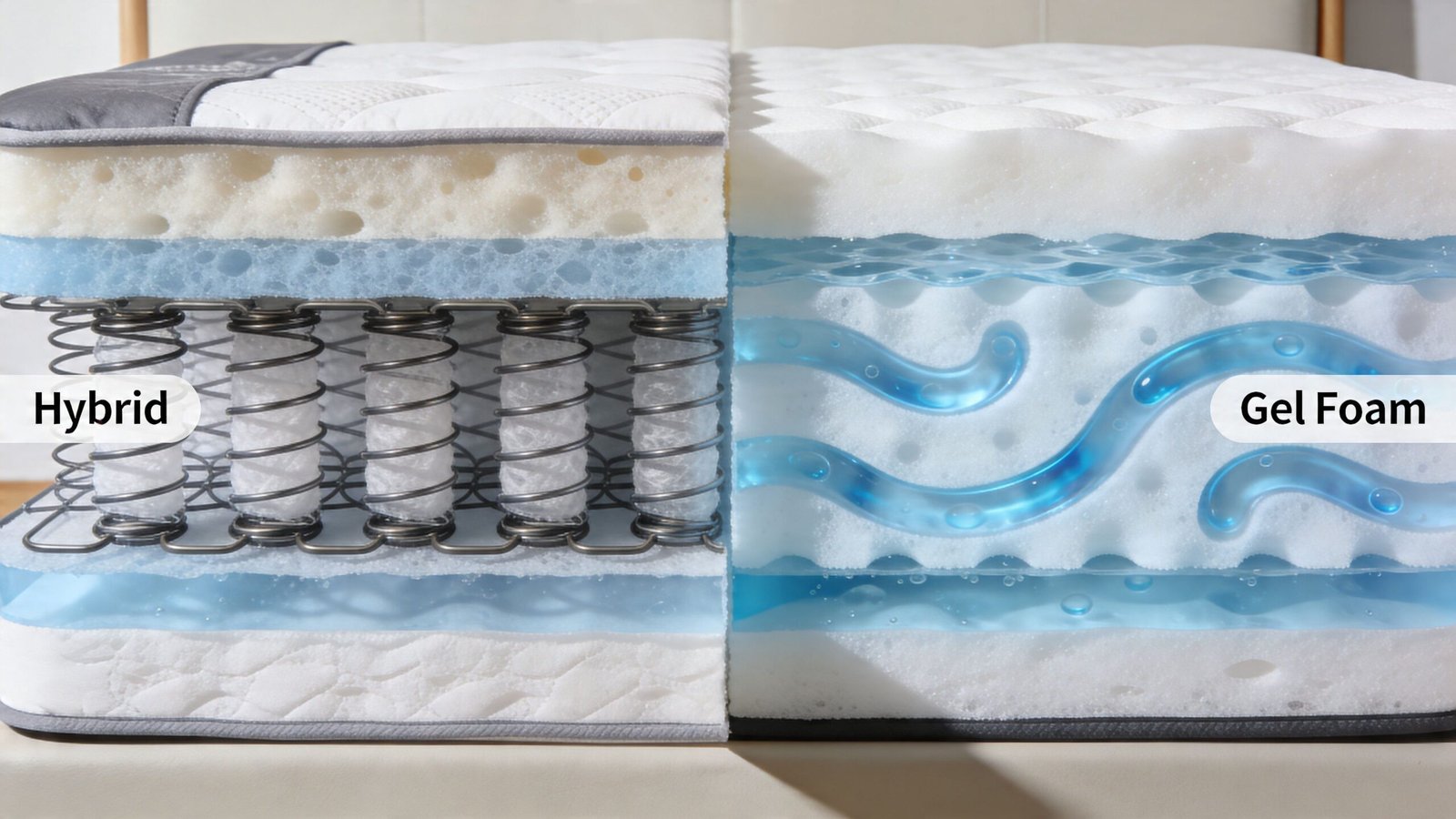
For hot sleepers in muggy rooms, hybrids are usually the best place to start. The coil core leaves open space inside the mattress, which helps warm air escape instead of collecting under your back and hips. That benefit holds up better overnight than a cover that only feels cool for the first few minutes.
NapLab’s testing notes that the WinkBed stands out for cooling because of its breathable Tencel cover, Euro pillow top design, and pocketed coil support system in its best cooling mattress testing roundup. I would not treat that as proof that every hybrid sleeps cool, but it matches what I feel in hands-on testing. A well-built hybrid usually clears heat faster than an all-foam bed, especially once the room itself is humid.
Where hybrids win
- Airflow under load: Coils keep channels open after the surface compresses.
- Better overnight consistency: They are less likely to start cool and finish stuffy.
- Useful middle ground for couples: You can get pressure relief without trapping the hotter partner in a deep foam pocket.
Where hybrids can still miss
A hybrid can still sleep warm if the comfort layers are thick, dense, and slow to recover. I have tested several that looked promising on paper but held too much heat around the shoulders because the top layers let the body sink too far before the coil unit could help.
For couples with different temperature needs, this is often the best category to shop carefully rather than the best category to buy blindly. A firmer hybrid with responsive foams usually works better than a plush hybrid loaded with memory foam.
Latex and latex hybrids
Latex is one of the more dependable materials for humid climates. It rebounds fast, does not hug the body the way memory foam does, and usually leaves more room for air to move around the sleeper. That makes a noticeable difference when your skin already feels sticky before you even lie down.
It also helps with movement. If you toss and turn when you get hot, latex makes repositioning easier because it does not hold you in place.
Trade-offs with latex
The cooling performance is good. The feel is not for everyone.
Some sleepers love the buoyant, lifted sensation. Others want deeper contour at the shoulders and hips, especially side sleepers with sharper pressure points. Price is the other drawback. Good latex beds and latex hybrids usually cost more than basic foam models.
For couples, latex can solve one problem and create another. It tends to stay more temperature-neutral, but it can also transfer a bit more surface movement than softer foam-heavy designs.
Gel-infused foam mattresses
This category needs the most skepticism. Gel can help pull heat away from the body for a while, but it does not change the basic behavior of a dense foam mattress. If the bed lets you sink substantially and has limited internal airflow, the surface often feels fine at first and noticeably warmer later in the night.
That pattern gets worse in humidity because moisture lingers too.
What foam does well
- It usually isolates motion better than coil-forward builds.
- It can relieve pressure very well for side sleepers.
- It often costs less than a comparable latex or premium hybrid mattress.
What foam struggles with in sticky weather
Heat tends to accumulate instead of clearing quickly. Moisture also hangs around longer. For some sleepers, that creates the familiar problem where the mattress feels acceptable at bedtime and uncomfortable by early morning.
If you want foam, I would be selective. Look for shallower comfort layers, quicker response, and better support underneath. For a couple with different temperature preferences, an all-foam mattress is often the tougher compromise because the hotter sleeper pays the price for the cooler sleeper’s preferred plushness.
Traditional innerspring and coil-forward designs
Traditional innersprings and coil-forward models can work very well for cooling because they usually have less dense comfort material on top and more open air through the core. They also keep you sleeping more on the mattress than in it, which helps reduce that wrapped-in-warmth feeling.
The trade-off is easy to feel. These beds usually have more bounce, less contour, and sometimes more noticeable motion when your partner changes position.
If you sleep hot and also hate feeling stuck, this category deserves more attention than it gets.
A side-by-side view of the trade-offs
| Mattress type | Cooling strength | Common downside | Best match |
|---|---|---|---|
| Hybrid | Excellent if the comfort layers stay breathable and not overly deep | Can still run warm with thick plush foam on top | Most hot sleepers, especially couples with mixed temperature needs |
| Latex or latex hybrid | Very good airflow and fast rebound | Higher price, springier feel, some motion transfer | Sleepers who want cooling without the slow sink of memory foam |
| Gel-infused foam | Mixed, depends heavily on density and sink depth | Heat and moisture can build through the night | Sleepers who prioritize contour and motion isolation |
| Innerspring or coil-forward | Strong airflow and a lifted, drier sleep surface | Less contour, more bounce, motion can be more noticeable | Back and stomach sleepers, plus hot sleepers who dislike foam feel |
What I’d choose in real humid conditions
In dry climates, foam is easier to tolerate if you love close contouring. In humid climates, I narrow the list fast because the margin for error is smaller.
My usual order is:
- Well-built hybrid
- Latex hybrid or all-latex
- Coil-forward innerspring
- All-foam, only with careful construction choices
That ranking comes from what happens after midnight, not from showroom feel. In sticky weather, the best mattress is the one that still feels breathable at 3 a.m. and does not force one partner to sleep hot so the other can sleep soft.
The Best Cooling Mattress for Your Specific Needs
There isn’t one universal winner. The right pick depends on why you’re overheating, how much contour you want, and whether you sleep alone or with someone who runs at a different temperature.
Most mattress roundups get lazy. They hand out a “best for couples” badge based on motion isolation and stop there. That misses one of the most common bedroom problems.
Best for menopause and hormonal night sweats
For hormonal overheating, I’d lean toward a mattress that stays as temperature-neutral as possible and doesn’t let you sink too much. The reason is simple. Night sweats aren’t just about comfort. They often come in waves, so the bed needs to avoid amplifying those spikes.
Best fit: Saatva Classic Luxury Firm or Purple RestorePlus Hybrid
Saatva makes sense if you want airflow and a more traditional, lifted sleep surface. Purple makes sense if your biggest problem is heat buildup right around the body. Both approaches avoid the classic “marinated in foam” feeling that many hot sleepers describe.
If you’re sensitive to abrupt warmth, I’d favor designs with clear ventilation over plush, dense comfort layers.
Best for couples with mismatched temperatures
This is the most overlooked category.
A 2025 Sleep Foundation survey noted that 35% of couples cite temperature differences as a top sleep disruptor, and most reviews still don’t test heat transfer between partners or dual-zone cooling in a meaningful way, as highlighted in Mattress Clarity’s discussion of cooling mattresses for hot sleepers.
That matches what I see in practice. One partner sleeps hot, the other sleeps cold, and they end up compromising into a mattress neither one likes.
What usually works best
Best fit: Nectar Premier Hybrid for a conventional mattress, or an adjustable air design if you need side-to-side customization
Nectar Premier Hybrid is a sensible middle ground because it offers contour and partner-friendly feel without pushing as hard into the heat-trap territory as many soft foam beds. For couples with opposite preferences, adjustable air chamber beds deserve more attention than they get. They’re not automatically the best coolers, but they can solve the firmness compromise that often makes temperature problems worse.
Couples don’t just need low motion transfer. They need a mattress that doesn’t turn one partner into a space heater for the other.
If one of you runs cold, avoid overcorrecting into the most aggressively cool-feeling surface possible. Go for neutral, not icy.
Best for heavier sleepers
Heavier sleepers press deeper into the comfort layers, which makes airflow more important, not less. A mattress that feels breathable to a lighter person can sleep warmer once more of the body settles into the foam.
Best fit: WinkBed Plus or a sturdy coil-forward hybrid
I look for three things here: strong support, durable materials, and enough lift to keep the sleeper from bottoming into a warm pocket. WinkBed’s construction is a strong match for that job because its support and airflow work together rather than fighting each other.
A softer all-foam bed can feel great for twenty minutes and awful by the end of the night if you sink too far.
Best budget cooling mattress
Budget cooling is tricky because true temperature regulation costs money. Cheap “cooling” mattresses often rely on cover language and not much else. If your budget is tight, the smartest move is usually to buy the most breathable construction you can afford, not the most aggressively marketed cooling story.
Best fit: a simpler hybrid with a breathable cover over a basic all-foam mattress
At the lower end, I’d rather sleep on a straightforward hybrid with decent airflow than a plush foam bed with a cool-touch name. You may not get luxury materials, but you can still avoid the worst heat retention mistakes.
Best for side sleepers who still sleep hot
Side sleepers need enough pressure relief at the shoulder and hip, which often pushes them toward softer beds. That can create a cooling problem if the mattress gets too enveloping.
Best fit: Helix Midnight Luxe
This kind of mattress works because it gives side sleepers enough cushioning without forcing them into the dense, sticky feel that usually causes overheating complaints. If you need softness and cooling, this is the lane I’d stay in: pressure relief with airflow, not softness at any cost.
Practical Tips for Buying and Maximizing Your Cool Sleep
You wake up at 2 a.m., the room temp looks fine, and the mattress still feels damp and stuffy. In Florida, that usually means the problem is not just heat. It is heat plus humidity, plus the layers sitting on top of the bed.
I have tested breathable hybrids that slept noticeably warmer once I added a cheap waterproof protector and polyester sheets. I have also seen couples blame the mattress when the problem was a mismatched setup, with one partner under a heavy comforter and the other kicking covers off all night. Cooling performance is always a system test, not a showroom test.
What to check before you buy
Start with the build. Coils, latex, and firmer support systems usually do more for overnight temperature control than a cool-to-the-touch cover alone. Good airflow matters more in humid climates because sweat does not evaporate as easily, so any mattress that lets you sink deep into dense foam has a tougher job.
Independent testers at Sleep Foundation and NapLab both measure surface temperature change and heat retention during mattress evaluations, and their results consistently show the same pattern: breathable hybrids and coil-based designs tend to manage heat better than thick all-foam models with heavy contouring. See Sleep Foundation’s mattress testing methodology and NapLab’s cooling test explanations.
That matters even more for couples with different temperature needs. The coolest mattress in a lab can still be the wrong choice if one partner sleeps neutral or cool and the other runs hot. In those cases, aim for a mattress with neutral temperature regulation, then fine-tune each side with separate bedding instead of chasing the coldest bed possible.
A practical buying checklist
- Check the support core: Pocketed coils, coil-on-coil builds, and latex hybrids usually move more air than thick foam cores.
- Treat cover claims carefully: A cool cover can improve first contact. It does not fix heat-trapping comfort layers underneath.
- Watch how far you sink: If your hips and shoulders settle too deep, airflow drops and the bed usually feels warmer by the second half of the night.
- Take the trial seriously: Test the mattress with your actual protector, sheets, and comforter. That is the setup that counts.
- Read the negative reviews: Look for complaints about waking sweaty after a few weeks, especially from people in warm or humid climates.
- For couples, plan by side: Split firmness is one solution, but separate blankets or different sheet weights often solve the temperature mismatch more cheaply.
Build a cooler sleep system around the mattress
The mattress is the foundation. The layers above it decide whether that cooling design can do its job.
- Sheets: Linen, cotton percale, and Tencel usually breathe better than slick microfiber or polyester blends.
- Pillows: A hot pillow can undo a cooler mattress fast, especially if you trap heat around your head and neck.
- Protectors: Choose a protector advertised as breathable and thin. Some waterproof models feel like a heat seal over the bed.
- Toppers and pads: If your mattress is close but still too warm, a topper or pad can help at the surface. This guide to cooling mattress pads that actually help is a good place to start before replacing the whole bed.
One more real-world point. Humid rooms need room-level help. If your bedroom stays muggy, a dehumidifier or stronger air circulation often makes a bigger difference than upgrading from one decent cooling mattress to another.
Small habits that make a bigger difference than people expect
Keep the top of the bed simple. Heavy layered bedding traps moisture, and that clammy feel is what many hot sleepers notice first.
Wash sheets and protectors often. In humid climates, sweat, body oils, and moisture buildup can make breathable fabrics feel less breathable over time.
For couples, stop forcing one shared setup if it is clearly not working. Separate blankets, different pillow fills, and lighter bedding on the hotter side of the bed solve a lot of “mattress” problems without buying a new mattress.
A good cooling mattress helps. The right sleep system is what makes it work night after night.
Frequently Asked Questions About Cooling Mattresses
Do cooling mattress toppers actually work
Sometimes. They work best when your mattress is only moderately warm and the problem is mostly at the surface. They work worst when the mattress underneath is dense, soft foam that stores heat all night. In that case, a topper may improve first-touch comfort without solving the deeper issue.
Do cooling features wear out over time
Some cooling sensations fade faster than others. Cool-touch covers can feel less dramatic as the fabric ages and as your body adjusts to them. Structural cooling tends to last longer. Coils, latex, grid layers, and airflow channels usually matter more over the long term than a flashy surface treatment.
Can a cooling mattress feel too cold
Generally, no. The better ones feel neutral, not icy. That said, couples can run into problems if one person wants maximum cooling and the other already sleeps cool. In those cases, it’s usually smarter to choose a balanced mattress and adjust bedding on each side instead of chasing the coldest possible bed.
Are all-foam cooling mattresses worth considering
Only selectively. If you love the feel of foam and don’t overheat badly, one can still work. But if night heat is your top complaint and you live in a humid climate, hybrids, latex hybrids, and coil-forward beds are usually safer picks.
What’s the single biggest mistake hot sleepers make
Buying based on a quick cool-touch feel in the first five minutes. That tells you almost nothing about how the mattress will behave after hours of body contact, trapped humidity, and repeated wake-ups.
If you’re tired of guessing, CoolRestGuide helps you narrow down cooling mattresses, sheets, pillows, and toppers that make a difference for hot sleepers in humid climates. The goal is simple: less marketing fluff, more honest guidance that helps you sleep cooler tonight.
