

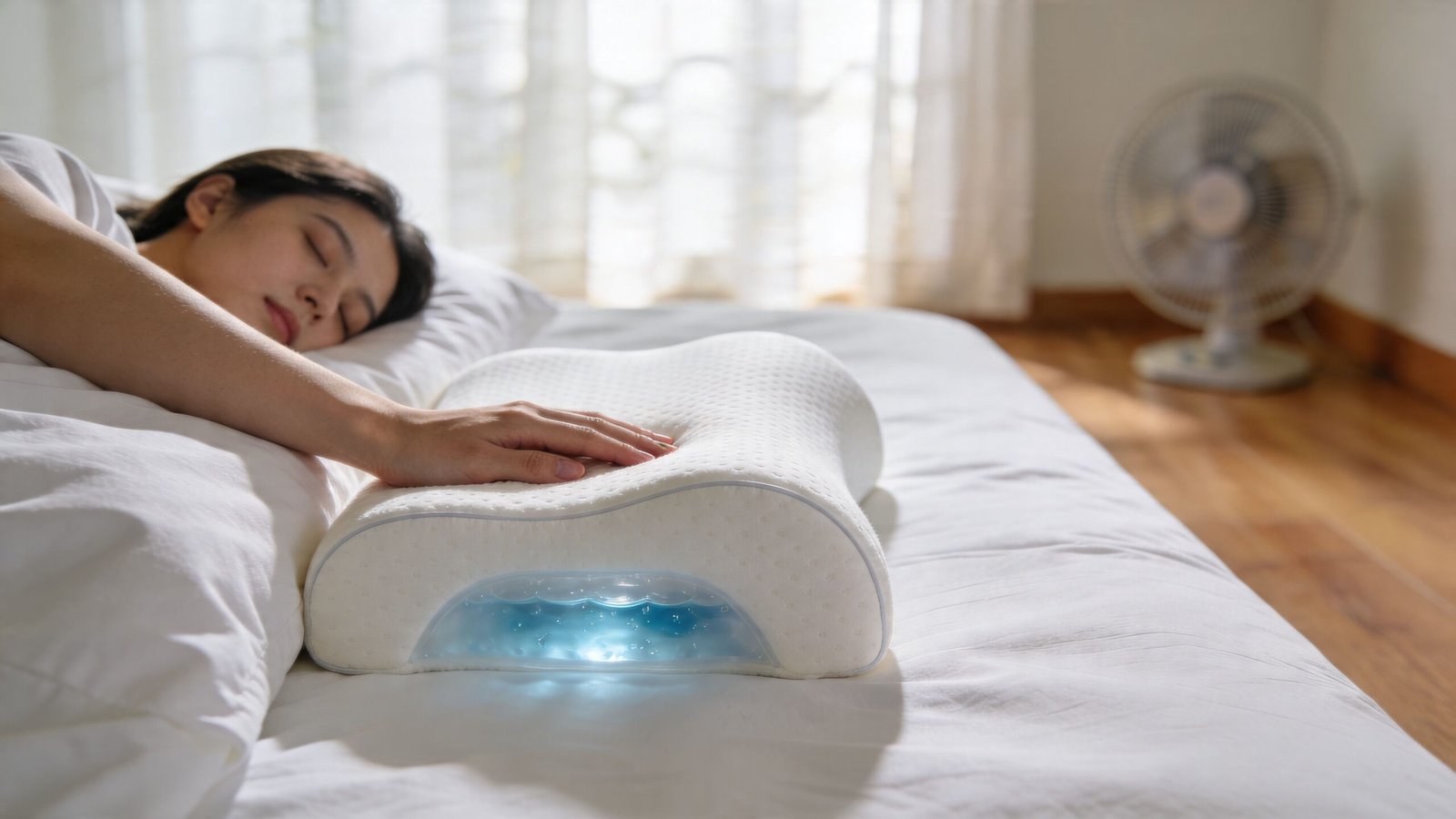
You go to bed tired, finally get comfortable on your side, and then wake up a few hours later with two problems at once. Your neck feels kinked, and the pillow under your face is warm, damp, and vaguely irritating. You flip it over for the cool side, get ten decent minutes, and then start the whole cycle again.
That pattern is common in hot, humid places. It’s especially brutal if you live somewhere like Florida or Texas, where the room can feel fine at bedtime but your bedding still turns into a heat trap after midnight. A standard pillow usually fails side sleepers twice. It doesn’t keep the neck aligned, and it holds onto heat right where your head and face need airflow most.
A cervical pillow for side sleepers is supposed to solve the first problem. The good ones can also help with the second, but only if you ignore a lot of the marketing and pay attention to how the pillow is built. Shape matters. Loft matters. Foam type matters. The cover matters more than most brands admit.
The End of Stiff Necks and Sweaty Nights
If you’re reading this after another sweaty, restless night, you’re not being picky. You’re dealing with a product mismatch. Most pillows are designed for broad comfort appeal, not for a side sleeper with a real shoulder gap and a body that runs hot.
That gap in the market is bigger than it should be. A 2025 sleep study cited in recent reviews found that 68% of side sleepers in humid regions report waking up sweaty, yet only 12% of top-rated cervical pillows in general tests score above average on breathability metrics, which is exactly why generic roundups often miss what hot sleepers need in warm climates (humid-region side sleeper review summary).
A lot of people try to solve this by buying softer pillows, flatter pillows, or “cooling” pillows with a slick fabric panel on one side. That usually backfires. The flatter pillow lets your head drop toward the mattress. The super-soft pillow compresses overnight. The fake-cooling pillow may feel chilly for a few minutes but still sleeps hot once your body heat sinks in.
Practical rule: If a pillow feels cool in the first five minutes but leaves your neck unsupported by morning, it’s not a solution. It’s a short demo.
What helps is a pillow built like support gear, not like decor. Cervical pillows use contours, raised side zones, and firmer structure to hold the head and neck in a steadier position. For side sleepers, that matters because your shoulder creates vertical distance that a basic pillow rarely fills well.
For hot sleepers, there’s a second filter. You need that support without the dense, heat-soaked feeling that many contoured foam pillows create. That means paying attention to airflow, cover fabric, and whether the foam is designed to resist heat buildup instead of just advertising “cooling” on the package.
If your body tends to overheat at night, it also helps to understand how temperature affects sleep overall. This guide pairs pillow fit with real-world heat management, and if you want the broader physiology behind nighttime overheating, body temperature when sleeping is worth reading too.
Why Your Flat Pillow Fails Your Spine
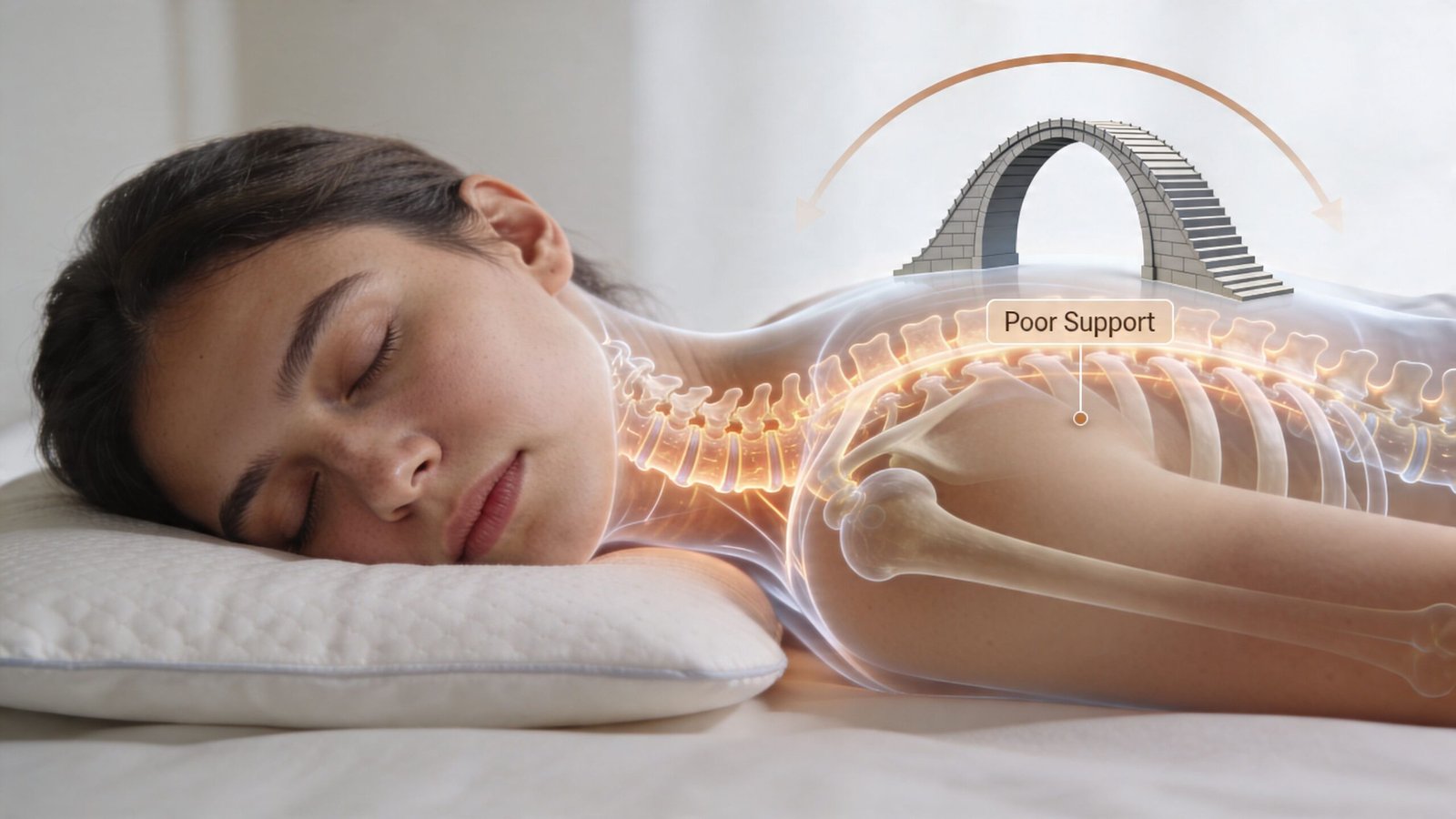
A side sleeper’s neck works like a bridge between two higher structures: your head on one side and your torso on the other. Your shoulder creates open space underneath that bridge. If the pillow doesn’t fill that space correctly, the bridge sags or tilts, and your neck muscles spend hours trying to stabilize it.
That’s why a flat pillow can feel “soft” and still leave you wrecked in the morning. Comfort at first contact isn’t the same thing as alignment through the night.
The shoulder gap is the whole problem
When you lie on your side, your mattress supports your shoulder only partly because the shoulder compresses into the bed. Your head doesn’t compress the same way. The pillow has to make up the difference and keep your nose, sternum, and spine in a straighter line.
A flat pillow usually can’t do that. It either collapses under the weight of your head or starts too low to begin with. If you fold it in half or bunch it up every night, you’re already doing manual compensation for a bad fit.
Pillow shape changes alignment fast
This isn’t one of those sleep topics where the effects show up only after months. Research found that pillow type creates measurable differences in spinal positioning within 10 minutes, and side-lying on a feather pillow produced significantly different slopes at the C2-C4, C4-C7, and C7-T3 segments compared with a foam contour pillow (randomized pillow alignment trial).
That matters because it confirms two practical things hot side sleepers often learn the expensive way:
- Fill material matters: Feather and loosely packed fills can shift too easily.
- Shape matters: Contoured support changes how the neck settles, not just how the pillow feels in your hand.
- Early feel can be misleading: A pillow can seem plush at bedtime and still pull your neck out of position quickly.
The same trial also identified the C2-C4 segment as especially sensitive to pillow changes and established that 10 minutes is the stabilization period for cervical positioning when lying on different pillow fills in the side-lying position. So if a pillow already feels “off” in the first few minutes, don’t assume your body will magically settle into good alignment later.
Your muscles notice bad geometry too
A pillow doesn’t just hold up your head. It changes how hard your neck muscles have to work while you sleep. That’s where shape becomes a bigger deal than most store listings suggest.
Research measuring neck muscle activity found that, in the lateral sleeping position, cylindrical pillows produced significantly lower activation in the Left Upper Trapezius and both Sternocleidomastoid muscles than rectangular pillows. The rectangular designs showed higher SCM activity, especially on the left side. In plain English, the wrong shape asks your neck to stay on duty overnight.
If you wake up feeling like your neck “worked all night,” that’s often a support problem, not just a firmness problem.
This is the hidden reason many people hate ordinary hotel pillows. They’re usually rectangular, overstuffed at first, and then compress unevenly under load. Your head shifts. Your neck braces. You wake up stiff and blame the mattress.
What tends to fail in the real world
The repeat offenders are predictable:
| Pillow type | What usually goes wrong for side sleepers |
|---|---|
| Flat fiberfill | Compresses fast and loses side-sleeping height |
| Feather or down | Feels plush but shifts and bunches instead of holding shape |
| Generic memory foam slab | May support better, but often lacks side-specific contour |
| Thick but soft pillow | Starts tall, then sinks enough to drop the head |
The fix isn’t “buy the firmest pillow you can find.” It’s buying a shape that supports the neck curve while maintaining enough height under the head for your body build and mattress.
That’s where cervical pillows earn their keep. They aren’t magic. They’re just one of the few pillow categories designed around side-sleeping geometry instead of broad, average-user softness.
Anatomy of a Cooling Cervical Pillow
You fall asleep on your side with the AC running, then wake up at 3 a.m. with two problems at once. Your neck feels slightly twisted, and the side of your face is hot enough that you flip the pillow hunting for a cool patch that is already gone.
That is the exact failure point for a lot of cervical pillows sold to side sleepers in Florida, Texas, and other humid places. They get the shape half right, then trap heat like a foam brick. Or they feel breezy for 20 minutes, then collapse and leave your neck doing the work.
A good cooling cervical pillow has to solve both problems at the same time. It needs a support structure that keeps your head level on your side, and it needs materials that release heat and humidity instead of collecting them around your cheek.
I shop for these pillows as two separate systems. The first is the support core. The second is the heat and moisture system. If either one is weak, the pillow usually ends up in the closet.
The support engine
For side sleepers, loft is the starting point because the pillow has to fill the gap between the mattress and your head. In real use, that means enough height under load, not just a tall profile on the product page.
Loft
A cervical pillow can look tall and still fail once your head settles into it. That is common with softer foams and fluffy fills that photograph well but compress too far overnight.
For side sleeping, I look for:
- A stated loft measurement
- Higher side zones or built-up edges
- A center cradle that keeps the head from rolling
- A shape that holds its form without constant fluffing
The label matters less than the geometry. “Orthopedic” is marketing. Actual height and shape are what keep your neck from bending sideways.
One quick check helps. Lie on your side and notice where your nose points. If your face angles down toward the mattress, the pillow is probably too low. If it tips upward, the pillow is probably too tall.
Firmness
Side sleepers usually do better with medium-firm support because height only counts if the pillow keeps that height after several hours of pressure. Plush can feel great for ten minutes. It often feels terrible at sunrise.
The goal is controlled compression. Your head should sink in a little, but not enough to erase the loft that was supposed to support your neck. If the core bottoms out under the ear and jaw, it is not a side-sleeper pillow anymore, even if the box says it is.
Shape
Cervical pillows often look strange compared with standard rectangles. That is usually a good sign.
Contours, neck rolls, side bolsters, and dual-height edges each solve a specific alignment problem. They help keep the neck curve supported while giving the skull a stable place to rest. For a hot side sleeper, shape also affects temperature more than people expect. A contoured surface exposes more of the pillow to the air than a flat slab, and that can make the pillow feel less swampy over the course of the night.
Here is how the common shapes usually behave:
| Shape | What it does well | Where it can annoy you |
|---|---|---|
| Contour wave | Supports the neck curve and adds side-sleeping height | Adjustment period can be rough if you are used to flat pillows |
| Rolled or cylindrical edge | Gives steady neck support on the side | Usually less forgiving if you change positions often |
| Flat rectangle | Familiar and easy to use | Rarely holds side-sleeping alignment for long |
| Dual-height contour | Gives two loft options in one pillow | Easy to use the wrong side and misjudge the pillow |
The cooling system
Heat control is where many cervical pillows fall apart, especially in humid bedrooms. A pillow can feel cool when you first touch the cover and still sleep hot once your head stays in one spot for an hour.
The actual issue is not surface coolness. It is heat buildup plus trapped moisture.
In a dry climate, a warm pillow is annoying. In a humid climate, it gets sticky. Sweat has nowhere to go, dense foam keeps your face sealed against the surface, and suddenly even a well-shaped pillow feels unbearable.
Gel-infused memory foam
Gel-infused memory foam can help, but only if the rest of the pillow design supports airflow. Gel by itself does not rescue a dense, closed-off foam core.
The best versions pair the foam with details like:
- Vent holes or internal channels
- A breathable knit or cotton-blend cover
- Contours that reduce full-face contact
- Foam that recovers without swallowing the head
The worst versions rely on a cool-touch fabric panel over dense foam that still holds heat. That type of pillow often wins the first impression test and fails the all-night test.
Latex
Latex is often the better pick for hot side sleepers who hate the stuck-in-foam feeling. It is springier, usually allows more airflow, and tends to feel less humid around the face.
There is a trade-off. Latex does not mold around the head the same way memory foam does. Some side sleepers love that lighter, bouncier feel. Others miss the slow contouring pressure relief of foam, especially if they have sharper shoulders or more pressure sensitivity around the ear and jaw.
If you sleep hot enough to kick off the sheet at 2 a.m., that trade-off is often worth making.
Fiber and feather
Fiberfill and feather can feel cooler at first because they are less dense. The problem is stability.
For a true cervical function, they usually shift too much, flatten too fast, or bunch in the wrong places. That means you get airflow but lose the neck support that made you shop for a cervical pillow in the first place. For side sleepers with recurring stiffness, that is usually a bad swap.
Cooling material comparison for hot sleepers
| Material | Cooling Ability | Moisture Handling | Support/Firmness | Best For |
|---|---|---|---|---|
| Gel-infused memory foam | Good if the core is ventilated | Fair to good, depends a lot on the cover | Medium-firm, contour-friendly | Side sleepers who want pressure relief and a molded feel |
| Perforated latex | Very good | Good | Responsive, springier feel | Hot sleepers who want support without the “sinking in” sensation |
| Standard memory foam | Often warm | Fair at best | Good support, but can trap heat | Cooler rooms or sleepers who care more about contour than temperature |
| Fiberfill or polyester | Feels airy at first | Fair | Low to medium, often inconsistent overnight | Sleepers who prioritize softness over precision support |
| Feather or down | Can release heat well early in the night | Fair | Unstable for neck support | People who want plushness and do not need structured cervical support |
The cover matters more than the marketing
In hot climates, the cover is not decoration. It is the layer touching your skin, catching sweat, and deciding whether heat escapes or stays parked against your face.
I trust simple, breathable covers more than flashy “ice” branding. Cotton, moisture-wicking knits, and washable removable covers usually perform better over time than slick synthetic covers that feel cold for a minute and humid by midnight. Thick quilting is another common mistake. It can make a pillow feel premium on the shelf while blocking airflow in actual use.
These features usually help:
- Ventilation channels through the core
- A removable, washable cover
- Dual-height sides for loft adjustment
- Stable edges that do not collapse when you sleep near the side
These claims deserve skepticism:
- “Ice silk” with no explanation of airflow or fabric content
- Heavy quilted tops that muffle ventilation
- Shredded fill sold as cervical support without a fixed contour
- Generic “cooling technology” with no material details
The best cooling cervical pillow for a side sleeper is not the coldest one on first touch. It is the one that still feels supportively shaped and reasonably dry at 4 a.m. That is the standard that matters if you live where the air already feels damp before sunrise.
Finding Your Perfect Fit A Measurement Guide
Bad fit is why so many side sleepers try a cervical pillow once, wake up sore and sweaty, and send it back.
The shape can be excellent and still be wrong for your body. Side sleeping is a spacing problem. Your shoulder width, mattress firmness, and how far your shoulder sinks into the bed all decide how much height your neck needs. In hot, humid places like Florida, fit also affects temperature. If the pillow is too high or too firm, your face and jaw press harder into the surface, and that trapped contact area gets warm fast.
Measure your side-sleeping gap
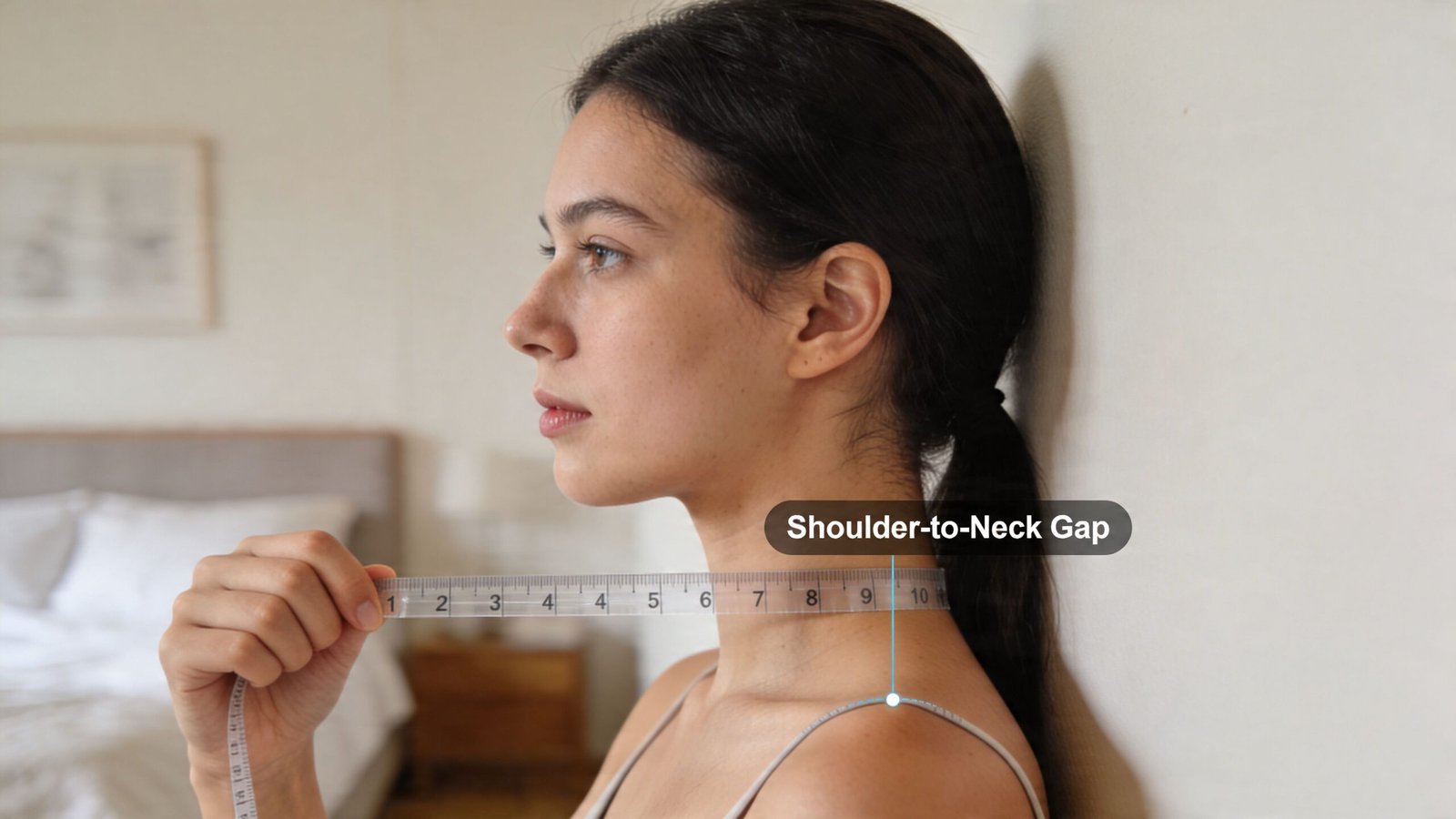
Use a wall and a tape measure. You are estimating the space between the outside of your shoulder and the point where your head needs support to stay level.
Here is the simple version:
- Stand naturally against a wall: Keep your shoulders relaxed and your head level.
- Locate the support zone: Find the outer edge of your shoulder and the side of your neck where the pillow will carry your head.
- Measure the distance: Record that gap as your starting point.
- Adjust for real life: A mattress changes the final number because your shoulder will sink into it to some degree.
It is not a perfect prescription. It is a much better starting point than buying whatever contour pillow has the best reviews.
Match the pillow to your body and your mattress
A broad-shouldered side sleeper on a firm mattress usually needs more loft than a narrower sleeper on a softer bed. Softer mattresses let the shoulder drop farther, so the pillow can be lower. Firmer mattresses hold the shoulder up, so the pillow has to fill more space.
That is why one sleeper says a pillow is supportive and another says it cranks the neck sideways. They are often describing the same pillow on different bodies and different beds.
Use these rules:
- Firm mattress: Start with the taller side of a dual-height pillow.
- Soft mattress: Start with the lower side.
- Side and back combination sleeper: Choose a contour with two usable heights instead of one steep ridge.
- Wide shoulders: Skip low-profile cervical pillows unless the brand clearly builds them for smaller frames.
A practical heat note matters here. If your loft is too low, your head tilts down and you tend to bunch a hand or arm under the pillow. That blocks airflow and adds heat. If the loft is too high, more of your cheek and jaw get pinned into the cover. Same result. Correct height helps posture and usually feels less stuffy over the course of the night.
Use dual-height designs the smart way
Dual-height cervical pillows are easier to fit because they give you two real options without making you buy twice. Brands like Therapeutica build that idea into the shape, with different neck support heights intended to match different body sizes and sleep positions (ergonomic contour and sizing details).
Test each side for several full nights. Ten minutes before bed tells you almost nothing. The useful signals show up the next morning in your neck, shoulder, jaw, and how often you woke up hot.
Your bed setup matters too. If you sleep hot, the pillow cannot do all the temperature control by itself. Breathable bedding helps the neck pillow do its job without turning the whole sleep surface humid. A set of cooling sheets for hot sleepers can reduce the clammy feeling that gets blamed on the pillow.
Here’s a quick visual on measuring and matching pillow height before you buy.
Signs your fit is wrong
Even a well-made cervical pillow can miss for your frame. Watch what happens after a full night, not just while you are reading in bed.
| Symptom in the morning | Likely fit issue |
|---|---|
| Neck bends downward | Pillow too low or too soft |
| Neck feels pushed upward | Pillow too high or too rigid |
| Ear and shoulder pressure | Side contour too aggressive or surface too firm |
| Constant repositioning | Shape mismatch or unstable loft |
The right fit usually feels uneventful after a few nights. Your head stays level. Your shoulder is not fighting for space. You are not flipping the pillow around at 3 a.m. trying to find a cooler spot that should not have disappeared in the first place.
Your First 30 Nights A Trial Period Guide
A cervical pillow can be the right pillow and still feel weird at first. That’s normal. If you’ve spent years sleeping on flat, collapsing pillows, your neck muscles may have adapted to bad support. When you switch to a contour that properly holds your head in place, your body notices.
Research on pillow ergonomics shows that cylindrical or contoured pillows lead to significantly lower neck muscle activation for side sleepers than rectangular pillows, and users often need at least two weeks to adapt to that more supportive position (pillow ergonomics and adaptation period).
What to check on night one
Don’t judge the pillow only by “comfort” in the first half hour. Judge it by how your body responds the next morning.
Focus on three things:
- Heat buildup: Did the pillow feel stuffy around your face and neck?
- Pressure points: Did your ear, jaw, or shoulder get sore?
- Alignment response: Did you wake up less stiff, more stiff, or just different?
“Different” is common early on. “Sharp pain” is not.
What to check after one week
By the end of the first week, you should have a clearer signal. Minor adjustment is acceptable. Escalating discomfort is not. If the pillow still feels too high, too low, or too warm every night, that probably isn’t adaptation. That’s a mismatch.
I always tell people to keep notes for a few mornings. Nothing elaborate. Just a simple score in your phone for neck stiffness, shoulder pressure, and overheating. Patterns show up faster when you stop relying on fuzzy half-awake memory.
Don’t let a return window expire because you kept hoping the pillow would “break in” while your neck kept voting no.
The night 21 reality check
By around the third week, a good cervical pillow should start to feel natural. You shouldn’t need to scrunch it, fold it, or rotate to the edge for support. If you’re still doing those things, return it if you can.
This is also a good time to evaluate the rest of your sleep setup. A supportive pillow can’t fully compensate for heat-trapping bedding. If your sheets hold sweat and warmth, that can make even a good pillow feel hotter than it is. For that part of the setup, best sheets for hot sleepers can help you clean up the rest of the bed.
Care matters more in humid climates
A pillow that sleeps acceptably cool when clean can get funky fast in a sweaty room if you ignore maintenance.
Keep it simple:
- Wash the removable cover regularly: Follow the care label.
- Air out the foam core: Especially after humid nights.
- Use a breathable protector only if needed: Thick waterproof covers often trap heat.
- Check for foam softening or sagging: Once the contour loses integrity, support usually goes with it.
A trial period is a test drive, not a commitment ceremony. If a pillow is cooking your face or cranking your neck into a bad angle, send it back.
The Hot Side Sleeper's Buying Checklist
Shopping gets easier when you stop asking whether a pillow is “good” and start asking whether it fits your body, climate, and sleep habits. For a hot sleeper in a humid place, that means screening for support and cooling at the same time.
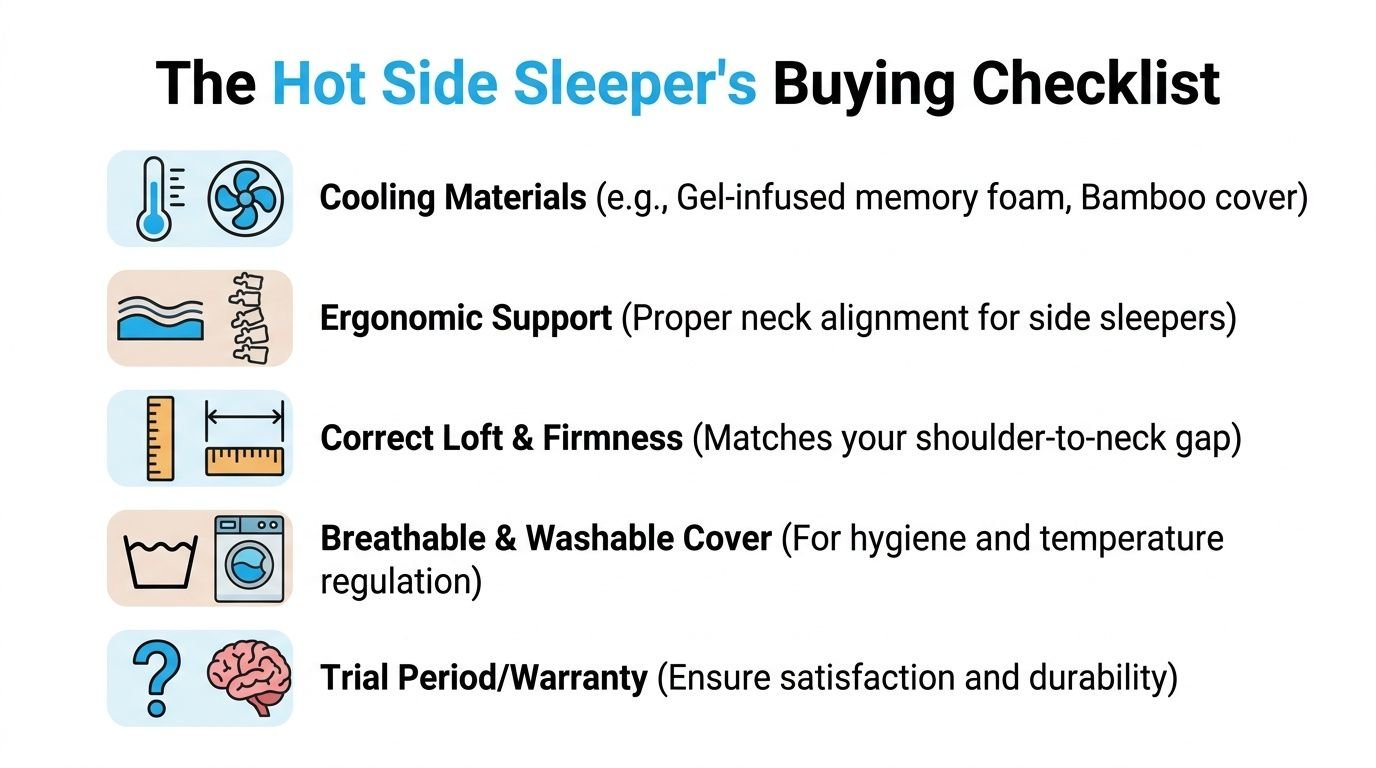
Keep this checklist open when you shop.
The shortlist test
- Measure first: Know your shoulder-to-neck gap before you buy anything.
- Look for side-sleeper loft: The pillow should be built with enough height to fill that gap, not just labeled “supportive.”
- Choose a real contour: Raised side support and a neck cradle beat a generic rectangle for most side sleepers.
- Check the core material: Gel-infused memory foam and perforated latex are usually better bets than dense, plain foam if you sleep hot.
- Read the cover details: Breathable, removable, washable covers matter in humid climates.
- Avoid mystery specs: If the brand won’t tell you height, materials, or construction, move on.
Red flags that save you money
These aren’t automatic deal-breakers, but they should make you cautious:
| Red flag | Why it matters |
|---|---|
| “Cooling” with no material explanation | Often just a surface-fabric gimmick |
| No loft listed | Hard to match the pillow to your body |
| Ultra-plush side-sleeper marketing | Support may collapse overnight |
| Non-removable cover | Tougher to manage sweat and hygiene |
| One-shape-fits-all claims | Side sleepers vary too much for that |
Buy the pillow that fits your measurements and climate, not the one with the prettiest product render.
Final shopping filter
If you want one extra check before clicking buy, compare your shortlist against a dedicated cooling pillow guide for hot sleepers. It’s a quick way to separate breathable designs from pillows that only feel cool in ads.
The best cervical pillow for side sleepers won’t be the softest or the flashiest. It’ll be the one that keeps your neck quiet, your shoulder unjammed, and your face from overheating at 2 a.m.
Frequently Asked Questions
How long does it really take to get used to a cervical pillow
Usually a few nights to a couple of weeks. If the pillow shape is correct but unfamiliar, your neck may need time to relax into better support. If pain keeps getting worse instead of settling down, that’s usually a fit issue, not an adjustment issue.
Can I use a regular pillowcase on a contoured cervical pillow
Sometimes, but it depends on the cut and stretch of the fabric. A tight standard pillowcase can flatten contours, pull the edges inward, and reduce airflow. A stretchy or properly sized case works better. If the pillow comes with a shaped cover, keep that on and use only a compatible outer case if the brand allows it.
Are expensive cervical pillows actually worth it
Sometimes yes, sometimes absolutely not. The money is worth it when you’re paying for better contour design, stable loft, quality foam or latex, and a breathable washable cover. It isn’t worth it when the price comes from branding and vague “cooling tech” language. I’d rather buy a plainly designed pillow with honest specs than an expensive one with a fancy name and no dimensions listed.
What if I switch between side sleeping and back sleeping
Look for a dual-height or dual-purpose contour. Those designs are easier to live with if you change positions during the night. A very aggressive side-sleeper contour can feel great on your side and awkward on your back, so hybrid sleepers usually do better with moderate contouring instead of extreme shape.
Will a cervical pillow fix my neck pain by itself
Not always. It can remove one major cause of nighttime strain, but it can’t cancel out a bad mattress, heat-trapping bedding, or daytime posture habits. Think of it as one important piece of the sleep setup, not a miracle object.
If you’re tired of wasting money on “cooling” sleep products that don’t stay cool in actual humidity, CoolRestGuide is built for exactly that problem. It’s a no-BS resource for hot sleepers who need bedding and pillows that work in practical conditions, especially in places like Florida where warm, sweaty nights don’t care about marketing claims.
