


You wake up on your back because that’s how your body feels best. Then the pillow ruins it. Your neck feels pinched, the pillowcase is damp, and flipping to the cool side buys you maybe two minutes before the heat builds again.
That combination is brutal in Florida. A lot of pillows can handle one problem. They either support your neck and sleep hot, or feel airy for an hour and collapse by morning. If you’re trying to solve both support and overheating, generic pillow roundups usually waste your time.
The best pillows for back sleepers who overheat need to do two jobs at once. They have to keep your head and neck in a neutral position, and they have to stop acting like a heat trap. That sounds simple. In practice, it rules out a huge chunk of the market.
Stop Tossing and Turning from Heat and Pain
The most common failure pattern looks like this. You buy a pillow that feels great when you first lie down. It’s plush, cool to the touch, and inviting. Then around the middle of the night your head sinks deeper, your neck starts working to hold itself steady, and the surface turns warm and clammy.
That isn’t just your imagination. A 2025 National Sleep Foundation study found that 68% of back sleepers in warm climates report nighttime overheating disrupting sleep, according to Sit 'n Sleep's write-up on back sleeper pillows. That tracks with what hot sleepers deal with every summer in the Southeast.
In humid climates, the problem gets worse because sweat doesn’t evaporate fast. Your pillow becomes part support system, part heat reservoir. If the fill hugs too tightly or the cover holds moisture, your body keeps fighting the bed instead of settling into sleep. If you’re trying to understand why that happens night after night, this guide on body temperature when sleeping is useful context.
I’ve learned to distrust the phrase “cooling pillow” on its own. Some pillows feel cool for the first few minutes and then store heat. Others breathe well but don’t give a back sleeper enough structure to prevent morning stiffness. The right pick sits in the overlap.
The true test isn't whether a pillow feels cool at bedtime. It's whether it still feels supportive and breathable at 3 a.m.
That’s the filter throughout this guide. Not hype. Not showroom softness. Just what works for back sleepers who run hot and are tired of choosing between neck relief and temperature control.
Spine Alignment for Back Sleepers What You Must Know
Back sleeping works best when your pillow acts like a support pillar under the curve of your neck. If that pillar is too tall, your head tips forward. If it’s too short, your head falls back and the neck loses support. Either way, the muscles around the cervical spine stay busy when they should be resting.
Sleep experts widely recognize back sleeping as the healthiest sleep position because it helps maintain neutral alignment of the head, neck, and spine. They also emphasize that medium-firm pillows strike the right balance of cushioning and support, and Saatva notes that Brooklinen Marlow testers reported its adjustable memory foam and fiber blend gave them the sinkage and support needed to prevent neck strain in this position, as described in Saatva’s guide to pillows for back sleepers.

Think of your neck like a bridge
A bridge needs support in the right place. Not somewhere close. Not something soft that shifts under load. Your neck is similar.
The natural curve in your cervical spine needs a pillow that fills the space between your head and the mattress without forcing your chin toward your chest. That’s why back sleepers usually do best with a pillow that feels balanced rather than dramatic.
What usually works:
- Steady loft: Enough height to fill the gap under the neck.
- Controlled give: Your head should settle in a bit, not sink through.
- Shape retention: The pillow should still support you after hours under pressure.
What usually fails:
- Overstuffed pillows: These push the head too far forward.
- Flat, tired pillows: These let the neck drop out of alignment.
- Ultra-soft fills: These can feel luxurious at first and useless later.
Comfort and alignment are not the same thing
A pillow can feel comfortable for ten minutes and still be wrong for your body. That’s one of the biggest mistakes back sleepers make.
A back sleeper doesn’t need a towering pillow. They also don’t need something pancake-thin. They need a pillow that keeps the neck supported without lifting the head into a strained angle. Medium-firm designs usually do that better than very soft ones because they resist overnight collapse.
Practical rule: If your chin feels pushed down toward your chest when you’re lying on your back, the pillow is too tall or too soft in the wrong way.
Signs your pillow is the problem
A bad pillow fit shows up fast. Usually within a few nights.
Look for these clues:
- Morning neck stiffness: Your neck muscles spent the night compensating.
- Headaches after waking: Forward head posture during sleep can trigger tension.
- Heat plus restlessness: You keep shifting because you’re warm and unsupported.
- Flattened center by morning: The fill isn’t holding the shape your neck needs.
For hot sleepers, poor alignment creates a second problem. Once you start tossing to escape pressure or heat, you generate more friction, more trapped warmth, and more interrupted sleep. Support and cooling aren’t separate issues. They affect each other all night.
Pillow Materials A Guide to Cooling and Support
Material choice matters more than brand slogans. For hot back sleepers, the fill determines whether a pillow holds your neck in place, dumps heat, or turns into a warm sponge by midnight.
The target for most back sleepers is a medium-loft pillow in the 4 to 6 inch range, and Mattress Clarity reports that testing on the Saatva Latex Pillow found its shredded Talalay latex core reduced peak pressure points by 25% compared to synthetic foam while its open-cell structure dissipated heat 15-20% faster than memory foam, with thermal conductivity of about 0.13 W/mK versus 0.16 W/mK for memory foam. That combination is why latex gets so much attention from hot sleepers in Mattress Clarity’s back sleeper pillow testing.
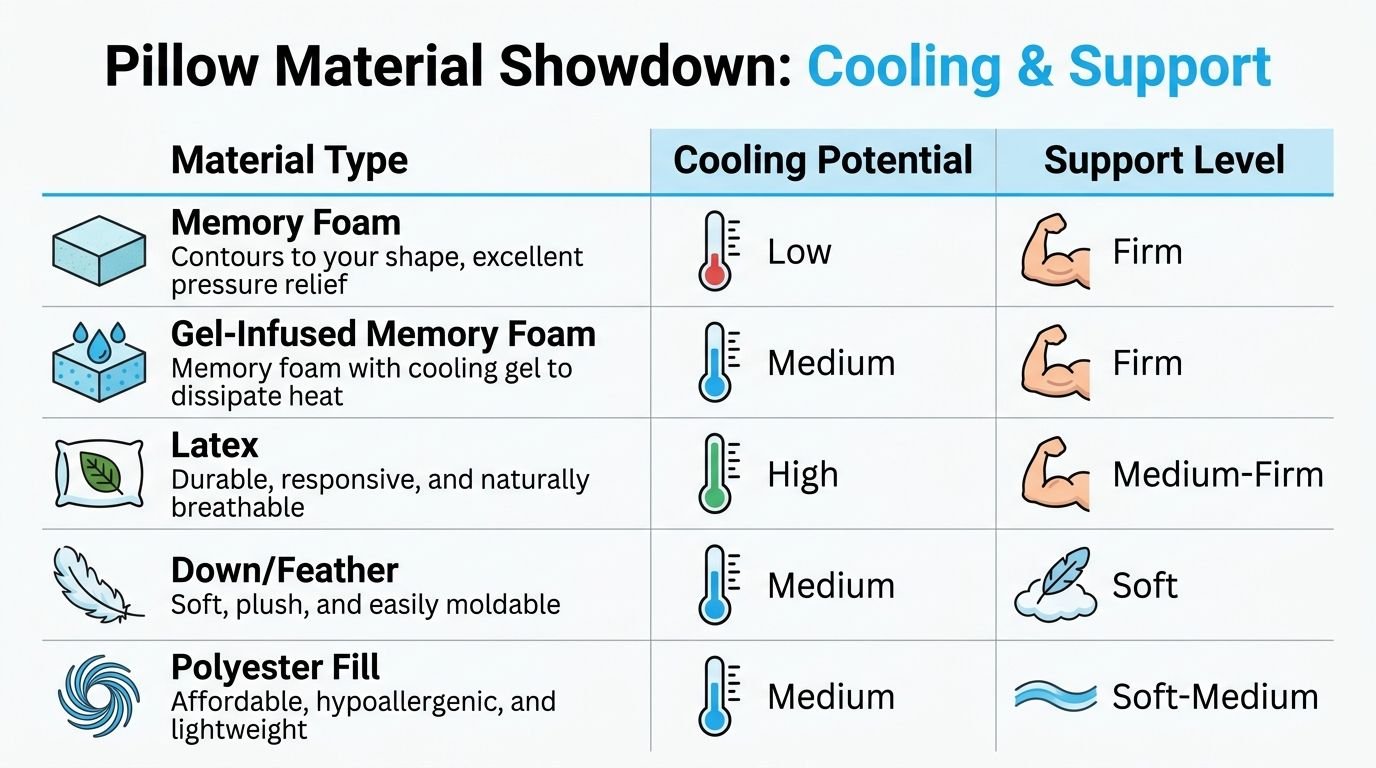
Latex is the cleanest answer for many hot back sleepers
If you sleep hot and stay mostly on your back, latex is the material I’d look at first.
It doesn’t hug the head the way dense memory foam does. Instead, it feels buoyant. Your head stays supported on top of the pillow more than inside it. That matters for airflow. It also matters for neck support because the material rebounds instead of compressing into a crater.
For this specific sleep profile, latex gets a lot right:
- It breathes better: Open-cell construction helps release heat instead of storing it.
- It supports without trapping: The surface has spring, not deep melt.
- It holds shape well: That’s useful if you wake up sore on pillows that compact overnight.
The trade-off is feel. If you love the slow, deep contour of classic memory foam, latex can seem more lifted and less cocooning.
Traditional memory foam supports well but often sleeps too warm
Memory foam is popular for a reason. It contours closely, spreads pressure, and can feel excellent under the neck at first. For back sleepers with neck tension, that contour can be helpful.
The problem for hot sleepers is obvious after a few hours. Dense foam tends to hold heat. It can also soften as it warms, which changes the support profile during the night. If you’re already prone to night sweats, that’s a rough combo.
Memory foam can still work if:
- The pillow uses shredded fill instead of a solid slab
- The cover is breathable
- You don’t run extremely hot
- You prioritize contouring more than maximum airflow
If you know you sleep sweaty, I’d treat solid memory foam with caution.
Gel-infused foam is better than plain foam, but not a miracle
Gel-infused memory foam sits in the middle. It’s usually an improvement over standard foam, especially in the first part of the night. But gel doesn’t automatically turn a heat-retentive material into a breathable one.
That distinction matters. Some gel pillows feel cool to the hand and then level off quickly once body heat builds. They can still be worth considering if you need firmer contouring and want more cooling than basic memory foam offers. Just don’t assume “gel” means the pillow solves humidity and sweat.
If you also want to cool the rest of the bed, pairing your pillow with breathable bedding matters a lot. A good set of best sheets for hot sleepers often makes the difference between a decent cooling pillow and a full setup that works.
Shredded fills and adjustable designs give you more control
For back sleepers, adjustability is a major advantage. Shredded foam and latex fills let you fine-tune loft and firmness in a way fixed pillows can’t.
That helps with two common issues:
- Your pillow starts out too full and pushes your head forward.
- Your pillow feels good under the head but leaves the neck unsupported.
Adjustable fill lets you remove enough material to stop over-elevation while keeping structure where you need it. It’s one of the most practical ways to dial in support without gambling on a one-piece core.
Down and basic polyester are usually the wrong tool
Down, feather, and low-cost polyester can feel cool at first because they’re airy. For a hot back sleeper, that sounds promising until the pillow compresses flat.
That’s the catch. Soft fills often lose the support battle long before they lose the temperature battle. You may get initial fluff and airflow, but not the stable neck support that back sleeping demands. If you wake up with your head lower than where it started, the pillow isn’t doing its job.
Quick material verdict
| Material | Cooling for hot sleepers | Support for back sleepers | My take |
|---|---|---|---|
| Latex | Strong | Strong | Best balance for many people |
| Shredded latex or adjustable hybrid | Strong | Strong | Best for fine-tuning fit |
| Gel-infused memory foam | Moderate | Strong | Good compromise, not the coolest |
| Traditional memory foam | Weak to moderate | Strong | Supportive, often too warm |
| Down or feather | Moderate at first | Weak | Usually too collapsible |
| Polyester fill | Moderate at first | Weak to moderate | Budget option, rarely a long-term fix |
Top Cooling Pillows for Back Sleepers in 2026
Not every pillow below is “the best” in the same way. Some are best if you need adjustability. Some are best if cooling is your top complaint. Others work because they land in the middle and avoid major mistakes.
These are the picks I’d narrow down first if you’re searching for the best pillows for back sleepers and you also overheat.
2026 Top Picks at a Glance
| Pillow Name | Primary Material | Cooling Tech | Best For |
|---|---|---|---|
| Brooklinen Marlow Pillow | Adjustable memory foam and fiber blend | Adjustable airflow through zippered construction | Back sleepers who want easy loft tuning |
| Saatva Cloud Memory Foam Pillow | Memory foam | Thick profile with contouring pressure relief | Back sleepers who want pressure relief first |
| Saatva Latex Pillow | Shredded Talalay latex | Naturally breathable open-cell latex | Hot sleepers who want bounce and airflow |
Brooklinen Marlow Pillow
This is one of the better answers for people who know they need support but aren’t sure exactly how much loft feels right. The big appeal isn’t hype. It’s adjustability that’s simple enough to use.
The pillow uses an adjustable memory foam and fiber blend. Saatva’s summary of testing notes that back sleeper testers found the blend gave them optimal sinkage and support to prevent neck strain when configured properly, which is exactly what a lot of back sleepers need from a pillow with some flexibility.
Why it made this list:
- It’s easier to tune than many adjustable pillows
- The feel lands between plush and structured
- It gives uncertain buyers room to correct a bad first setup
What works:
For back sleepers who’ve been burned by pillows that are too lofty or too flat, this style makes sense. You can nudge the feel without turning your bedroom into a fill-removal project. That’s valuable if your body is picky.
What doesn’t:
If you sleep very hot and are highly sensitive to foam heat retention, this may still run warmer than latex-based options. The adjustability helps fit. It doesn’t automatically make foam airy.
Best for:
Back sleepers who want one pillow they can tweak until their neck stops complaining.
Saatva Cloud Memory Foam Pillow
This one is worth considering if pressure relief matters as much as cooling. Sleep Foundation rated the Saatva Cloud Memory Foam Pillow highly for back sleepers, praising its thick profile and medium feel for contouring closely to relieve aches, pains, and pressure points along the neck.
That score matters because it reflects what memory foam can do well when executed properly. It cushions pressure and supports the neck in a very body-conforming way. For some back sleepers, that’s the difference between waking up relaxed and waking up irritated.
Where it shines:
- Close contouring for sore necks
- A substantial, supportive feel
- Good fit for people who like pressure relief over bounce
Where I’d hesitate:
If you battle night sweats hard, thick memory foam can still be a gamble even when the pillow is otherwise excellent. Support may be there. Airflow may still lag behind latex or more breathable hybrids. In cooler homes, that’s manageable. In humid bedrooms, it can be the tipping point.
Best for:
Back sleepers who want a cushiony, contouring feel and don’t need the absolute coolest material category.
If your main complaint is pressure at the base of the skull or along the neck, a quality memory foam pillow can help. If your main complaint is trapped heat, look harder at latex.
Saatva Latex Pillow
For the back sleeper who overheats first and worries about support second, this is the most balanced option of the group.
The reason is straightforward. Latex gives you support without the slow-sinking warmth of dense foam. In testing covered earlier, the shredded Talalay latex core showed real advantages in both pressure relief and heat dissipation. That’s the profile many hot sleepers are looking for, even if they initially think they want memory foam.
What stands out in real use:
- Buoyant support that doesn’t swallow your head
- Better airflow than traditional foam
- A medium-firm feel that suits back sleeping well
What to expect:
This pillow won’t feel like a marshmallow. It feels springier and more lifted. Some people love that immediately. Others need a few nights to stop expecting deep contouring. Once you adjust, it can be a major upgrade if heat has been ruining your sleep.
Best for:
Hot back sleepers in humid climates who need support and airflow in the same pillow.
How to choose for your needs
If I had to reduce the decision to three buyer types, it would look like this:
- Choose Brooklinen Marlow Pillow if your biggest problem is not knowing your ideal loft and firmness yet.
- Choose Saatva Cloud Memory Foam Pillow if neck pressure relief is your priority and overheating is only moderate.
- Choose Saatva Latex Pillow if you run hot, hate heat buildup, and still need real support for back sleeping.
A few blunt buying notes
Not every premium pillow is worth it. The useful question is whether the pillow solves your specific failure pattern.
Ask yourself:
- Do you wake up hot first, or sore first?
- Do you like buoyant support or close contouring?
- Do you need adjustability because your past picks missed the mark?
A cooling cover alone won’t rescue a bad core. A perfectly supportive core won’t help much if it turns into a warm brick under your head. The best pillows for back sleepers who overheat work because the fill, loft, and temperature behavior all line up.
Unpacking Advanced Cooling Pillow Technology
Cooling language gets sloppy fast. Brands throw around words like gel, PCM, copper, breathable, and thermo-regulating as if they all mean the same thing. They don’t.
The first distinction to understand is passive cooling versus active cooling. Passive cooling means the pillow’s structure naturally allows heat and moisture to move away. Latex is the classic example. Active cooling means an added feature is trying to absorb, transfer, or moderate heat at the surface.
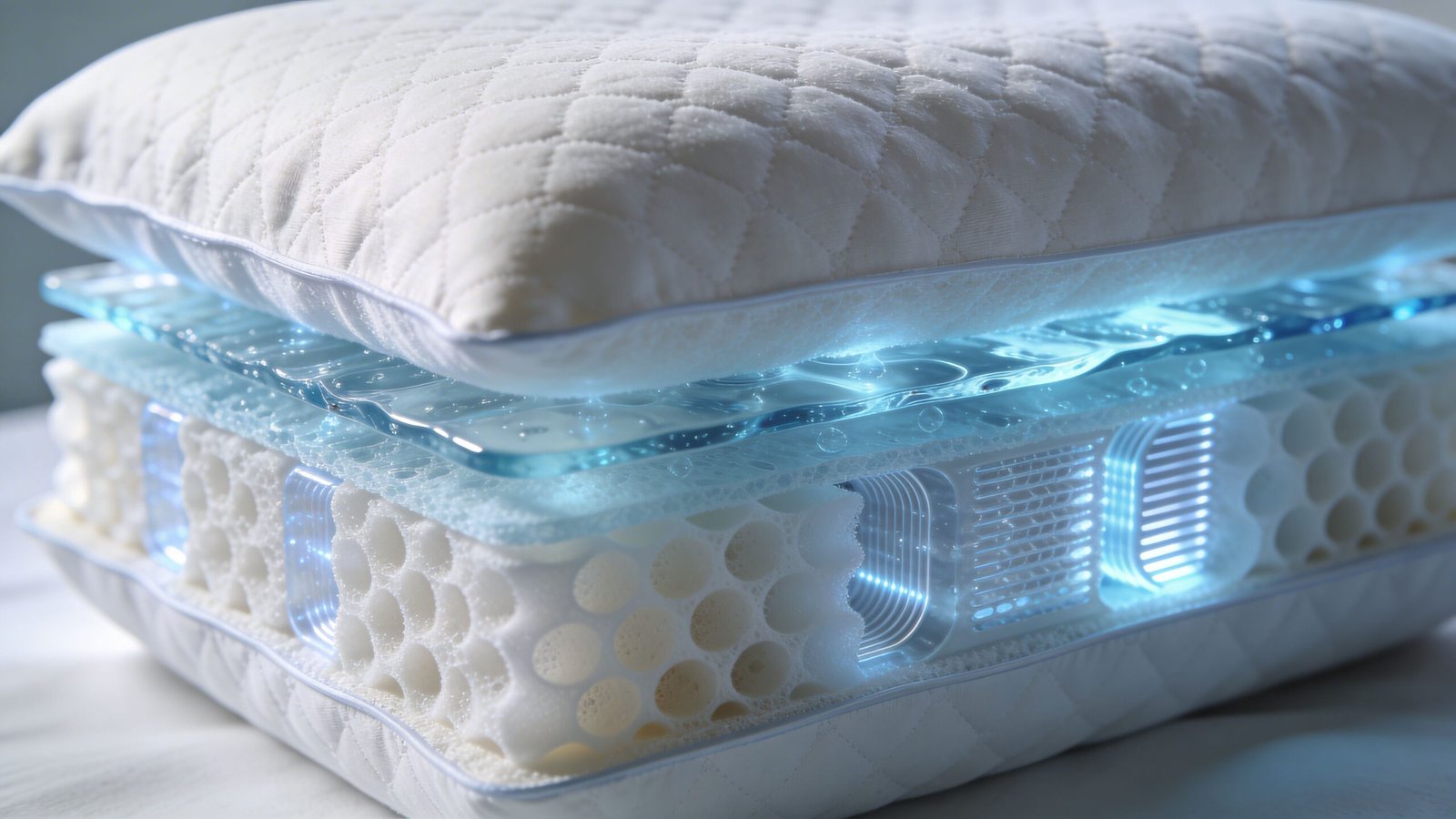
What gel does
Gel-infused foam usually aims to spread heat more effectively than plain foam. That can help reduce the swampy, heat-locked feeling some memory foam pillows create.
What gel usually does well:
- Improves the initial temperature feel
- Helps move heat away from the hottest contact point
- Makes foam more tolerable for mild hot sleepers
What it often doesn’t do:
- Turn dense foam into a highly breathable material
- Prevent all overnight heat buildup in humid rooms
So if a pillow’s entire cooling story is “it has gel,” I treat that as a modest plus, not a final answer.
Phase-change material is more interesting
Phase-change material, often shortened to PCM, is designed to absorb heat when your skin temperature rises and release it as things cool down. The simplest way to think about it is thermal buffering. It helps smooth out temperature spikes.
That can be useful for people who fall asleep cool and then wake up hot. The caveat is that PCM usually works best as part of a broader cooling design. A good cover with PCM can improve the surface feel. It still can’t fully compensate for a heat-retentive core underneath.
Cooling tech works best when the pillow already has a breathable structure. Add-on features are helpers, not saviors.
Copper, specialty fibers, and cool-touch covers
Copper infusions, slick knit covers, and cool-touch fabrics all live in the same general category. They affect the pillow’s immediate hand feel and surface temperature behavior.
Some are worthwhile. Some are mostly marketing garnish.
I pay attention to these only after the basics check out:
- Does the core support a back sleeper properly?
- Does the fill avoid obvious heat trapping?
- Does the cover help moisture and airflow instead of fighting them?
If the answer to the first two is no, the fancy cover won’t matter much.
How to read cooling claims like a skeptic
When evaluating a pillow, look past the label and ask what kind of cooling you’re getting.
| Cooling feature | What it usually means | Best use case |
|---|---|---|
| Open-cell latex | Passive airflow and less heat retention | Hot sleepers who want dependable cooling |
| Gel infusion | Some heat dispersion | Moderate hot sleepers who like foam |
| PCM cover | Surface temperature moderation | People who overheat in waves |
| Breathable cover | Better moisture release | Useful on almost any pillow |
| Copper or mineral infusions | Mostly supplemental surface effect | Nice extra, not core reason to buy |
A lot of people overpay for visible cooling features and ignore the pillow’s actual structure. For back sleepers, that’s backwards. Start with support and airflow. Then use cooling tech as a bonus layer, not the foundation.
Your Personal Pillow Playbook How to Choose and Maintain
Buying the right pillow gets easier once you stop chasing “luxury” and start matching the build to your body, mattress, and heat level.
For back sleepers, adjustable pillows deserve serious attention. NCOA’s 2026 research across 20+ pillows found that adjustable models scored 15-20% higher in spinal alignment metrics for back sleepers, and their guidance says petite users can aim for a 3-inch loft while larger frames may need a firmer 5-inch variant. That data comes from NCOA’s review of the best pillows for back sleepers, and it lines up with what I’d recommend in practice.

Start with your body, not the brand
Your build changes what “correct” feels like. A smaller frame often needs less pillow height. A broader or heavier build often needs more structure so the pillow doesn’t flatten out too far.
Use this checklist:
- Petite frame: Start lower. Too much loft is usually the first mistake.
- Larger frame: Look for firmer support and a taller setup.
- Soft mattress: You may need slightly less pillow because your body sinks more.
- Firm mattress: You may need a bit more loft because the mattress gives less.
Adjustable pillows are useful because they let you test instead of guess.
Decide how hot you really sleep
Not all hot sleepers are the same. Some just dislike warm surfaces. Others wake up sweating through the pillowcase.
That difference changes what you should buy:
- Mild overheating: Gel-infused foam or a breathable hybrid may be enough.
- Frequent night sweats: Prioritize latex, shredded fills, and moisture-friendly covers.
- Humidity-sensitive sleepers: Focus on airflow first, then add cooling features second.
If you’re struggling beyond the pillow alone, this broader guide on how to stay cool at night helps tie the whole sleep setup together.
Maintain the pillow so it keeps working
A cooling pillow can lose a lot of its value if you care for it badly.
Basic rules matter:
- Wash the cover as directed: Sweat, oil, and buildup reduce breathability.
- Don’t machine-wash solid foam cores: That can damage structure and drying is difficult.
- Fluff shredded fills regularly: This helps restore loft and airflow.
- Replace when support is gone: If the pillow stays compressed or your neck pain returns, it’s time.
Here’s a useful visual explainer before you buy or adjust one:
A pillow that used to work can become the problem. If your setup hasn't changed but your sleep has, check the pillow first.
My strongest recommendation
If you’re unsure, buy an adjustable pillow or a latex pillow before buying another generic plush “cooling” pillow. Adjustable models give you room to correct the loft. Latex gives you the best shot at real airflow with reliable support. Both are smarter bets than gambling on surface-cool marketing.
Frequently Asked Questions from Hot Back Sleepers
Are expensive cooling pillows really worth it
Sometimes. Not automatically.
A pricier pillow is worth it if the money goes into better materials, useful adjustability, or a breathable design. It isn’t worth it if the whole pitch is a cool-touch cover wrapped around a heat-trapping core. For hot back sleepers, structure and airflow matter more than luxury language.
I’m a combination sleeper who ends up on my back. Do these recommendations still apply
Usually, yes. If you spend a meaningful part of the night on your back, you still need enough support to keep your neck neutral in that position.
The key is flexibility. Adjustable shredded-fill pillows tend to work better for combination sleepers because you can fine-tune the loft and still get some give when you roll.
My partner runs cold and I run hot. What kind of pillow works for both of us
Separate pillows. Shared mattress compromise is common. Shared pillow compromise is usually a mistake.
Pillows are personal. A hot back sleeper may need breathable latex or a cooling hybrid, while a cold sleeper may prefer something denser and less airy. You don’t need matching pillows to have a compatible bed.
Can a cooling pillow fix snoring too
Sometimes it can help indirectly, but it shouldn’t be treated as a guaranteed snoring solution.
If a pillow improves your head and neck position, keeps your airway more open, and prevents awkward chin tuck, it may reduce one contributor to noisy breathing. But if snoring is frequent or severe, the pillow is only part of the conversation.
What usually works best for sweaty back sleepers on a budget
Look for the simplest version of the right design. Breathable fill, medium loft, decent shape retention, washable cover. Fancy tech is optional. Support and airflow are not.
A reasonably built latex or adjustable pillow often beats a flashy budget “cooling” pillow that relies on surface feel alone.
How long should I give a new pillow before deciding
Give it several nights unless the fit is clearly wrong right away.
Some materials, especially latex or firmer adjustable builds, can feel different from what you’re used to. But if your neck feels strained, your head is pushed forward, or you’re overheating worse than before, trust that signal early.
If you’re tired of wasting money on “cooling” pillows that don’t stay cool or don’t support your neck, CoolRestGuide is built for exactly that problem. We focus on honest, real-world advice for hot sleepers in warm, humid climates, with practical reviews on pillows, sheets, toppers, and other cooling sleep gear that helps you stay asleep.
