

You flip to your other side because the spot under your shoulder feels warm. Ten minutes later, your hip feels like it’s parked on a heating pad. You kick off the blanket, cool down for a minute, then get chilly and pull it back on. By morning, your sheets feel damp, your neck is tight, and the part that really stings is this: you were tired enough to sleep, but your bed would not let you stay asleep.
That pattern is especially brutal for side sleepers. You need enough cushioning to take pressure off your shoulder and hip, but the softer materials that feel good at first can also hold onto body heat. A mattress can feel plush in the showroom or on night one, then turn into a sweaty crater at 2 a.m. That is why finding the best cooling mattress for side sleepers is not about buying the coldest-sounding marketing term. It is about finding the right mix of contouring, airflow, and support so your joints stop aching and your body stops overheating.
I take this category seriously because the usual advice is often too vague. “Get gel foam.” “Buy breathable sheets.” “Sleep cooler.” That is not enough if you are waking up sweaty with a numb shoulder. A true cooling mattress for side sleepers has to do two jobs at once. It has to reduce pressure where side sleepers usually feel jammed up, and it has to release heat instead of trapping it under your torso.
The good news is that some mattress builds do this much better than others. Hybrid designs with coils and better airflow tend to beat thick, dense all-foam beds for hot sleepers. Some covers feel cool at first touch but fade fast. Others keep working because the whole mattress is built for ventilation. That distinction matters.
Below, I break down the 5 best cooling mattresses for side sleepers in 2026, with a close look at what helps, where the trade-offs are, and which type of side sleeper cooling mattress makes the most sense for your body and heat level.
The Nightly Battle Every Hot Side Sleeper Knows Too Well
If you sleep on your side and run hot, the problem rarely shows up all at once. It builds.
Your shoulder sinks in a little. Your hip sinks in a little more. The foam around those pressure points starts to hold warmth. Then you start rotating like a rotisserie just to find a cooler patch of bed. By the time the alarm goes off, your lower back feels off, your shoulder feels pinched, and you are already annoyed before coffee.
Why side sleepers get stuck with a bad trade-off
Side sleeping is often the most comfortable position for pressure relief, but only when the mattress gets the balance right. Too firm, and your shoulder and hip take the hit. Too soft, and you sink too much, which can trap more heat around your body.
That is why so many people bounce between two disappointing options:
- A firmer bed that sleeps cooler but leaves the shoulder sore
- A softer bed that feels better on joints but turns into a heat trap overnight
The search for the best cooling mattresses for side sleepers usually starts after months of trying to fix the wrong layer. People swap pillows, change sheets, lower the thermostat, add a fan, or buy a topper. Sometimes that helps. Often the core problem is still underneath you.
Heat and pressure build in the same places
For side sleepers, the shoulder and hip are the two biggest pressure zones. They are also two of the biggest hot spots. When those areas press into a mattress, you lose some airflow and gain a lot of contact heat.
A mattress that works for this position needs to let those joints settle in without swallowing them. That is the sweet spot. A good pressure relief cooling mattress gives you enough contouring to avoid pain, but not so much that you feel smothered by the bed.
A side sleeper does not need the plushest mattress. They need the mattress that cushions pressure points without letting heat collect around them.
Why the wrong mattress feels worse at night than in the morning
A lot of hot sleepers describe the same thing. The mattress feels okay when they first lie down. The problem starts later, once body heat has had time to build. That delayed discomfort is one reason online reviews for a cooling memory foam mattress for side sleepers can be all over the place. Initial comfort and all-night temperature control are not the same thing.
The mattresses below were chosen with that in mind. The goal is not a quick cool-touch gimmick. The goal is a bed that still feels breathable after you have been in one position long enough to really test it.
What Makes a Great Cooling Mattress for Side Sleepers
A great cooling mattress for a side sleeper has to do two jobs at the same time. It needs enough pressure relief for the shoulder and hip to sink in, and enough airflow or heat management to keep those same areas from turning into hot spots after a few hours.
That combination is harder to get right than mattress marketing makes it sound.
Hybrid builds usually give side sleepers the best balance
In my testing, hybrids solve this problem more consistently than thick all-foam beds. The reason is straightforward. Side sleepers usually need a comfort layer soft enough to cushion sharp pressure points, but dense foams hold more heat once your body has been in one spot for a while. A coil unit underneath creates room for air to move and usually makes the mattress easier to reposition on.
The best versions are not just foam plus springs. The layer mix matters. Softer foam or latex near the surface handles pressure relief. Transitional foam keeps the shoulder from dropping too abruptly. Zoned coils add pushback under the waist and midsection, which helps side sleepers keep a straighter line from neck to hips instead of bowing into the bed.
Body type matters here too. Lighter side sleepers often do well on a plusher surface because they do not compress the comfort layers as much. Heavier side sleepers usually need thicker comfort layers paired with stronger support underneath, or they can bottom out into the firmer parts of the mattress and start trapping more heat around the hips.
Cooling tech that changes the feel of the bed
A lot of cooling claims are surface-level. Some covers feel cold to the touch for a minute, then the bed sleeps warm because the deeper materials still hold heat.
I pay more attention to the full stack of materials:
- Phase-change covers or infusions help buffer the first wave of body heat, which matters if you overheat early in the night.
- Open-cell memory foam usually releases heat better than older dense foams, while still giving the slow contour many side sleepers want.
- Latex or latex-like comfort layers tend to sleep less stuffy than memory foam and can be a better fit for side sleepers who want pressure relief without a deep hug.
- Pocketed coils do more than add support. They create internal airflow and usually reduce the swampy feel common in all-foam beds.
- Zoned construction helps cooling indirectly by keeping heavier parts of the body from sinking too far into the mattress, which reduces heat-trapping contact.
This is why material combinations matter more than buzzwords. Gel foam alone does not tell you much. Gel foam over dense support foam can still sleep warm. A breathable cover over responsive foam and coils usually performs better over the full night, especially for side sleepers who stay in one position for long stretches.
Pressure relief still decides whether the mattress works
Cooling features do not rescue a mattress that creates shoulder pain.
For side sleepers, the mattress has to let the shoulder sink enough to avoid numbness, let the hips settle enough to avoid a jammed lower back, and still support the waist so the spine does not sag. That balance changes based on build and sleeping weight. A mattress that feels plush and cool for a 140-pound sleeper may feel shallow and warmer to someone over 220 pounds because they engage more of the deeper foam.
Sleep temperature is also personal. People who are trying to sort out whether they run hot because of bedding, the room, or their own sleep physiology can get useful context from this guide on how body temperature changes when sleeping.
What usually does not work
Some disappointing patterns show up again and again.
| What tends to fail | Why it fails for hot side sleepers |
|---|---|
| Thick, dense all-foam builds | Good pressure relief at first, but they often hold heat around the shoulders and hips |
| Very firm “cooling” beds | Airflow may be better, but pressure builds faster at the joints |
| Plush tops with weak support underneath | The body sinks too far, which can trap heat and throw off alignment |
| Cool-touch covers alone | The surface feels nice briefly, but the core materials decide overnight temperature |
Shop for a mattress that manages heat after three or four hours, not one that only feels cool in the first five minutes.
5 Best Cooling Mattresses for Side Sleepers
You fall asleep on your side feeling fine, then wake up at 3 a.m. with a hot shoulder, a damp neck, and a hip that has been bearing too much load for hours. That is the problem these picks are meant to solve.
I prioritized beds that do two jobs at once. They need enough give at the shoulder and hip for side sleeping, and they need a construction that keeps heat from collecting around the parts of the body pressed deepest into the mattress. If you want a broader primer on materials and cooling performance, this guide to a cooling mattress adds useful background before you choose.
A quick video overview can help if you want to compare mattress types before reading the reviews.
Nectar Premier Hybrid
Best for side sleepers who want plush pressure relief without the heat buildup common in thick foam beds
The Nectar Premier Hybrid gets the basics right for hot side sleepers. It has enough surface cushioning to take the edge off the shoulder and hip, but the support core is coils rather than a dense foam block. That matters after a few hours, when trapped heat usually becomes obvious.
Its material mix is the main reason it earns a spot here. Phase-change foam can pull some heat away from the surface at first contact, while the coil layer leaves space for air to move through the center of the bed. For side sleepers, that combo usually works better than gel foam by itself because the body is sinking into the comfort layers at the pressure points, not just lying on top of them.
It is a strong fit for average-weight sleepers who want a medium feel with some plushness. Heavier side sleepers may still like it, but they should expect to engage more of the deeper layers and get a slightly firmer, warmer experience than a lighter sleeper would.
Why it stands out
- Cushions the shoulder and hip without the stuck-in-foam feel
- Hybrid support core improves airflow better than many all-foam builds
- Good choice for sleepers who want softness on top but still need easier movement
Pros and Cons
| Pros | Cons |
|---|---|
| Plush pressure relief with better airflow than dense foam | Too buoyant for sleepers who want a deep memory-foam hug |
| Cooling materials work at both the surface and core | Premium hybrid pricing can run high |
| Easy to reposition on compared with softer all-foam beds | Edge support may not satisfy every shopper |
Amazon reviewer feedback, paraphrased
- One reviewer said the shoulder felt cushioned, but the mattress did not create the sweaty pocket they got from an older foam bed.
- Another said they stopped waking up to readjust their hips and flip the pillow.
CTA: Check current price and availability on Amazon
Leesa Sapira Chill Hybrid
Best for side sleepers with sore shoulders who also sleep hot
The Leesa Sapira Chill Hybrid is one of the better examples of layered cooling done correctly. Instead of relying on a single “cooling” feature, it uses a cooler-touch cover, contouring foam, and pocketed coils with enough responsiveness to keep the body from sinking too far.
That construction matters for side sleepers with sharper pressure sensitivity. A mattress can feel cool at first touch and still fail if the shoulder bottoms out into firmer support or if the hip sinks so deep that heat gets trapped around it. The Leesa avoids that better than many plush hybrids because it balances contouring with pushback underneath.
I would steer this one toward side sleepers who want noticeable pressure relief but do not want the slow, enveloping feel of traditional memory foam. It has more contour than a classic innerspring, but it stays easier to move on than many foam-heavy models.
Why it stands out
- Strong shoulder and hip pressure relief for many average-weight side sleepers
- Multi-layer cooling approach works better than basic gel foam claims
- Zoned support helps keep the waist and midsection from sagging
Pros and Cons
| Pros | Cons |
|---|---|
| Excellent balance of contouring and airflow | Some sleepers will want a softer, plusher top feel |
| Cooler overnight feel than many foam-forward beds | Edge support is good, not class-leading |
| Responsive enough for easier position changes | Couples highly sensitive to movement may want more motion damping |
Amazon reviewer feedback, paraphrased
- One reviewer said it stayed cooler through the night instead of just feeling cool at bedtime.
- Another said their shoulder numbness improved, but they still felt supported rather than swallowed.
CTA: Check current price and availability on Amazon
Helix Midnight Luxe
Best for average-weight side sleepers who want balanced contouring with less heat retention than standard memory foam
The Helix Midnight Luxe suits a very common need. Many side sleepers want the pressure relief memory foam can provide, but they do not want the heavy, heat-holding cradle that often comes with it.
Its design handles that trade-off well. The comfort system gives enough conformity for the shoulder to settle in, then the transitional layers and zoned coils keep the torso from dropping too far. That reduced sink matters for cooling because less body enclosure usually means less warmth collecting around the ribcage, hips, and upper legs.
This is a sensible choice for sleepers in the middle weight ranges who want a true medium feel. Lighter sleepers may prefer something softer. Heavier sleepers who want deep pressure relief may need thicker comfort layers than this style typically provides.
Why it stands out
- Medium feel works for many side sleepers without excessive sink
- Zoned support helps with alignment while still allowing shoulder give
- Better airflow than a typical all-foam memory-foam bed
Pros and Cons
| Pros | Cons |
|---|---|
| Good pressure relief without a trapped feel | Not plush enough for every side sleeper |
| Easier movement than many soft foam beds | Some memory-foam feel is still present |
| Hybrid construction reduces heat buildup better than dense foam | Heavier sleepers may want more cushioning depth |
Amazon reviewer feedback, paraphrased
- One reviewer said it eased hip pressure without making them feel stuck.
- Another said they noticed less heat buildup under the torso after switching from foam.
CTA: Check current price and availability on Amazon
Saatva Classic
Best for side sleepers who prefer a lifted, breathable feel over deep contouring
The Saatva Classic works for a specific type of hot side sleeper. It is for the person who sleeps warmer whenever too much material wraps around the body and who would rather have a cushioned top over a more open, spring-driven support system.
That design has a real trade-off. Better airflow and easier movement usually come at the cost of deeper pressure relief. Some side sleepers love that because they feel freer and cooler. Others, especially those with pronounced shoulder or hip pressure, may decide they need more conforming comfort than this style usually delivers.
For the right sleeper, the upside is obvious by morning. A more elevated feel can reduce that baked-in sensation that develops when the shoulder and torso sit deep in foam for hours.
Why it stands out
- Very breathable construction compared with many foam-heavy beds
- Easy to change positions on during the night
- Good fit for side sleepers who dislike the hugged feeling of memory foam
Pros and Cons
| Pros | Cons |
|---|---|
| Sleeps airier than many contour-heavy hybrids | Does not cradle pressure points as much as softer hybrids |
| Responsive surface helps with repositioning | Motion isolation is less muted than on foam-forward beds |
| Classic mattress feel with some cushioning on top | Highly pressure-sensitive side sleepers may want more softness |
Amazon reviewer feedback, paraphrased
- One reviewer said it slept much cooler than their previous foam bed and still felt gentler on the hips than a standard firm innerspring.
- Another liked being able to switch sides without fighting a body impression.
CTA: Check current price and availability on Amazon
Casper Snow
Best for lighter side sleepers who want a softer surface and cooler foam performance
The Casper Snow makes the most sense for lighter bodies and sleepers who know they need a plusher top to get enough shoulder compression. That group often struggles on firmer hybrids because they do not sink in far enough to relieve pressure, even if the bed has good airflow.
A softer foam design can solve the pressure issue, but only if the materials manage heat better than standard memory foam. That is the key distinction here. The goal is not just softness. It is softness with enough heat dissipation to avoid the swampy feel that ruins many plush beds.
I would not put this at the top of the list for heavier side sleepers. They are more likely to sink through the comfort layers, sleep warmer, and want more support under the hips. For lighter sleepers who want contouring without a springy surface, it is a much better match.
Why it stands out
- Softer comfort layers can better relieve pressure for lighter side sleepers
- Cooling-focused foams work better than traditional plush foam setups
- Good option for sleepers who want contour without a lot of bounce
Pros and Cons
| Pros | Cons |
|---|---|
| Plush comfort for sensitive shoulders and hips | Heavier side sleepers may need more support |
| Cooler than many traditional foam mattresses | Foam-forward feel will not suit sleepers who want bounce |
| Good for sleepers who dislike firm pushback | Deep contouring is not for everyone |
Amazon reviewer feedback, paraphrased
- One reviewer said it cushioned the shoulder well without turning warm and stuffy overnight.
- Another said it worked better for their lighter build than firmer beds that created pressure pain.
CTA: Check current price and availability on Amazon
Cooling Mattress Comparison Table
Some readers want the short version before diving deeper. If you are comparing the best cooling mattresses for side sleepers, this table gives you a quick read on feel, cooling approach, and who each mattress suits best.
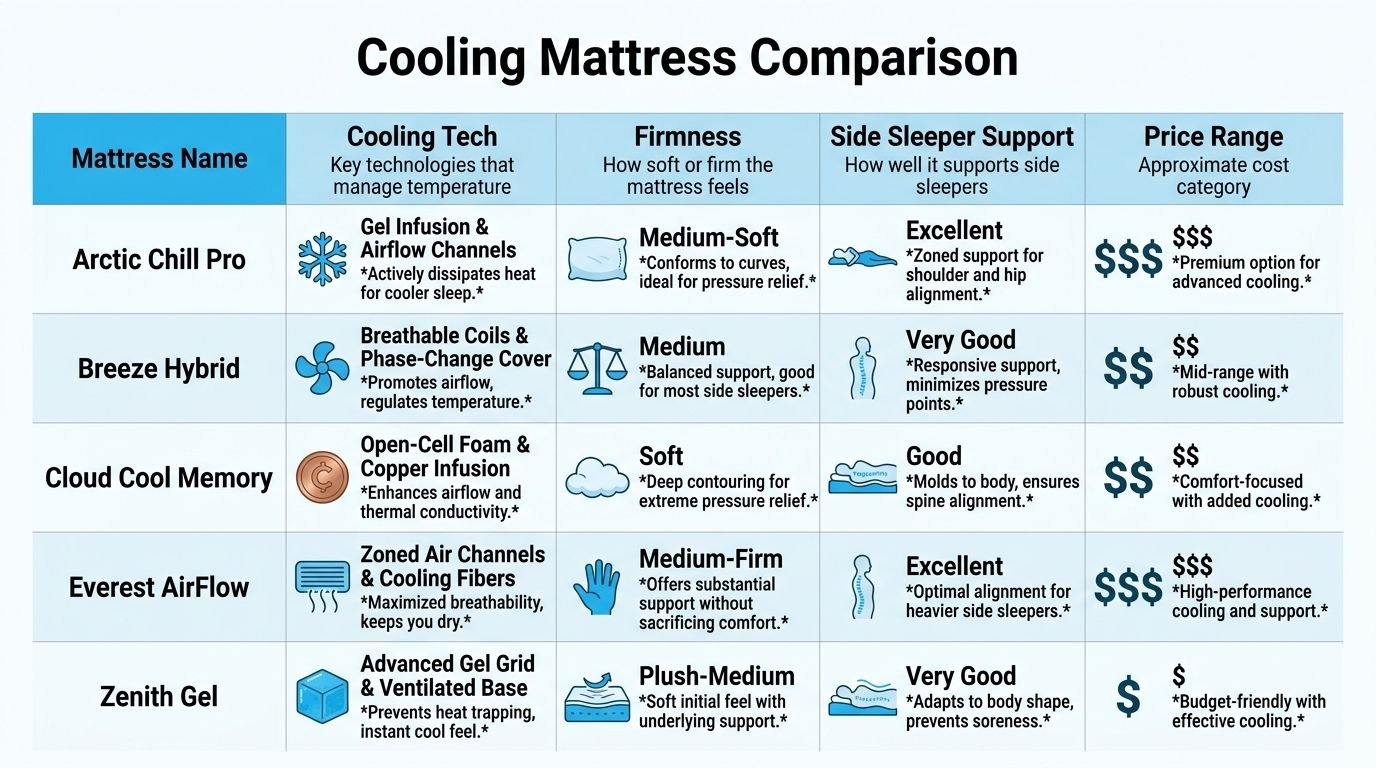
| Product Name | Cooling Technology | Firmness | Price Range | Best For |
|---|---|---|---|---|
| Nectar Premier Hybrid | Phase-change foam and breathable coils | Medium | $$$ | Hot side sleepers wanting plush support |
| Leesa Sapira Chill Hybrid | Cooling-fiber cover, gel-infused foam, pocketed coils | Medium | $$$ | Pressure relief plus strong cooling |
| Helix Midnight Luxe | Gel-infused memory foam and zoned pocketed coils | Medium | $$$ | Average-weight side sleepers |
| Saatva Classic | Quilted breathable surface and airflow-focused coil design | Medium to medium-firm feel | $$$ | Sleepers who want a lifted, breathable feel |
| Casper Snow | Cooling-focused foams with plush contouring | Plush to medium-plush feel | $$$ | Lighter side sleepers who prefer softer comfort |
A quick takeaway. A good cooling mattress for many people is usually a hybrid, but the right choice still depends on how much contouring you like and whether you prefer a buoyant or more hugging feel.
How to Choose Your Perfect Cooling Mattress
The easiest way to waste money here is to shop by buzzwords. “Cooling.” “Arctic.” “Ice.” “Snow.” Those names tell you almost nothing. A good best cooling mattress for side sleepers purchase starts with your body, your sleep position, and the kind of heat problem you have.
Start with your pressure points
If your shoulder goes numb or your hip aches, start by prioritizing contouring. Side sleepers usually need enough surface give to cushion those joints.
A mattress that is too firm can sleep cool and still be miserable.
Look for:
- Plush-to-medium comfort at the top for shoulder and hip relief
- Transitional support underneath so you do not sink too far
- Zoned support if available to keep the waist and hips aligned
If your current bed feels cool enough but leaves you sore, your problem is not just temperature. You need a better pressure relief cooling mattress.
Match the material to your heat level
Not all hot sleepers overheat the same way. Some feel warm only at first contact. Others build heat gradually through the night. That difference changes what kind of cooling mattress for side sleepers makes sense.
If you sleep mildly warm, a well-built hybrid with gel foam may be enough.
If you wake up sweaty, look harder at mattresses with phase-change materials, cooling covers, or more breathable coil systems.
If you love foam, do not assume every foam bed is off-limits. A good cooling memory foam mattress for side sleepers can work, but it needs design help from ventilated foams, less dense comfort layers, or a more breathable support core.
If you hate feeling stuck, skip deep, slow foam and lean toward a hybrid or responsive innerspring-hybrid mix.
Be honest about the feel you like
People often buy the wrong mattress because they shop for what sounds right instead of what feels right.
Use this quick cheat sheet:
| Your preference | Better match |
|---|---|
| You want a hugging feel | Foam-forward hybrid or cooling foam design |
| You want to sleep more on top of the bed | Hybrid or breathable innerspring |
| You shift positions often | Responsive hybrid |
| You stay on one side all night | Pressure-relieving hybrid with stronger cooling features |
If you already like your mattress but just need more surface relief and cooling, a topper can be the better fix. This guide to the best cooling mattress topper for side sleepers is worth a look before replacing the whole bed.
Watch the common trade-offs
Every mattress solves one problem by giving up a little in another area.
- Softer mattresses often relieve pressure better, but they can sleep warmer.
- More responsive beds are easier to move on, but may contour less at the shoulder.
- Foam-heavy designs can isolate motion well, but may hold more heat.
- Breathable coil-heavy designs often sleep cooler, but may feel less cuddly.
This is why the best cooling mattresses for side sleepers usually sit in the middle. Enough plushness to cushion pressure points. Enough airflow and support to stop the mattress from turning into a heat pocket.
Do not ignore the rest of your setup
A mattress can only do so much if everything around it traps heat.
Before blaming the bed alone, check:
- Sheets that feel slick or dense and hold warmth
- Mattress protectors that block airflow
- Pillows that push your neck out of alignment and make you toss more
- Room humidity that makes any warm surface feel worse
The goal is a full sleep surface that works together. The right best cool mattress for side sleepers performs much better when the bedding on top of it is also breathable.
Our Research and Expertise
Hot side sleepers usually need more than a mattress that feels cool for the first 10 minutes. They need a surface that keeps the shoulder and hip from jamming into the bed while also preventing that heat-trap feeling that shows up after a few hours. That combination is harder to get right than standard “cooling mattress” marketing suggests.
Our picks come from comparing three things together: construction details, hands-on test results, and recurring complaints from real sleepers. We paid close attention to how different builds handle side-sleeping pressure. A quilted Euro top over coils behaves differently from dense memory foam with a phase-change cover. Both can feel cool at first touch, but they do not manage body heat or pressure in the same way once weight settles in.
That matters because side sleepers load the mattress unevenly. More body weight concentrates at the shoulders and hips, which increases sinkage and can create warmer pockets around those contact points. Softer foams may cushion that pressure well, but they can also hold more heat if the comfort system is too dense. Coil support cores, ventilated latex, and phase-change covers tend to work better for sleepers who run hot and still need enough give at the surface.
We also weighed body type heavily in our evaluations. Lighter side sleepers often do best on plusher comfort layers that let the shoulder sink enough for alignment. Heavier side sleepers usually need stronger support underneath that softness, or the added sink can reduce airflow and make the bed feel warmer through the night.
The result is a shortlist built around practical performance, not cooling buzzwords. If a mattress had impressive cooling materials but missed on pressure relief, it did not make the cut. If it relieved pressure beautifully but slept warm after sustained contact, it also fell short.
Frequently Asked Questions
Do cooling mattresses really work for side sleepers
Yes, but only if the mattress also handles pressure relief. A mattress can feel cooler and still be wrong for side sleeping if it is too firm at the shoulder and hip. The best cooling mattress for side sleepers solves both problems together.
Is a hybrid usually better than foam for a side sleeper cooling mattress
For many hot sleepers, yes. Hybrids often give you a better balance of contouring and airflow. Foam can still work, but a foam bed has to be built carefully to avoid trapping heat.
What firmness is best for side sleepers who sleep hot
Most side sleepers do best somewhere around soft-to-medium or medium, depending on body type and how much pressure relief they need. Too firm often creates shoulder pain. Too soft can increase sinkage and heat buildup.
Can a cooling gel memory foam mattress for side sleepers still sleep hot
Yes. Gel helps, but gel alone is not a guarantee. If the rest of the mattress is dense and poorly ventilated, it can still trap heat. That is why a cooling gel memory foam mattress for side sleepers works best when paired with airflow-friendly layers or a hybrid core.
How is a cooling memory foam mattress for side sleepers different from a hybrid
A cooling memory foam mattress for side sleepers usually leans more into contour and motion isolation. A hybrid usually adds more bounce, easier movement, and better airflow through its coil layer. If you hate feeling stuck, hybrid is usually the safer bet.
Can a cooling mattress help with night sweats
It can help reduce heat buildup at the sleep surface, which may make night sweats easier to manage. It is not a medical treatment, but many hot sleepers find that better airflow and less heat retention make the night more tolerable.
Are cooling mattresses good for shoulder and hip pain
They can be, if they also provide enough pressure relief. A true pressure relief cooling mattress should cushion your shoulder and hip while keeping your spine in a healthier position.
Do I need cooling sheets with a cooling mattress
You do not need them, but breathable sheets can help the mattress do its job. Heavy or slick synthetic bedding can cancel out some of the benefit of a side sleeper cooling mattress.
Should couples choose the same type of cooling mattress
Usually, yes, but the choice depends on shared priorities. If one person sleeps much hotter and the other is sensitive to motion, a hybrid with balanced cooling and decent motion control is often the best compromise.
Is a topper enough, or should I replace the whole mattress
If your mattress still supports you well and the issue is mostly surface heat or mild pressure discomfort, a topper may help. If the mattress already sags, traps heat, or leaves your shoulder and hip sore every morning, replacing it is usually the smarter move.
If you are tired of waking up hot, sore, and frustrated, CoolRestGuide helps you cut through the hype and find cooling sleep products that make nights easier.
