

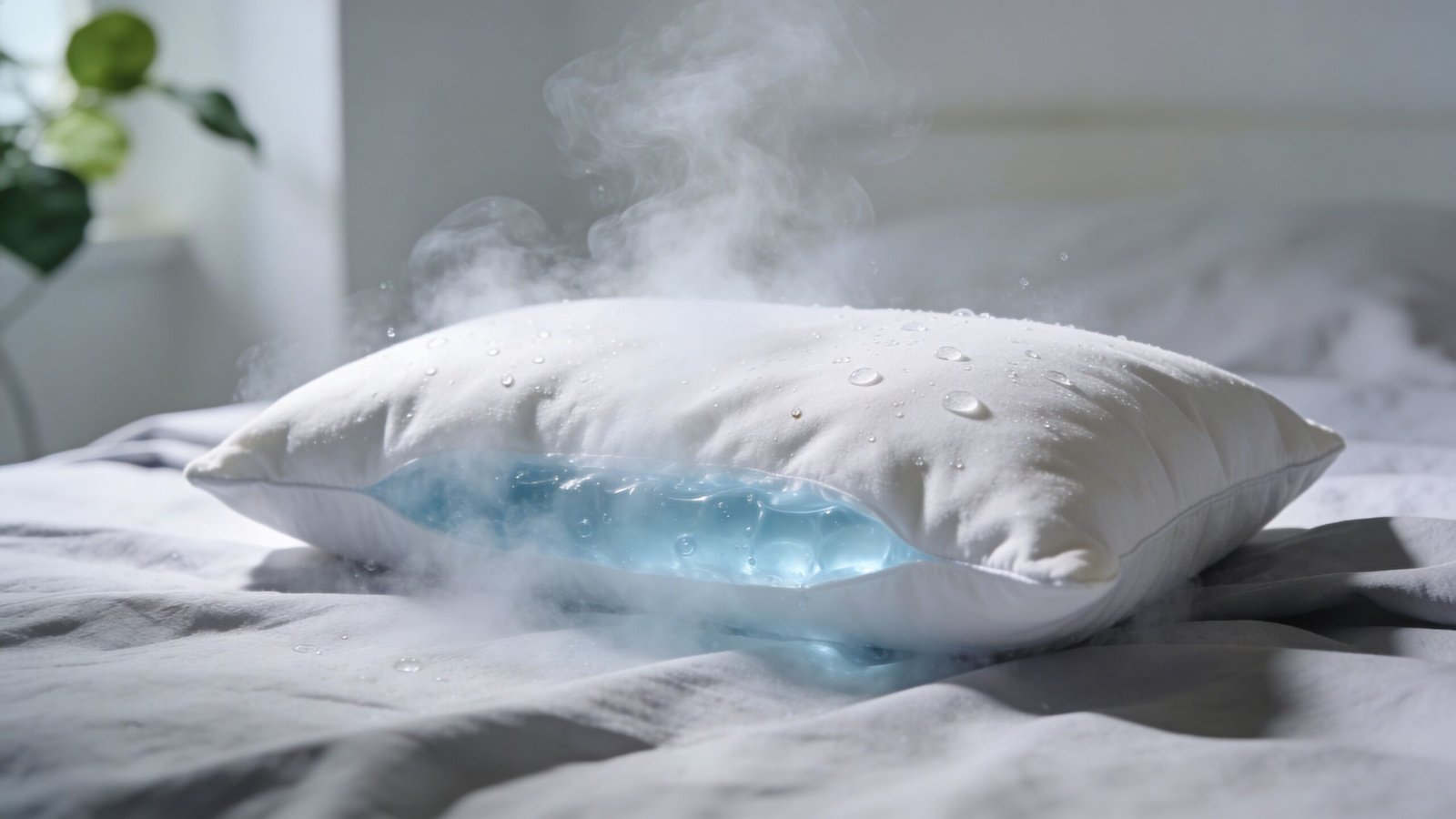
You wake up at 2:13 a.m., flip the pillow to the “cool side,” and get maybe five minutes of relief before it turns damp, warm, and weirdly sticky again. The AC is on. The ceiling fan is running. You already bought a pillow that promised “ice cooling gel” on the box. And yet your head still feels like it’s sleeping on a sponge that’s been left in a sauna.
That’s the problem with most cooling pillow advice. It treats heat like the only enemy. In Florida and across the Southeast, humidity is the second enemy, and a lot of “cooling” pillows lose the fight there.
One source that calls this out says existing reviews mostly sort pillows by sleep position and ignore humid-climate performance, even though a 2025 sleep study found 68% of humid-climate sleepers report pillow sogginess as a primary issue, reducing sleep quality by 25%. It also notes major reviewers don’t test in more than 80% relative humidity environments, which is exactly where a lot of hot sleepers need answers most (humid-climate cooling pillow gap analysis).
That’s why the usual “best for side sleepers” list often misses the mark. A pillow can feel cool when you first touch it and still fail by midnight because it holds sweat, traps moisture, and stops breathing once your body heat builds up.
If you’re trying to solve overheating for real, you need to think beyond “cool to the touch.” You need a pillow that manages heat, airflow, and moisture together. You also need to look at your whole sleep setup, including how body temperature changes during sleep, because your pillow isn’t working in isolation.
Introduction Why Most Cooling Pillows Fail Hot Sleepers
Most cooling pillows fail because they’re built to win the first impression, not the whole night.
A slick cover with a chilly feel in the store is easy to market. Long-term temperature regulation is much harder. The cheap trick is a surface that feels cold for a moment. The better design keeps moving heat and moisture away after you’ve been on it for hours.
Cool touch isn’t the same as staying cool
A lot of brands know shoppers judge a pillow in the first ten seconds. So they build around that moment. You touch it, it feels crisp, and you assume it’ll stay that way until morning.
That’s where people get burned. In a humid room, your head and neck don’t just produce heat. They produce moisture, and moisture changes everything. Once a pillow starts holding dampness, even a decent cooling layer can get overwhelmed.
Practical rule: If a pillow’s main selling point is the initial chill of a gel panel, I get suspicious fast.
In dry climates, a pillow can get away with basic breathability. In humid climates, it can’t. That “soggy pillow” feeling isn’t in your head. It’s what happens when fabric, fill, and foam don’t move moisture out fast enough.
Marketing loves simple labels
“Cooling gel.” “Ice fiber.” “Arctic fabric.” Most of those phrases tell you almost nothing.
What matters is the mechanism. Does the pillow pull heat away through contact? Does air move through it? Does the material react as your temperature changes? Does the cover wick moisture instead of just sitting there glossy and cold?
Here’s my blunt take. If you’re shopping for cooling pillows best suited for real hot sleepers, stop chasing labels and start looking at design. The pillow has to stay breathable after your cheek has been pressed into it for hours, not just feel nice when it comes out of the package.
The humid-climate filter changes the whole ranking
A side sleeper in a dry mountain climate might love a pillow that would be miserable in coastal Florida. Same loft. Same support. Different outcome, because humidity punishes weak moisture management.
That’s why I don’t trust generic “best cooling pillow” roundups that never mention dampness, sweat buildup, or sticky covers. For hot sleepers with night sweats, the true test isn’t whether the pillow starts cool. It’s whether it still feels usable at 4 a.m.
Decoding Cooling Pillow Technologies
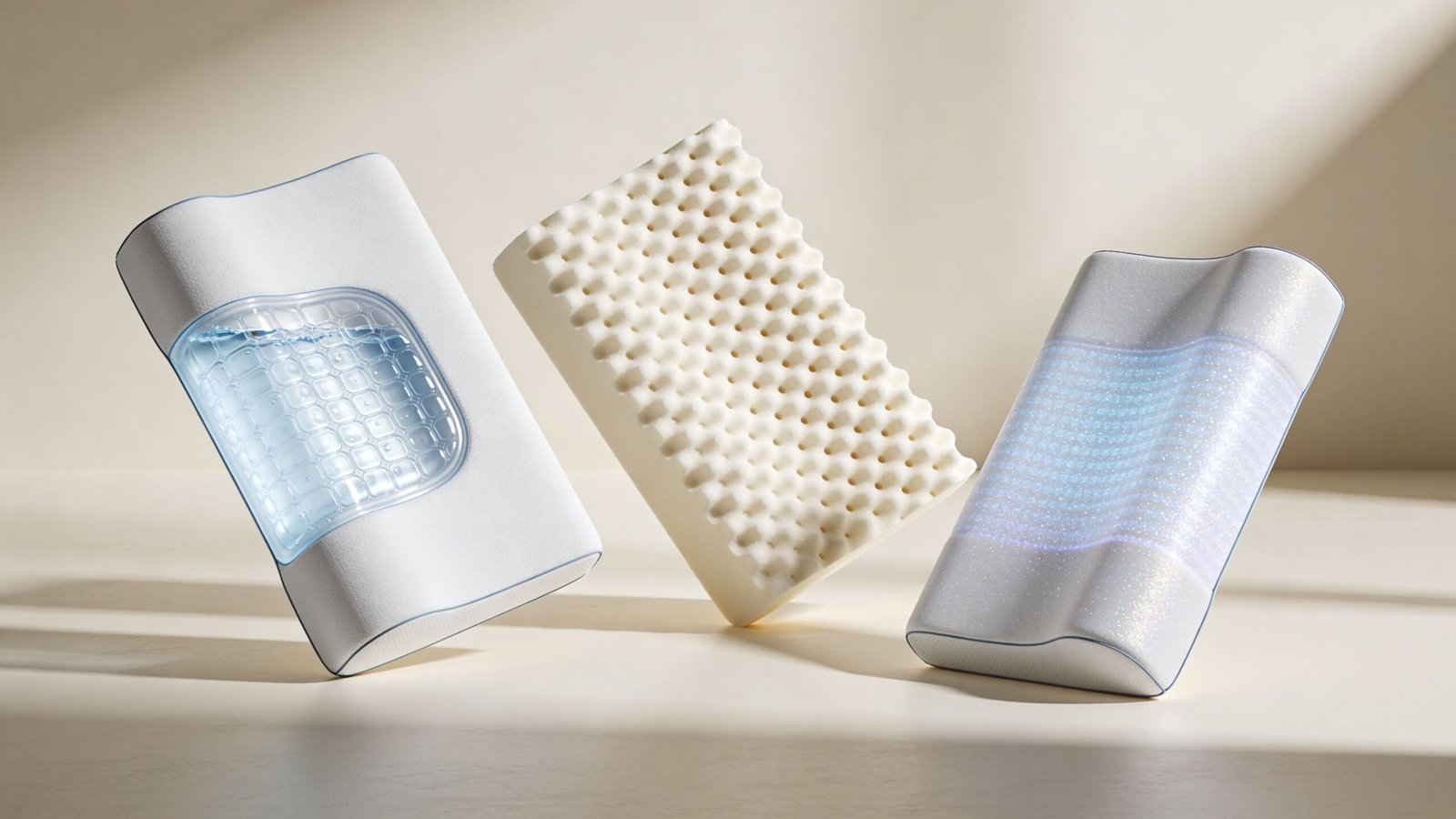
A cooling pillow is basically a heat sink for your head. It either pulls heat away, lets air carry heat away, or uses materials that react to temperature changes and smooth out the spikes. The best pillows usually combine more than one approach.
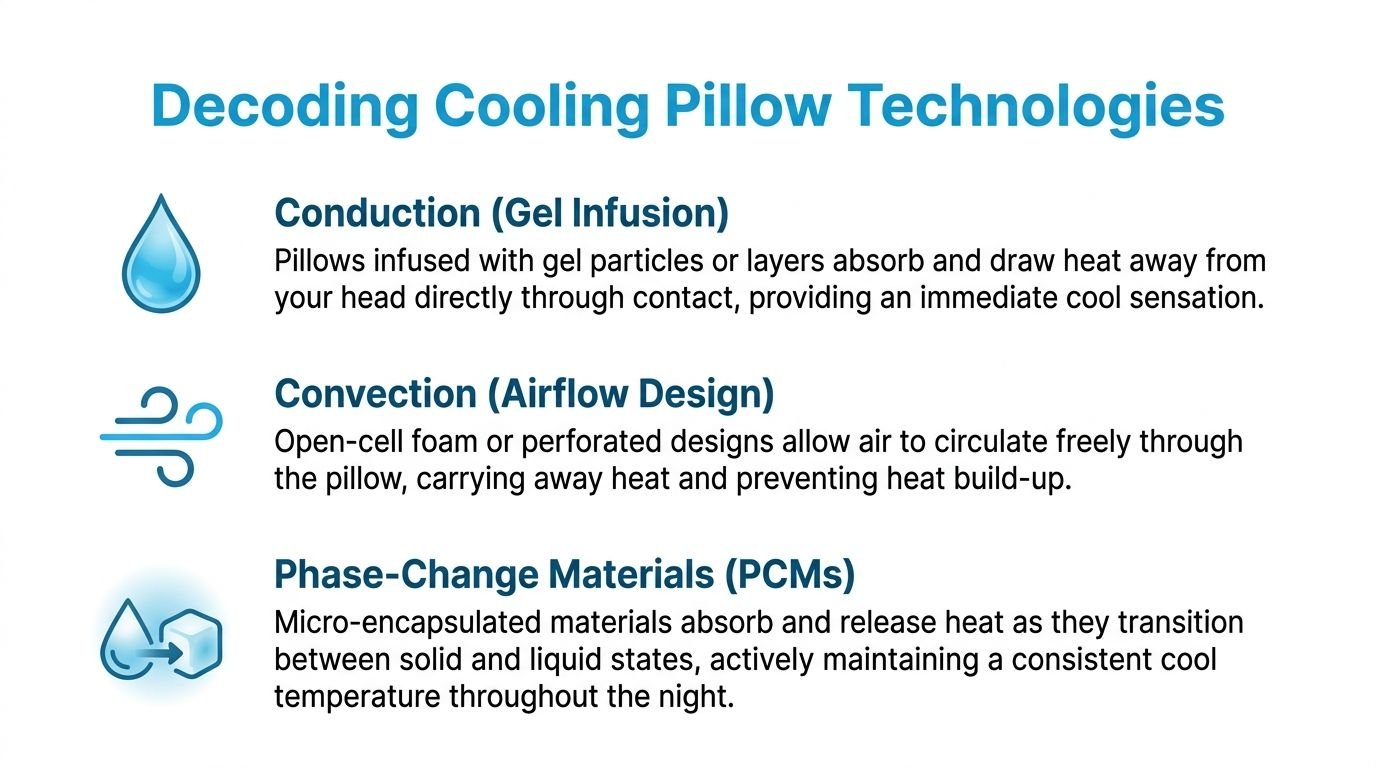
Conduction pulls heat through direct contact
This is the easiest cooling effect to understand. Your skin touches a cooler material, and the material draws heat away.
One reference on sleep temperature notes that optimal sleep occurs at 16 to 18°C, or about 61 to 64°F, and explains that cooling pillows work through conduction, transferring heat away from the head and neck. It also cites a study where water pillows maintained at 16°C helped users fall asleep faster and maintain deeper sleep cycles (cooling pillows and optimal sleep temperature).
That’s why water-based and conductive cooling designs can feel so effective right away. They create a stronger temperature contrast between your skin and the pillow surface.
The downside is simple. If the pillow can’t dump that absorbed heat into the surrounding air, the cool sensation fades. Fast.
Convection depends on airflow
Convection is what happens when the pillow lets air move through and around the fill. Think open-cell foam, perforations, shredded fill, gusseted construction, and covers that don’t suffocate the core.
This matters more than people think. A pillow doesn’t need to feel icy if it keeps heat from building up in the first place. In humid weather, this is often the difference between “slightly warm but dry” and “clammy and gross.”
Phase-change materials regulate swings
Phase-change materials, often shortened to PCM, are the more advanced option. Instead of only feeling cold at first touch, they absorb and release heat as temperature changes.
That’s useful for hot sleepers whose body temperature rises and falls through the night. A good PCM setup doesn’t just give you a cold flash. It tries to keep the pillow from spiking hot.
Cooling that only works in the first half hour is comfort theater. Good cooling keeps your sleep from being interrupted later.
Why hybrid designs tend to work best
The strongest designs usually combine these systems. A conductive cover can pull off the first wave of heat. A breathable core can stop heat buildup. A temperature-reactive layer can smooth out the rest.
That combination matters because no single technology fixes every problem. Conduction gives immediate relief. Convection handles airflow. PCM helps with consistency.
Here’s the quick comparison I use when sorting through options:
| Technology | How It Works | Best For | Potential Downside |
|---|---|---|---|
| Conduction | Pulls heat away from the head and neck through direct contact with cooler materials | People who want an immediate cool feel when they lie down | The effect can fade if the pillow holds onto the absorbed heat |
| Convection | Uses airflow-friendly construction so heat can escape instead of building up | Hot sleepers who hate trapped heat and stale pillow surfaces | Some highly breathable pillows don’t feel especially cool at first touch |
| Phase-change materials | Absorb and release heat as temperature changes to keep the surface more stable | People with temperature swings and interrupted sleep from overheating | Performance depends heavily on the quality of the material and overall pillow design |
What I’d avoid first
If you live somewhere humid, I’d be cautious with pillows that rely almost entirely on a gel layer and vague claims. A basic cool-touch panel can feel impressive in a product photo and underperform badly overnight.
For sweaty sleepers, the smarter move is a pillow with a breathable core and a cover that handles moisture well. The initial chill is nice. The overnight dryness is what saves your sleep.
Key Metrics for Real Cooling Performance
If you want to judge a cooling pillow like a tester instead of a marketer’s dream customer, look at performance under pressure, heat, and repeated use. Not just how it feels with your hand in a store.
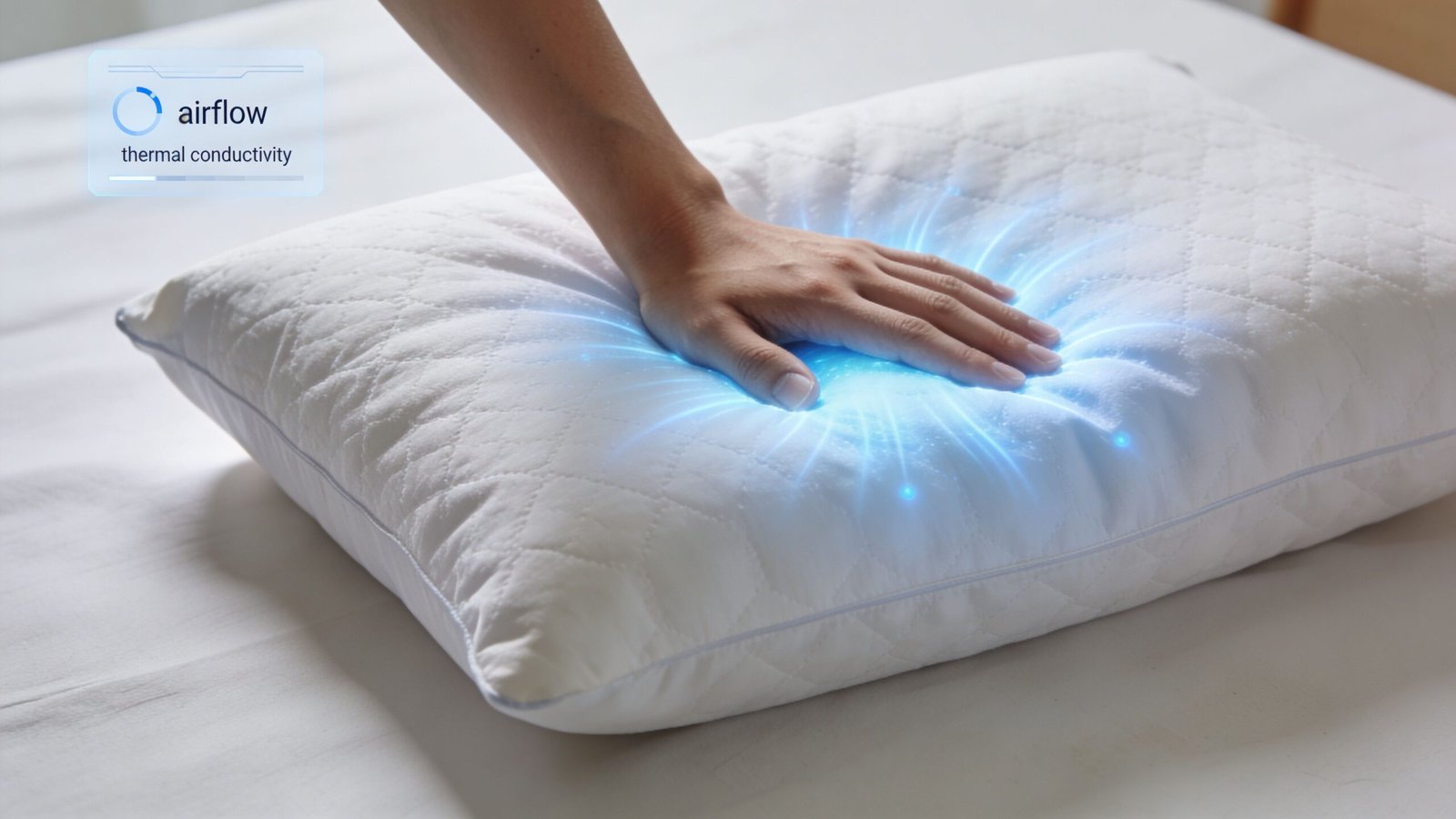
Thermal feel matters, but it’s only the start
Some pillows feel cool the instant you touch them because the surface material transfers heat quickly. That sensation is real. It just isn’t enough on its own.
A pillow can pass the hand test and still fail the overnight test. Once your body has warmed the surface and moisture enters the picture, weak designs start trapping both heat and dampness.
Breathability decides whether heat escapes
Breathability is the metric I care about most for hot sleepers in humid climates. If air can’t move through the pillow, the pillow becomes a storage bin for your body heat.
I’m looking for construction details that support airflow: open-cell foam, shredded fill, perforations, mesh gussets, and covers that don’t feel plasticky. Dense, solid blocks with sealed-up covers tend to sleep warmer, even when the branding says otherwise.
Moisture handling is the humid-climate dealbreaker
A lot of reviews talk about “cooling” but barely discuss what happens when sweat shows up. That’s a miss.
In Florida-style humidity, the pillow needs to avoid that damp, heavy, slightly swampy feel around your face and neck. Good moisture-wicking fabric helps. So does fill that doesn’t collapse into a warm, wet pad after a few hours.
The most honest test for a cooling pillow is simple. Sleep on it after a sticky day, not in an air-conditioned showroom.
Durability tells you whether the cooling is real
Rigorous evaluation reveals weak product performance. Consumer Reports notes that some pillows marketed with “cool” gel layers can trap heat and moisture. Their durability testing simulates long-term use by applying a 225-pound load in a 98.6°F environment for 96 hours, which helps show which materials keep performing and which break down (Consumer Reports pillow durability and cooling testing).
That matters because some cooling features are front-loaded. They work early, then flatten, compress, or lose effectiveness with regular use.
Here’s the filter I’d use before buying:
- Check surface feel: A cool-touch cover is nice, but don’t mistake it for full-night cooling.
- Inspect airflow design: Look for construction that lets air move through the core, not just across the top.
- Prioritize moisture control: In humid climates, this is often more important than the initial chill.
- Think about compression: If the fill mats down quickly, airflow drops and heat gets trapped.
- Read cooling claims skeptically: A gel badge on the label doesn’t prove the pillow stays cool under actual sleep conditions.
What I trust more than buzzwords
I trust pillows that explain how they cool. I trust materials that balance support and ventilation. I trust products that still feel decent after repeated nights, not just after unboxing.
I don’t trust vague “ice” language, overdesigned covers that feel rubbery, or products that act like one gel strip solves overheating by itself. For hot sleepers, especially sweaty ones, sustained airflow plus decent moisture handling beats a gimmicky cold flash every time.
Find Your Perfect Match by Sleeper Type and Climate
Support still matters. A pillow that stays cool but cranks your neck out of alignment isn’t a good pillow. The trick is matching sleep position and climate, not treating them as separate decisions.
Side sleepers need loft plus airflow
Side sleepers usually need enough loft to fill the space between the shoulder and the head. If the pillow is too low, your neck dips. If it’s too dense, heat gets trapped where you press into it the hardest.
In a dry climate, a breathable latex-style feel can work nicely. In a humid climate, I’d lean toward adjustable fills or ventilated foam designs with a cover that handles moisture better. You need support, but you also need a surface that doesn’t turn damp around the cheek and jaw.
A simple rule helps here:
- If you sleep on your side and run hot: prioritize loft, pressure relief, and airflow through the core.
- If you sleep on your side in humid weather: add moisture-wicking cover performance to the top of the list.
- If your shoulder drives you into the pillow: avoid overly dense slabs that seal off ventilation under pressure.
Back sleepers need balance, not bulk
Back sleepers usually do best with medium loft and steady support under the neck. Too much height pushes the head forward. Too little lets the head sink and can leave the upper back feeling unsupported.
This category has a little more flexibility because the face isn’t buried into the pillow as aggressively as it is for side sleepers. Still, if you sweat around the neck and hairline, humidity can make a back-sleeper pillow feel muggy by morning.
If your bed still runs warm, upgrading the layers under and around you matters too. A pillow can only do so much if the rest of the setup is heat-trapping, which is why many hot sleepers also need cooling sheets that actually breathe.
Stomach sleepers need the thinnest option
Stomach sleepers usually need a low-loft, softer pillow. Thick pillows can force the neck into a bad angle and create tension fast.
The challenge here is that softer, flatter pillows can compress into warm, damp pads if the materials aren’t resilient. For humid climates, I’d avoid anything that feels fluffy at first but packs down heavily as soon as body heat and moisture build up.
If you’re a stomach sleeper with night sweats, thinner is usually better, but only if the pillow still releases heat instead of storing it.
Climate changes what “best” actually means
This is the part most guides skip. The best pillow for your sleep position isn’t automatically the best pillow for your room conditions.
A side sleeper in Arizona and a side sleeper in Tampa may need the same loft. They do not need the same moisture behavior. In humid climates, the cover fabric and the way the core handles airflow matter more because the air itself isn’t helping much.
This short video gives a helpful visual on cooling pillow design and sleeper fit:
My blunt recommendations by profile
If you want the fastest way to narrow it down, use this:
- Humid-climate side sleeper: adjustable or ventilated design, medium-to-high loft, strong moisture-wicking cover
- Humid-climate back sleeper: medium loft, stable shape, breathable core that won’t feel swampy at the neck
- Humid-climate stomach sleeper: low loft, softer feel, quick-drying cover, minimal heat-trapping foam
- Dry-climate hot sleeper: you can be more flexible and focus more on feel, since dampness is less likely to ruin the night
The best choice is personal. The wrong choice is almost always a pillow picked for sleep position alone while ignoring humidity.
Examples of Winning Cooling Pillow Designs
A good cooling pillow doesn’t need flashy language. It needs a design that solves a specific problem. Two examples stand out because they use different approaches and both make sense when you look at the engineering.
Sleep Number True Temp shows what smarter regulation looks like
The Sleep Number True Temp Pillow uses 37.5 active particle technology, and in tests it maintained a surface temperature 3 to 5°C lower than standard memory foam (Sleep Number True Temp and Helix GlacioTex performance data).
That matters because traditional memory foam often feels great on pressure relief and lousy on heat retention. A design like this tries to fix that weakness by making the foam more responsive to temperature changes instead of just slapping a cold-feeling cover on top.
What I like about this type of design is the intent. It’s not chasing the cheap thrill of instant cold. It’s trying to regulate the pillow surface so heat buildup doesn’t get out of hand later in the night. For people who like foam support but hate the usual “my head is sinking into a toaster” effect, this is the right direction.
Helix GlacioTex is strong where humid sleepers struggle
The Helix GlacioTex Cooling Memory Foam Pillow uses a proprietary fabric and copper-infused foam. The reported performance includes up to 5°F lower surface temperature and 40% improved breathability, which is exactly the kind of combination that matters in muggy conditions.
The reason this design catches my attention is that it addresses more than one problem at once. Lower surface temperature helps with the first-contact feel. Better breathability helps with the second half of the night, when heat buildup usually ruins the experience.
For humid-climate sleepers, that’s the smart combo. A pillow has to feel cooler and stay less swampy.
Some cooling pillows are built like ads. Better ones are built like systems.
Why these designs are better examples than generic gel pillows
Both of these examples point to the same lesson. Real cooling comes from integrated design. It doesn’t come from a random gel badge or a shiny panel stitched onto a basic foam block.
When I look at a pillow seriously, I want to see:
- a cover that does more than feel slick
- a core that doesn’t choke off airflow
- materials chosen to manage overnight heat, not just first-touch temperature
- support options that fit actual sleeper positions
That’s also why “cooling pillows best” searches can get messy fast. The market mixes legit performance products with copycat gimmicks that all use the same frozen-blue packaging and the same vague promises.
What good design looks like in practice
A winning cooling pillow usually does three things well.
First, it gives you some immediate relief when your head hits the pillow. Second, it avoids trapping heat in the core as the night goes on. Third, it doesn’t become a damp pad once sweat and humidity enter the picture.
A lot of products can do one of those things. Fewer can do two. The best ones do all three without wrecking support.
My recommendation if you’re choosing between styles
If you love the contour and pressure relief of memory foam, look for advanced temperature-regulating technology rather than standard foam with a gel label. That’s where something like the Sleep Number True Temp concept makes sense.
If your biggest issue is humid, sticky discomfort and not just warmth, I’d pay close attention to breathability-focused designs like the Helix GlacioTex approach. Better airflow is often the deciding factor when the room already feels damp.
The product names matter less than the pattern. Look for pillows that solve heat and moisture together, not separately.
Care and Maintenance for Lasting Coolness
A cooling pillow can lose a lot of its edge because of bad maintenance. I’ve seen people buy a breathable pillow, then wrap it in a thick, heat-trapping pillowcase and wonder why it sleeps hot. That’s not the pillow failing. That’s the setup choking it.
Your pillowcase can ruin the whole system
This is the mistake I see most often. People spend extra for cooling features, then cover them with a dense case that blocks airflow and hangs onto moisture.
Use a breathable pillowcase that feels light and dry, not heavy and slick. If your current pillowcase makes the pillow feel muggy, start there before blaming the pillow itself.
A cooling pillow works best when the layers above it don’t smother it. If your room runs hot, your whole bedtime setup matters, including habits and bedding choices that help you stay cool at night without overcomplicating things.
Clean gently and follow the material
Not every cooling pillow should be washed the same way. Solid foam cores usually need spot cleaning and plenty of drying time. Adjustable or shredded-fill models may have removable outer covers that are easier to wash.
My rule is simple. Wash what’s designed to be washed, and don’t soak foam unless the manufacturer clearly says it’s safe. Water trapped inside foam is bad news for odor, feel, and performance.
Signs your cooling pillow is losing the fight
You don’t need lab gear to tell when a pillow is done. Your sleep will tell you.
Watch for these signs:
- It feels flatter than it used to: compressed fill means less airflow and worse support.
- The surface stays warm longer: that can signal worn materials or reduced ventilation.
- It dries slowly after sweaty nights: moisture handling may be fading, or your pillowcase may be blocking performance.
- You keep flipping it for relief: occasional flipping is normal, constant flipping usually means the cooling isn’t keeping up.
A cooling pillow should get out of your way. If you’re constantly adjusting it, flipping it, or punching it back into shape, it’s probably not doing its job anymore.
Storage and rotation help more than people think
If you use multiple pillows, rotating them can help maintain shape and freshness. Keep them in a dry space, not shoved into a humid closet where they can absorb stale moisture.
You don’t need a complicated system. Just keep the pillow clean, keep the case breathable, and don’t crush the life out of the fill. Good cooling performance lasts longer when the pillow can breathe.
Answering Your Top Cooling Pillow Questions
Will a cooling pillow feel cold all night?
Probably not cold. That’s the wrong expectation.
The better goal is less heat buildup and less dampness through the night. The best cooling pillows usually feel cooler at first contact, then work by staying more temperature-stable and breathable than regular pillows.
Are gel pillows worth it?
Sometimes, but I wouldn’t buy one just because it says “gel.”
A gel feature can help with initial cooling. It can also be a shallow gimmick if the rest of the pillow traps heat and moisture. I’d only take gel seriously when it’s paired with breathable construction and a cover that doesn’t get clammy.
What’s more important, cooling or support?
Support, if you’re forced to choose. A cool pillow that wrecks your neck is still a bad pillow.
That said, hot sleepers usually don’t need to choose between the two. The better products manage both. You should still match loft and shape to your sleep position first, then filter for strong cooling design.
Can I use a regular pillowcase?
You can. You just might undo the benefit you paid for.
A thick, dense, less breathable pillowcase can cancel out a lot of the pillow’s cooling and moisture-wicking behavior. If your pillow suddenly feels warmer than expected, the case is one of the first things I’d swap.
Are expensive cooling pillows really worth it?
Some are. Some absolutely aren’t.
The expensive ones worth paying for usually have a clear system behind them: better fabric, better airflow, better temperature regulation, better shape retention. The overpriced ones rely on cold-sounding branding and little else.
My advice is simple. Don’t pay more for the word “cooling.” Pay more only when the materials and construction make sense.
What’s the best cooling pillow for night sweats?
The best style is one that handles moisture and airflow, not just temperature. If night sweats are your main issue, I’d skip dense, sealed-off designs and focus on pillows that stay dry-feeling instead of turning soggy.
Humid-climate logic proves useful for all. Night sweats create a mini humidity problem even in a cooler room. A pillow that performs well in muggy conditions usually does better here too.
Is memory foam always too hot?
No, but standard memory foam often runs warm.
If you like foam’s support, look for designs built to offset that weakness with better temperature regulation or improved breathability. The foam itself isn’t automatically the problem. Cheap, dense, poorly ventilated foam usually is.
How do I know a cooling pillow is failing?
You’ll notice the pattern. More flipping. More dampness. More heat trapped under your head. Worse sleep.
If the pillow used to feel dry and stable and now feels flat, warm, or sticky, the materials may be wearing down. Sometimes the fix is as small as replacing the pillowcase. Sometimes the pillow has reached the point where it’s not performing anymore.
What would you buy first if you sleep hot in Florida?
I’d buy for humidity first. That means a breathable core, a cover that handles moisture well, and a shape that fits my sleep position.
I would not buy based on the coldest first touch. In real-world sticky weather, the winner is usually the pillow that still feels decent hours later.
If you’re tired of waking up sweaty and sorting through fake “ice cooling” marketing, CoolRestGuide gives you the no-BS version. It’s built for hot sleepers who need bedding that works in real humid conditions, not just in polished product photos.
