

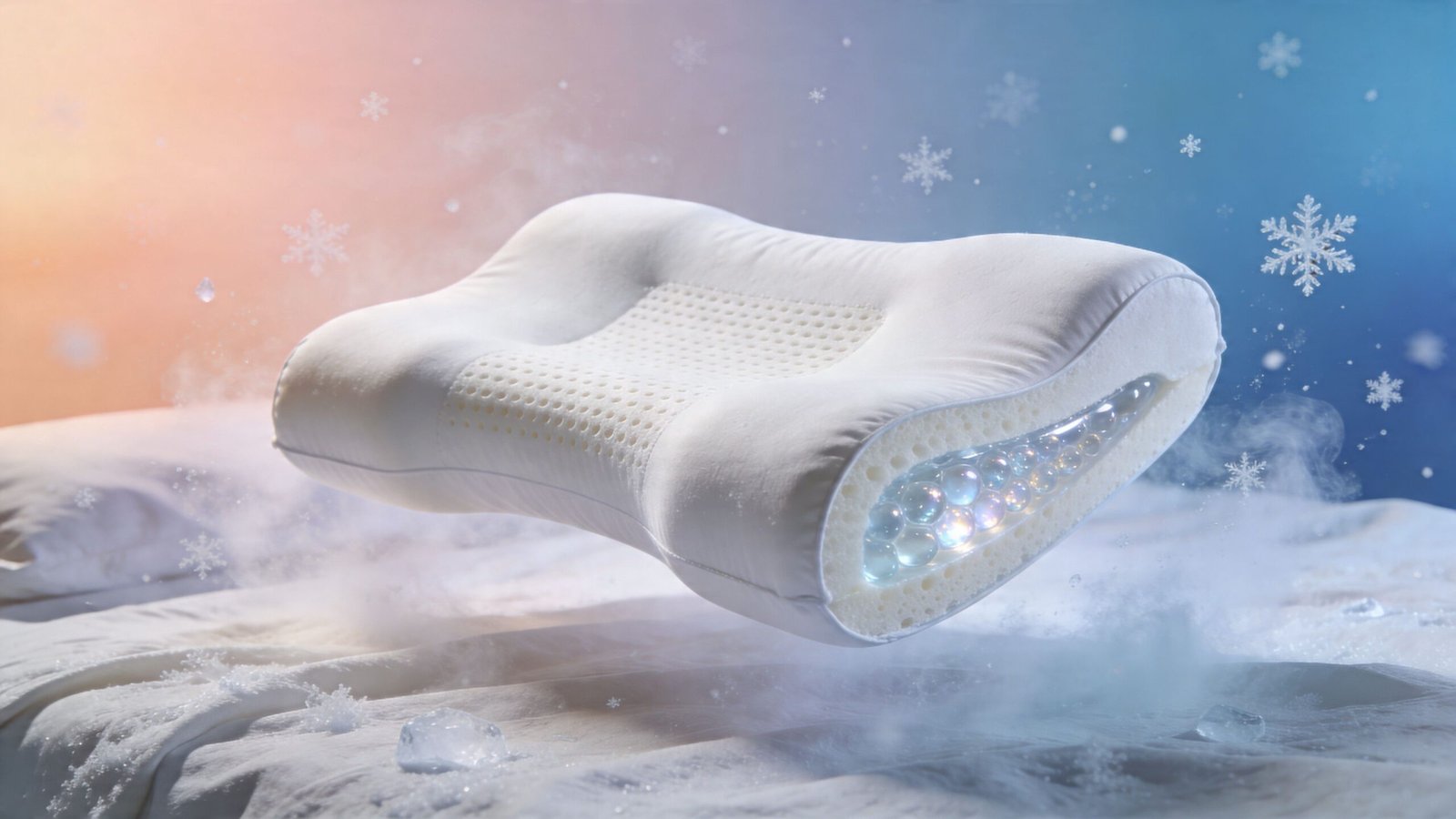
Your pillow feels cool for about five minutes. Then your neck gets damp, the back of your head starts radiating heat, and you do the midnight flip again, hoping the other side buys you another short stretch of sleep.
That routine is even worse in humid climates. In Florida, the problem isn’t just heat. It’s heat that can’t leave your body efficiently because the air already feels loaded. A pillow that seems fine in a dry bedroom can turn swampy fast when moisture hangs in the air and your pillow starts trapping both heat and sweat.
That’s why buying pillows with cooling takes more than tapping “best seller” on a gel foam model with a slick cover photo. Some cooling designs give you a brief cold touch and then quit. Others manage heat over the course of a whole night. And if you deal with menopause night sweats, post-training overheating, or a partner who wants cozy while you want Arctic, the wrong pillow gets annoying fast.
How Cooling Pillows Really Work
You know the classic move. You flip the pillow to the “cool side,” and for a moment it works. That instant relief is real, but it’s not the same thing as lasting temperature control.
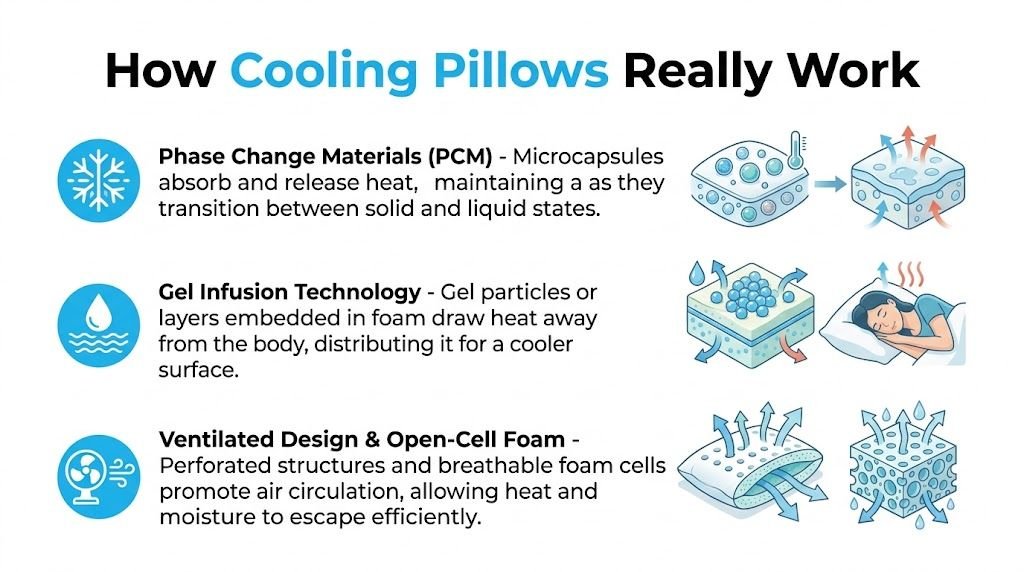
Cooling pillows work through three basic mechanisms: conduction, convection, and phase change. Once you understand those, most pillow marketing gets much easier to decode.
Conduction pulls heat away fast
Conduction is the quick-transfer effect. Think of a cool marble countertop. When you touch it, it feels cold because it draws heat out of your skin quickly. A lot of cooling covers and gel layers are built to create that exact sensation.
Advanced fabrics like GlacioTex use polymer coatings with thermal conductivity in the 0.5-1.0 W/m·K range and are benchmarked to pull heat away from the skin three times faster than cotton, while reducing surface temperature by 3-5°C over 60 minutes, according to Rest’s GlacioTex product technology page. That’s useful, especially for the first part of the night when your pillow usually feels hottest against your face and scalp.
The catch is simple. Conduction helps most at the beginning. Once the surface warms up, it needs another mechanism to keep from becoming just another warm pillow.
Practical rule: If a pillow only advertises “cool-to-the-touch,” assume that describes the first contact, not the whole night.
Convection lets the pillow dump heat and moisture
Convection is airflow. A pillow cools better when air can move through it and around it. That means open-cell foam, perforated foam, shredded fill, mesh side panels, breathable covers, and natural fills that don’t seal off airflow.
This matters even more in humid climates because sweat doesn’t evaporate as easily. A pillow has to do more than feel cool. It has to let heat escape and help moisture move away from your skin. If the core is dense and the cover is tight, the cooling effect usually fades once your body heat saturates the surface.
I’ve seen this constantly with glossy foam pillows that feel impressive for the first few minutes. In a dry showroom, they seem high-tech. In a humid bedroom, they can feel like a wrapped brick.
A useful way to think about it is this: your head is producing heat all night. The pillow needs a path to get that heat out. If you want more context on how your body handles heat overnight, this guide on body temperature when sleeping is worth reading.
Phase change materials absorb heat differently
Phase Change Materials, usually shortened to PCM, handle heat in a more active way. Instead of only pulling heat across the surface, they absorb it during a material shift. According to GhostBed’s explanation of cooling pillow technology, PCM was originally developed by NASA and uses compounds that shift between solid and liquid to absorb excess body heat. That same page states PCM layers can wick away 20-30% more heat than standard gel foams, with the potential for sustained cooling over 8-12 hours.
That’s why PCM can outperform plain gel in real use. Gel often gives a nice first impression. PCM is better suited to stabilizing the temperature around your head and neck instead of providing an initial cold feeling.
The materials matter, but the build matters more
A pillow can use good ingredients and still fail if the design is bad. Poor design frequently disappoints buyers. A dense foam core with a token “cooling” panel on one side often can’t keep up. On the other hand, a ventilated core paired with a breathable cover and a genuine thermal-regulating layer usually performs much better.
Here’s the quick comparison I use.
| Technology Type | How It Works | Pros | Cons |
|---|---|---|---|
| Gel infusion | Pulls heat from the skin through fast surface transfer | Pleasant cool-touch feel, common, easy to find | Often fades once the surface warms |
| PCM | Absorbs excess heat during a phase shift | Better temperature stability, more all-night potential | Usually costs more, quality varies a lot |
| Ventilated open-cell foam | Increases internal airflow so heat can escape | Better breathability, less heat buildup | Still can run warm if the cover is restrictive |
| Cooling fabric covers | Moves heat and moisture away from the skin | Immediate comfort boost, helps in humid rooms | Won’t fix a heat-trapping core |
| Natural breathable fills like buckwheat | Uses open structure for strong airflow | Excellent breath release, doesn’t rely on gimmicks | Heavier feel, noisier, not for everyone |
The best pillows with cooling usually combine more than one mechanism. Surface cooling alone is rarely enough for a hot, humid bedroom.
How to Choose the Right Cooling Pillow for You
The right pillow isn’t “the coldest one.” It’s the one that keeps your head and neck supported without turning into a heat trap by 2 a.m.
Start with fit. Then look at cooling tech. This order is often reversed, leading to a pricey pillow that's unbearable to sleep on.
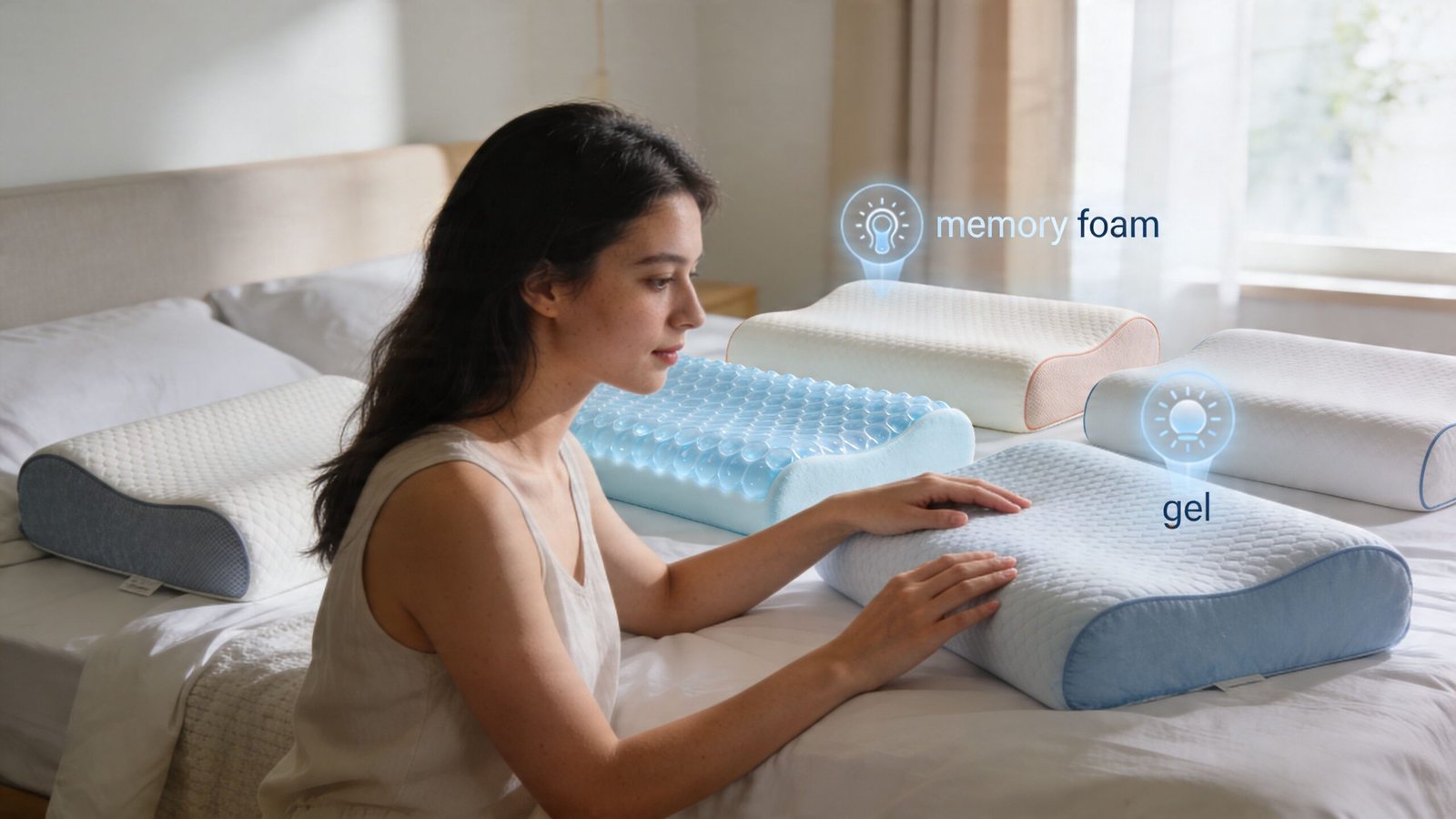
Match the loft to how you sleep
A cooling pillow that throws your neck out of alignment is still a bad pillow.
- Side sleepers usually do better with a higher, more supportive loft because the pillow has to fill the space between the shoulder and head. For hot side sleepers, adjustable fill or responsive ventilated foam tends to work better than a slab of dense memory foam.
- Back sleepers often need a medium loft that supports the neck without pushing the head too far forward. For these sleepers, PCM covers and ventilated cores can be a strong combo.
- Stomach sleepers need the least loft. If that’s you, avoid bulky cooling pillows that force the neck upward. Breathable, lower-profile options are safer.
- Combination sleepers usually benefit from adjustable pillows. If you move a lot, a pillow that reshapes easily matters as much as the cooling layer.
Humidity changes what “cooling” should mean
In a dry climate, a cool-touch cover can go a long way. In a humid climate, that’s not enough. Moisture sticks around. Your skin feels clammy faster. A pillow has to help with airflow and moisture management, not just initial chill.
That’s why I’m harder on gel-heavy pillows than many general review sites are. Some gel models feel great at first contact, then hold onto warmth once the room, your head, and the pillow all settle into the same muggy zone. Breathable covers, open internal structure, and less heat-retentive fill become much more important in Florida-like conditions.
If your whole sleep setup runs hot, your pillow won’t fix everything on its own. Your sheets matter too, especially in sticky weather. A set of best sheets for hot sleepers can make a bigger difference than people expect.
Menopause night sweats need a different filter
If night sweats are part of the problem, don’t shop like a generic “hot sleeper.” Shop like someone who needs a pillow that can deal with repeated moisture and fast heat spikes.
Women’s Health’s cooling pillow roundup notes that 60-80% of women are affected by menopause-induced night sweats, and that in high-humidity areas sweat evaporation is impaired by 40%. That same source points out that standard gel pillows can underperform, making moisture-wicking fabrics and breathable cores essential.
That lines up with what works in a humid room. If your pillow surface feels slick but the core stays stuffy, you wake up damp anyway. Better choices usually include:
- Moisture-wicking covers that don’t stay wet against the skin
- Ventilated or breathable cores that release trapped warmth
- Adjustable loft so you can avoid burying your face in the pillow when you’re already overheating
If you wake up sweaty, don’t chase “icy.” Chase dry, breathable, and stable.
A quick visual breakdown can help if you’re comparing common pillow builds and sleep positions.
Couples with opposite temperature preferences
This group gets ignored all the time. One partner sleeps hot. The other wants warmth. Then the thermostat battle starts.
For couples, pillows with cooling can be a smarter solution than overcorrecting the whole bedroom temperature. A single hot sleeper can get relief at the head and neck without turning the room into a meat locker for the other person. The practical move is to look for pillows that cool without forcing the entire bed to feel cold.
What usually works best:
- Targeted cooling at the cover and upper fill instead of an aggressively cold, rigid build
- Adjustable loft so each partner can tune support separately
- A neutral feel rather than a slippery, ultra-chilled surface that one partner may hate
There’s still a trade-off. If one person’s pillow is much taller, firmer, or more temperature-reactive than the other, bed feel can become uneven. That doesn’t ruin sleep, but it’s worth knowing before you buy two wildly different models.
Athletes and heavy sweaters
Post-workout overheating changes pillow needs too. After hard training, the issue often isn’t just comfort. It’s getting your body to settle down instead of staying flushed and restless.
For athletes, I’d lean toward pillows that prioritize airflow and moisture handling over plush sink-in feel. Dense contour foam can feel supportive, but if it hugs your head and holds heat, recovery sleep suffers. Breathable fill, ventilated foam, or PCM paired with a cooling fabric usually makes more sense than a heavy traditional memory foam block.
Judging Performance Beyond the Marketing Hype
A pillow can feel cold in the first minute and still be lousy by the middle of the night. That’s the biggest trick in this category.
Brands know buyers respond to the phrase cool-to-the-touch. And yes, that feature has value. But it’s often used as a substitute for talking about what happens after your head has been on the pillow for an hour.
The first five minutes are not the whole night
Initial coolness is mostly a surface event. Real performance is about whether the pillow keeps heat from accumulating. That depends on the core, the airflow, and whether the cover can move moisture instead of sealing it in.
A lot of weak pillows with cooling do one thing well. They give that “ahhh” moment when your cheek hits the cover. Then they slowly warm up and never recover while you’re still lying there. That’s not temperature regulation. That’s a brief head start.
What actually deserves your attention
When I’m assessing a cooling pillow, I care about three questions more than anything else:
Does it release heat, not just absorb it at first?
If the design is dense and closed off, the pillow often turns warm and stays warm.Can it deal with humidity and sweat?
In muggy climates, trapped moisture makes a pillow feel hotter than the room temperature alone would suggest.Does the cooling survive normal use?
Some covers feel slick and chilled in the packaging, then become ordinary once they’re under a pillowcase and used night after night.
You don’t need a lab to judge a lot of this. Product pages that obsess over “icy feel” but barely mention airflow are a warning sign. Reviews that say “felt cool at first” but also mention flipping, sweating, or flattening are another.
Don’t confuse a cold surface with a cool sleep system. One is a sensation. The other is performance.
Look for evidence of real sleep improvement
Most pillow claims are soft. “Refreshing.” “Advanced.” “Engineered.” Fine. That language tells you almost nothing.
The strongest evidence in this space comes from actual sleep outcomes. A clinical study published in Sleep found that effective cooling pillows increased REM sleep by 9% and improved overall SleepScore by 3%, with participants also reporting that they felt more rested and more satisfied with their sleep, according to the Sleep journal field study abstract.
That matters because it shifts the conversation away from gimmicks. The point of a cooling pillow isn’t to impress your hand in a showroom. The point is to help you sleep better.
How to read reviews without getting fooled
User reviews are messy, but they still help if you read them the right way.
- Pay attention to room conditions. Reviews from hot, humid areas are more useful for Florida sleepers than comments from cool, dry climates.
- Watch for timing language. “Cool at first” means something different from “stayed comfortable all night.”
- Notice repeat complaints. If many buyers mention trapped heat, a sweaty neck, or a damp pillowcase, that pattern matters.
- Separate support from cooling. Some people love a pillow because it fixes neck pain, even if it sleeps warm. Others love the chill but hate the loft.
The best buyer is a skeptical one. If a pillow sounds miraculous and nobody explains how the heat leaves the pillow, keep scrolling.
Smart Buys Top Pillows with Cooling by Need and Budget
At 2 a.m. in a Florida summer, the difference between a decent cooling pillow and a bad one gets obvious fast. The bad one feels cool for ten minutes, then turns damp, warm, and sticky under your cheek. The good one keeps enough airflow and moisture control that you are not flipping it over all night.
Price matters less than fit. Buy for the heat problem you have, your sleep position, and how much humidity you deal with in the room.
Budget-friendly picks that get the basics right
In the budget tier, simple usually wins. I trust breathable fill, a lighter cover, and the right loft more than any “ice” label printed on the packaging.
A good lower-cost pick should have:
- A breathable cover
- A core that is not overly dense
- Loft that matches your sleep position
- A feel you can tolerate for the whole night
For hot sleepers in humid climates, dense memory foam is often the first thing I skip at this price. It can hold support well, but cheap dense foam also tends to hold heat and stay clammy once sweat enters the picture. Back and stomach sleepers often do better with a lower-profile pillow that lets heat escape more easily.
If your bedroom still runs warm, fix the whole setup, not just the pillow. These ways to stay cool at night help more than shoppers expect.
Mid-range options for most hot sleepers
Mid-range is where cooling pillows usually start making practical sense. You get better covers, better airflow, and more adjustability without paying luxury pricing for branding and packaging.
This is also the range I recommend most for couples with different temperature needs. One partner may want a cooler, slicker surface feel. The other may care more about neck support and only need moderate heat relief. Separate pillows solve that better than trying to force one “best” model on both people.
| Best For | What to Prioritize | Why It Usually Works |
|---|---|---|
| Side sleepers | Adjustable fill plus breathable cover | Better alignment without pressing your face into a dense heat-trapping block |
| Back sleepers | Medium loft with a cooler-touch cover | Keeps the neck supported without building as much heat under the head |
| Combination sleepers | Responsive fill that reshapes easily | Reduces hot spots from staying compressed in one position |
| Humid climates | Moisture-wicking fabric and open structure | Handles sweat better and dries out faster between position changes |
| Couples | Different pillow builds for each partner | Lets each sleeper match temperature and support needs separately |
A strong mid-range pillow usually combines surface cooling with a core that can breathe. If only the cover feels cool and the inside traps heat, performance falls off once the pillow reaches body temperature. In Florida-style humidity, that drop-off shows up quickly.
Premium buys for the toughest cases
Premium pricing makes sense for harder cases. Heavy night sweats, heat retention after late training, menopause-related flushing, and repeated failure with standard foam pillows all fit that category.
I look for four things here:
- PCM-based builds
- High-performance cooling fabrics
- Ventilated cores with real airflow
- Adjustable designs for mixed sleep positions
Side sleepers often get the most value from premium models because they need more height and support. That extra material can trap more heat. Better materials and better venting help reduce that trade-off, though they do not erase it completely.
Pay more when the pillow solves a stubborn problem. Skip premium pricing if it is just another thick foam pillow with fancy language on the box.
My practical matches by sleeper type
I shop by failure point.
For Florida-level humidity
Pick an open, breathable build first. Then add a cooler-touch cover or PCM layer. In humid air, moisture management matters almost as much as temperature.
For menopause night sweats
Choose a pillow that dries out fast and does not stay stuffy after a sweat episode. Breathable fill and washable covers matter more here than a brief cold feel at bedtime.
For athletes
Post-workout overheating usually punishes dense foam. A more breathable, faster-rebound pillow tends to recover better through the night and feels less swampy by morning.
For couples
Use two different pillows if needed. One sleeper can use a cooler, lower-loft option while the other keeps a more supportive model. Matching sets are overrated if one person sleeps hot and the other does not.
For budget shoppers
Buy the least heat-trapping pillow that still supports your neck well. Marketing names do not cool anything. Materials and structure do.
Keeping Your Cool Maintenance and Troubleshooting
A lot of people think their cooling pillow “stopped working” when what happened is simpler. The pillow got dirty, the cover got clogged with oils and sweat, the pillowcase blocked airflow, or the material reached the same temperature as the sleeper and room.
That doesn’t mean the pillow is useless. It means it needs the right setup and maintenance.
Why a cooling pillow can stop feeling cool
Cooling materials aren’t magic. They work by moving heat, absorbing heat, or releasing heat. If you wrap that pillow in a thick, non-breathable case, pack it against a mattress topper that also runs hot, and never wash the cover, performance drops.
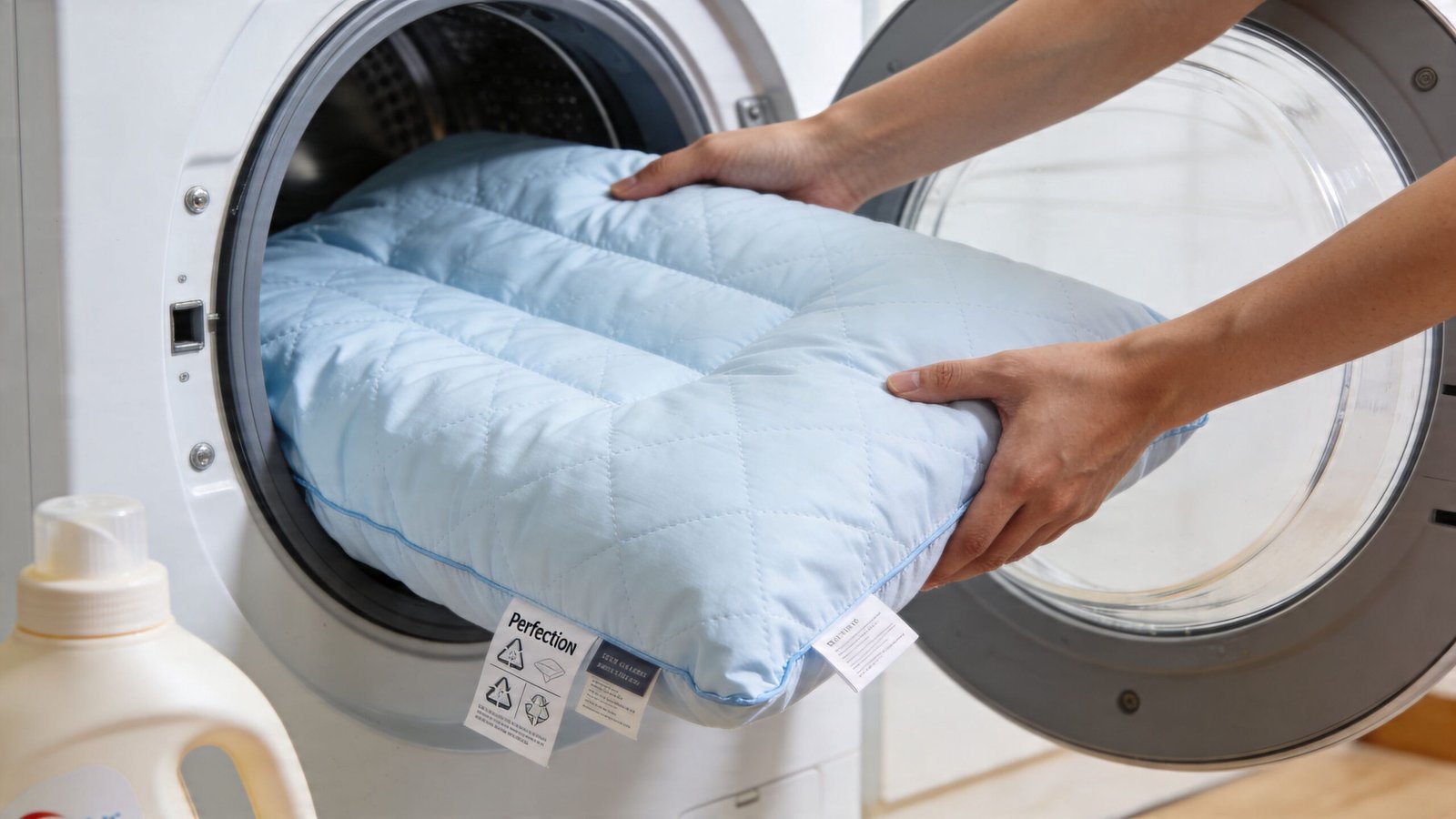
A few fixes help immediately:
- Wash the removable cover regularly so sweat, oil, and residue don’t interfere with moisture transfer.
- Use a breathable pillowcase instead of a heavy, heat-trapping one.
- Air the pillow out when possible, especially in a conditioned room with decent airflow.
- Check the fill distribution on adjustable or shredded-fill models since compacted fill reduces airflow.
If you’re trying to cool down your whole setup, not just the pillow, these broader ways to stay cool at night can help.
Material-specific care
Different pillow types need different handling.
Foam pillows usually shouldn’t be machine washed unless the manufacturer explicitly allows it. The removable cover often can be washed, but the core usually needs spot cleaning and full drying.
Latex pillows are resilient, but they still need airflow and gentle cleaning. Keep them out of direct harsh heat.
Buckwheat pillows are different from both. They don’t rely on a chemical cooling treatment, so their performance is less about “wearing off” and more about keeping the pillow dry and clean. According to Hullopillow’s temperature comparison, buckwheat pillows returned to room temperature in under 2 minutes, which was 3.5 times faster than PCM memory foam and 5 times faster than gel pillows due to convective airflow. That airflow advantage is one reason they can keep performing well over time.
Troubleshooting the common complaints
“If your cooling pillow only works uncovered, the pillowcase is part of the problem.”
Too warm after an hour
The core may be too dense, or your pillowcase may be blocking the cooling surface.Feels damp by morning
You likely need better moisture-wicking fabric and more breathable fill, not a colder gel panel.Lost shape and sleeps hotter now
Compressed fill restricts air movement. Fluff, redistribute, or replace fill if the design allows it.Still overheating despite a cooling pillow
The pillow may be fine, but the mattress protector, sheets, or bedroom humidity may be overpowering it.
Your Final Checklist for a Cooler Night's Sleep
The best pillows with cooling don’t all feel the same, and they shouldn’t. The right choice depends on what’s making you hot in the first place.
Use this checklist before you buy:
Start with the real problem
If you deal with night sweats, prioritize moisture-wicking fabric and airflow. If you just run warm, a breathable pillow with a solid cooling cover may be enough. If you overheat after workouts, focus on fast heat release instead of deep sink-in foam.
Make support non-negotiable
Your sleep position decides the loft and shape you need. Side sleepers usually need more height. Back sleepers need balanced neck support. Stomach sleepers should stay lower and flatter. A pillow that cools well but wrecks alignment won’t feel like a win for long.
Value all-night performance over showroom chill
Initial cool-touch feel is nice. It’s not the main event. In humid climates, breathability and moisture handling usually matter more than a dramatic first impression.
Spend where it solves a real issue
If basic overheating is your problem, you may not need premium tech. If you’re dealing with menopause sweats, athlete-level heat retention, or repeated failures with standard foam, better materials can be worth it.
A good pillow should make you forget about your pillow. No flipping. No damp cheek. No waking up angry at 3 a.m. because your head feels like it’s parked on a space heater.
If you want honest help sorting through pillows, sheets, toppers, and other cooling sleep gear that holds up in hot, humid bedrooms, visit CoolRestGuide. It’s built for hot sleepers who are tired of gimmicks and want practical, no-BS recommendations.
